
TL;DR
- The core decision: whether to fix recurring payroll errors at the point of calculation, which is the only place payroll fully controls, or at the point of entry, which is where they actually originate.
- When doing nothing is right: when your last two error cycles were clean, when variance reports run to zero, and when upstream owners confirm data within twenty-four hours of cut-off.
- What has to be true: someone outside payroll must own data entry as a deliverable, not as a favour.
- How the options split: process redesign, ownership transfer, or systemic change in HRIS controls, and the right one depends on where the error genuinely enters.
- Decision rule: if the same error class appeared more than once in the last four cycles, the fix belongs upstream of payroll.
- Outcome to expect: fewer corrections on payday, faster cycle close, and the same conversation stopping.
The Payroll Manager Who Already Knows
A payroll manager opens the variance report on Tuesday morning. The first run of the new cycle paid cleanly. The second run has three underpayments in the same cost centre: a starter whose record was created late, a leaver whose final pay missed a shift, and a promotion whose effective date was typed into the wrong field by the line manager. The manager phones the HR business partner. The HR business partner says the line manager is sorry. The line manager says she filled in the form on time. The system says otherwise. By Thursday the underpayments are corrected, and the conversation moves on. By next cycle, two of the three will be back.
But the real issue isn't the calculation. The calculation engine did exactly what it was told. The real issue is that the line manager, the HR business partner and the payroll manager all believe they did their job, and the payslip says somebody didn't.
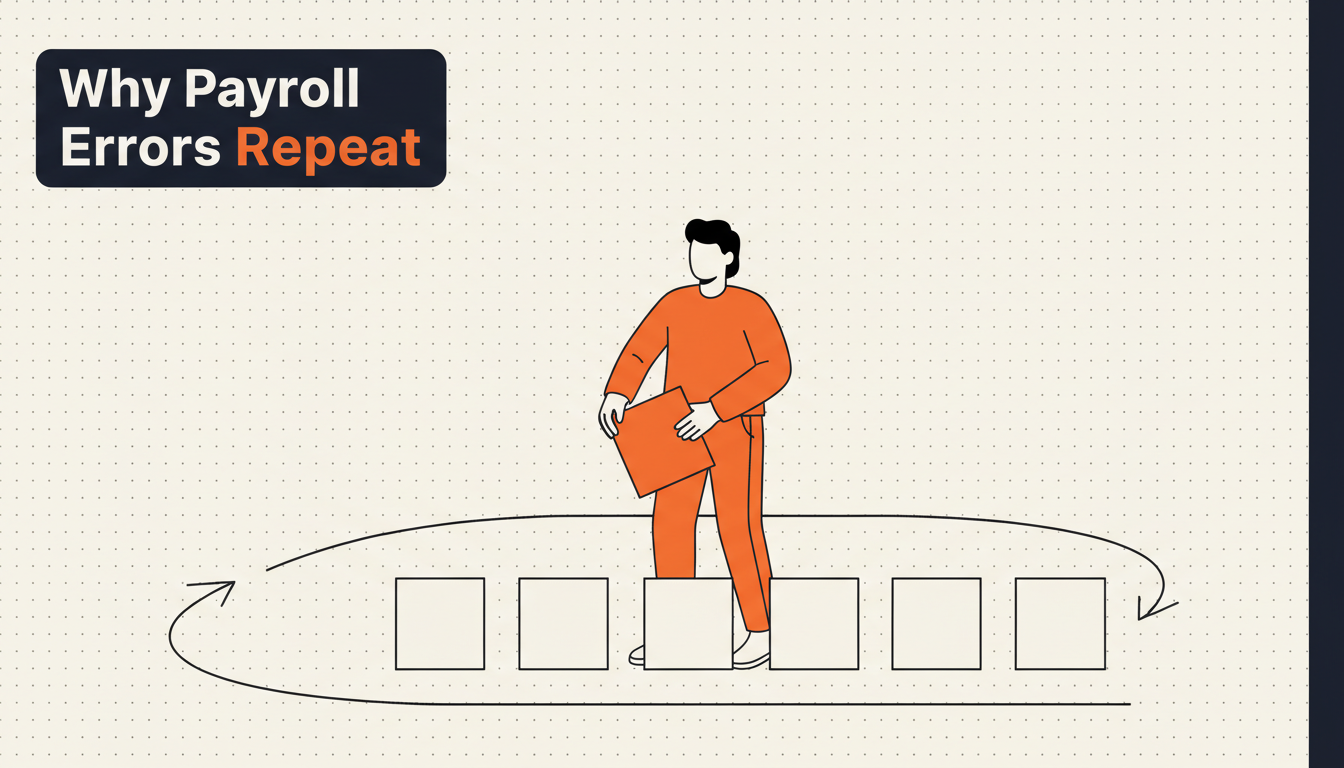
This piece is about that gap. The arithmetic on a payslip is almost never where the error lives. The error lives upstream, in a starter form filed late, a leave day never recorded, a timesheet approved by someone who didn't read it. By the time the wrong figure lands on a payslip, it has already passed through three or four hands, each of which checked their own step and none of which checked the chain. Fixing it at the payroll desk restores the number. It doesn't restore the chain. That's why the same class of error comes back, and that's why the fix that finally holds is rarely a payroll fix at all.
Best tools for Payroll & Compensation
When You Genuinely Do Not Need to Act Yet
Most payroll teams reading this aren't in crisis. They're in friction, and the difference matters, because the response to friction is different from the response to risk, and pretending otherwise burns trust and budget in equal measure.
Stage one, your setup is genuinely fine. Picture a payroll team of three running monthly payroll for a professional services firm of around four hundred headcount, with two HR business partners and a small finance team. The last four cycles closed without a single employee-visible correction. Variance reports run to zero or to immaterial rounding that nobody queries. Joiners and leavers land in HRIS within hours of their start or exit date, because the HRBPs have a morning ritual of updating records before opening their inboxes. Payroll confirms cut-off the morning after, signs off the variance report, and moves to the next task. If that's your picture, the right response isn't to redesign anything. The right response is to keep doing it, write down what is working, and protect it from the next reorganisation. The risk at this stage is disruption, not failure: a new HRBP who doesn't inherit the morning ritual, a system migration that breaks a quiet workflow, a reorganisation that splits a working team. Your job is to make the working pattern visible so it survives the people who built it.
Stage two, friction that's mostly noise. Picture the same team, eighteen months later, with headcount now closer to six hundred and the HRBPs each covering more business units. You see one or two corrections a cycle, almost always small, almost always caught in pre-run validation before the run executes. You have a working relationship with the HRBPs. They fix things when you ask, sometimes by close of business, sometimes the next morning. The cost is the time you spend chasing, the small dent in confidence when a payslip needs a second touch, and the slow accumulation of background effort that nobody sees. This is the stage most payroll teams live in for years, and most of them are right to tolerate it. The trap is to call it fine when it's friction, because friction left alone eventually becomes risk. The other trap is to over-engineer at this stage, introducing checks and approvals for problems that a five-minute phone call already solves.
Stage three, real risk that has started to surface. Picture a payroll team where the same error class has appeared in three of the last four cycles. An employee has asked a question you could not answer with confidence and you had to come back the next day. A finance colleague has asked why a particular cost centre keeps missing forecast by a small but consistent amount, and you don't have a clean answer. None of this is a regulatory problem yet. None of it has reached a director. It's a signal that the upstream chain is no longer holding under its current load, and the next thing that breaks won't be a rounding error. The response at this stage isn't a process redesign yet. It's a deliberate mapping of the chain, a written statement of who owns which step, and a conversation with the people who own those steps about whether they have the capacity and the motivation to hold them. If that conversation lands, stage three resolves. If it doesn't, you're one cycle away from stage four.
Stage four, the edge case. An underpayment has gone out to more than one employee in the same cycle. A leaver has been overpaid and the recovery is contested, with the employee disputing the figure or the right to recover at all. A manager has told staff not to query their payslips because "payroll sorts it out", which means the payslip has stopped being a source of truth in that team. At this stage you're not deciding whether to act. You're deciding how fast. The right moves are a written acknowledgement of the failure to the affected employees, a reconstruction of the chain that produced it, a named owner for the fix, and a date by which the fix will be evidenced. This is also the stage at which you take local advice on the exposure shape, because what looks like an internal recovery question can carry obligations you don't want to discover after the communication has gone out.
Five Questions This Reader Asks at 11pm
Why does this keep happening when nobody seems to be careless? Because carelessness isn't the cause. The cause is that the step where the error enters belongs to someone whose performance isn't measured on it. The line manager is measured on output, schedule and cost. Getting a starter form in by Wednesday isn't on her scorecard, so when Wednesday is busy, the form slides to Thursday, and by Thursday the HRBP has moved on, and payroll discovers the gap on Monday. Nobody was lazy. Nobody was careless. The system simply didn't require the step to happen on time, and everyone involved made a rational choice about what to deprioritise. The reasoning behind the answer is that errors cluster where accountability is thinnest, and accountability is thinnest where the role has no metric for the work. If you get this framing wrong and assume carelessness, you'll send a polite reminder, the reminder will change nothing, and you'll be asking the same question next 11pm.
Am I the right person to fix this, or am I the wrong person with the loudest voice? Probably the second. If you're payroll, you can see the failure clearly because the failure lands on your desk. You can't own the input, because you don't have the relationship with the employee, you don't sit in the line management chain, and you can't change what the HRBP measures her team on. The fix has to land in someone else's accountability, and your job is to make the case clearly enough, and with enough specificity, that they accept it without feeling accused. The reasoning behind this is structural: the person closest to the failure is rarely the person closest to the lever that prevents it. If you answer this wrong and try to fix it yourself, you'll build a workaround in payroll that catches the symptom, and the workaround will absorb time you don't have until something else breaks.
What will the conversation with HR actually cost me politically? Some. You're going to say, in writing, that an error class repeats because the upstream owner doesn't have it as a deliverable, that the role is measured on other things, and that the pattern will continue until the deliverable changes. That's a true statement and an awkward one, because the person reading it is being told, gently, that their team's work has a gap. The reasoning is that the cost of the conversation is real but bounded: an uncomfortable meeting, a few weeks of careful wording, a written note that lives in a shared folder. The alternative is to keep absorbing it, which costs more in corrections and credibility than the conversation ever will, and which teaches the rest of the organisation that payroll will carry whatever falls into its lap. If you get the framing wrong and make the conversation personal rather than structural, you spend the political capital without changing the input.
What happens if I get this wrong? You redesign a process that didn't need redesign, and you spend six months chasing a metric that didn't matter while the real upstream issue stays untouched. That's annoying and a waste of effort, but it isn't catastrophic. What is catastrophic is staying with the same error class into a third cycle and treating it as normal, because by then the pattern has been internalised as "how things are", and the conversation about changing it gets harder every cycle it isn't had. The reasoning here is asymmetric: the downside of acting when you shouldn't is mostly wasted time, and the downside of not acting when you should is a slow erosion of the function's credibility that is much harder to reverse.
Is this a payroll problem or an HR problem? It's an HR problem with payroll consequences. The calculation is correct. The input is wrong. The input lives in an HR-owned system, updated by HR-adjacent roles, and the work to fix it has to be done by people whose chain of command runs through HR, not payroll. The reasoning is that the sooner that distinction is in writing, the sooner the ownership question stops being personal and starts being organisational. If you answer it wrong and treat it as a payroll problem, you accept the work, you under-resource it, and the error class continues under a different label.
The Three Honest Categories the Approaches Split Into
Process redesign inside payroll. This is the category most teams reach for first, because it's the one payroll controls. It looks like tighter validation, pre-run checklists, second-person sign-off on every variance, mandatory fields in payroll's own templates, daily cut-off reminders sent from the payroll inbox, and a written checklist for every cycle. It is the right answer when the error genuinely originates inside the payroll function: a keying error where the wrong amount was typed into the system, a missed tax code because the new starter's P45 wasn't applied, an incorrect manual calculation for a one-off payment, a backdated adjustment applied to the wrong cycle. In those cases the fix belongs in payroll, and a redesigned process will hold. It fails when the error enters upstream and the new process adds work without changing the input, which is the common case. A concrete example: a team introduces a five-point pre-run check on joiner records, with the payroll officer verifying contract type, start date, salary, tax code and bank details before the run. The check works perfectly on every joiner record that arrives. It does nothing for the joiner whose record was never created in HRIS because the HRBP never received the form from the line manager. The new process is real work, the error continues, and the payroll team is now doing more for the same outcome.
Ownership transfer out of payroll. This is the category that requires the conversation nobody wants to have. It looks like moving the input step into the function that already owns the relationship: line managers take responsibility for timesheet accuracy because they own the schedule, HRBPs take responsibility for joiner and leaver data because they own the employee record, finance takes responsibility for cost-centre mapping because they own the budget. It is the right answer when the existing owner has the information but no consequence for getting it wrong, which is the usual state of affairs. The ownership transfer works because it attaches the step to a role that already has a reason to care about the relationship, even if it doesn't yet have a reason to care about the data quality. It fails when the new owner can't actually do the work, which is common when HRBPs cover too many business units to chase every form, when line managers treat the new responsibility as a payroll imposition rather than part of their job, or when the transfer is announced without authority behind it. A concrete example: a payroll team escalates a pattern of late joiner records to the head of HR operations, who agrees that HRBPs will own joiner data accuracy as a deliverable. For two cycles it works. By the third cycle one of the HRBPs has covered a maternity leave and is running three business units at once, and the late joiner records return, because the new owner has been told to care about something she no longer has the capacity to care about. Ownership transfer works only when the new owner has the time and the authority to do the work.
Systemic change in HRIS controls. This is the category that appeals to anyone who has ever wanted the system to enforce what the conversation cannot. It looks like workflow rules that block a record from progressing until every mandatory field is complete, dual approval before a record becomes visible to payroll, automated alerts when a record sits incomplete past a threshold, mandatory attachments for certain change types, and exceptions reports that show every record that bypassed the rule. It is the right answer when the volume of inputs is too high for human follow-up to keep pace, when the same field is missing across many records, or when the chain of ownership is clear but the deadlines are not. It fails when the system rule is written too loosely and the upstream owner routes around it, which is exactly what happens when a mandatory field accepts a default value, when an approval can be marked complete without the underlying record being checked, or when the workflow sends an email to a mailbox nobody reads. A concrete example: a payroll team asks IT to make "start date" a mandatory field on the joiner form. IT does. The form now requires a start date. But the form does not require the contract type, because the contract type field accepts a default of "permanent", and three months later the payroll team discovers that a fixed-term contract has been processed as permanent because the line manager left the default in place. The system rule is real, the bypass is real, and the bypass is invisible until the next correction surfaces it.
Five Diagnostic Questions to Self-Assess Against
Where did the last underpayment actually start, and can you write that down in one sentence? To answer it, open the variance file for the last underpayment, trace the wrong figure back through the calculation, find the input that was wrong, and identify the role that provided that input. If you can write a single sentence that names the role, the input and the cycle date, you've located the real failure point. If you can't, the failure is in handoffs you've not mapped yet, and the conversation about the error will go in circles until the mapping is done. The way to actually answer it is to do the trace once, in writing, before you decide anything about the fix.
Which single role, by name, owns the input step that failed? To answer it, write the role title and the person's name, not "the HR team" or "line management". A role, not a team. A team doesn't own anything, and a department doesn't own anything, and "we all do" means nobody does. If you can't name the role, you've not yet identified the owner, and any conversation about the error will dissipate into a general discussion of process. The way to actually answer it is to find the person who is measured on the input step in their performance review, even if only informally. If no one is measured on it, the role has no real owner yet.
What does that role's performance get measured on, and is data accuracy on the list? To answer it, ask for the role's objectives, the team's scorecard, the manager's quarterly review template. Read them. If data accuracy to payroll isn't there, the role has no reason to change behaviour, and the request to change behaviour will be politely heard and then deprioritised the next time the role is busy. The way to actually answer it is to look at what the role is rewarded for, because what the role is rewarded for is what the role will do.
How long after the error was made was it discovered, and by whom? To answer it, look at the timestamp on the incorrect input and the timestamp on the discovery, and count the gap. If the answer is "on the payslip, by the employee", the chain has no internal check at all, and you've been relying on the employee to catch what the system should have caught. If it's "in pre-run validation, by payroll", you've a chance to push the discovery upstream, because the discovery point tells you where a check could have been. The way to actually answer it is to record the gap on every correction for the next two cycles, then look at the pattern.
What does the same error cost each time it appears, and is that figure visible to the upstream owner? To answer it, add up the payroll time spent on the correction, the manager time spent on the conversation, the employee time spent on the query, and a reasonable estimate of the trust cost. Put the number on a single line. A payroll team that quietly absorbs the cost teaches the rest of the organisation that the cost is invisible, and invisible costs don't drive change. The way to actually answer it is to write the number down, share it in a calm quarterly note, and see whether the conversation changes when the figure is in the room.
Six Error Classes, and Where Each One Really Starts
Late or Missing Joiner and Leaver Data
The new starter's record arrives on Monday for a Tuesday cut-off, or arrives with the wrong contract type, or doesn't arrive at all until payroll phones and asks. The leaver's final pay is calculated against last week's data because this week's exit form has not been processed. Both look like payroll errors on the payslip. Neither originates in payroll. They originate in the HRBP whose day is full of conversations, meetings and escalations, and whose system doesn't punish a form filed two days late. Payroll sees the consequence. HRBP sees the form. Until the form's delivery time is owned by someone with a reason to care about it, the error class will repeat.
Unrecorded Absence and Leave
An employee took a day's annual leave on the day the run executed. The leave was approved verbally by the line manager and never entered the system. Payroll paid full pay, which is wrong in either direction: it either underpaid the rest of the team or created an overpayment of one day's pay that will be clawed back awkwardly later. The error class repeats because absence is the step most often handled in conversation rather than in the system, and conversation doesn't leave a record. The genuine weakness here is that the verbal approval feels efficient at the time and feels like an error only later.
Timesheet Approval That Is a Rubber Stamp
A line manager approves twenty-eight timesheets on Friday afternoon in seven minutes. Three of them contain errors: a missing shift, a wrong project code, a duplicated entry. The approval step was designed to catch these. The step didn't catch them, because the approver treated approval as a click rather than a check. This is the error class most resistant to process redesign, because the redesign is already there. The redesign isn't being used.
Mid-Cycle Pay and Role Changes
A promotion takes effect on the fifteenth of the month. HR records the new salary but forgets to backdate it. A role change moves an employee onto a different pay scale. A cost-centre transfer changes which overhead they fall under. Each is a small administrative step with significant payroll consequence, and each is owned by someone whose week is full of similar small steps. The cost of any one error is small. The frequency is high. The total exposure over a year is meaningful.
Variable Pay Arriving After Cut-Off
Commission, bonus, overtime, shift premium, on-call allowance. Each is calculated by a different team, often on a different cadence, and arrives in HRIS at a time determined by that team's schedule rather than payroll's. When the variable pay lands after cut-off, payroll has a choice: delay the run, pay estimated and true up, or pay without it and correct next cycle. Each choice has a cost, and the cost is paid by the employee whose pay is wrong, not by the team that filed late.
Standing Data That Quietly Went Stale
An employee's bank account changed and the old one was never closed. A tax code is wrong and has been wrong for three cycles. A pension contribution percentage was updated in the letter to the employee but not in HRIS. A court order exists and isn't in the system. These are the errors that look like one-offs and turn out, on inspection, to have been wrong for a long time. They're also the ones most likely to escalate into something the regulator hears about, because standing data errors compound quietly until somebody asks.
The Decision Table
| Situation | Scale | Setup | Primary Pain | Recommended Starting Point |
|---|---|---|---|---|
| Recurring same-class errors, ownership unclear | Mid-size | HRBPs cover several business units | Same correction every cycle | Map the chain, name the role, raise the ownership question in writing |
| Timesheet approvals exist but are not catching errors | Any | Approval step is a click, not a check | Variance reports keep showing the same upstream cause | Move the consequence: pay approvers on accuracy, not volume |
| Variable pay missing cut-off more than once a quarter | Mid to large | Multiple teams, different cadences | Payroll choosing between delayed run and corrections | Negotiate a hard variable-pay deadline with finance, in writing |
| Standing data errors that have been wrong for multiple cycles | Any | No periodic data review | Errors compound, exposure grows | Quarterly data review with named owners, evidenced in HRIS |
| Leaver overpayments that are contested on recovery | Any | No exit-interview data check | Recovery conversations damage trust | Introduce a final-pay checklist owned by line manager, signed at exit |
| Payroll-originated errors (keying, tax code, manual calc) | Any | Internal payroll team | Corrections discovered after run | Tighten pre-run validation, add second-person sign-off, measure by error class |
| Joiner data arrives after cut-off for more than a fifth of new starters | Mid to large | HRBP workload high | Payroll fires every cycle | System rule: HRIS cannot accept incomplete starter records past threshold |
Tracing an Error to Its Real Owner
The fastest way to find the real owner of an error is to walk backwards from the payslip until the chain stops making sense. The payslip is the symptom. The chain that produced it has at least three links: the source record, the change that altered it, and the person who made or didn't make the change. The error lives at the link where the chain breaks.
The table below maps the symptom to the likely origin and to the role that can actually prevent it from recurring. The right column is the one that matters. It's rarely payroll.
| Symptom on Payslip | Likely Origin | Role That Can Actually Prevent It |
|---|---|---|
| New starter underpaid in first cycle | Joiner record created late or with missing data | HRBP, with line manager accountability for the source form |
| Leaver overpaid or underpaid in final cycle | Exit form processed late, shift data missing | Line manager, with HRBP confirming record closure |
| Wrong absence deduction or no deduction | Leave not entered after verbal approval | Line manager, with HRIS workflow enforcing entry |
| Timesheet variance on overtime or shift | Approved timesheet contained wrong data | Timesheet approver, treated as a check rather than a click |
| Wrong mid-cycle pay after promotion or transfer | Role change recorded without effective date or cost centre | HRBP, with finance confirming mapping |
| Variable pay missing or estimated | Variable pay file arrived after cut-off | Bonus or commission team lead, with a hard deadline owned by finance |
| Stale tax code, bank details, pension percentage | Standing data never reviewed | HRBP, with a quarterly data review owned by HR operations |
Once the role is named, the conversation can move from "this is an error" to "this step belongs to you, and here's the evidence". That's a different conversation, and it's the one that changes the chain.
What to Measure, and What Measuring It Changes
Metrics do two things: they make the invisible visible, and they change the behaviour of the people being measured. Pick the wrong metric and you push errors underground. Pick the right one and you create a reason for the upstream owner to act.
The metrics that drive the right behaviour are the ones that put the error in front of the role that owns the input. Days since last correction by error class. Percentage of joiner records complete at cut-off. Percentage of timesheets approved with zero variance. Number of cycles between the same error class. None of these is a payroll metric. All of them are metrics payroll can produce, which is the position to aim for: you don't need to own the fix, you need to own the visibility.
The metrics that push errors underground are the ones that punish the person who reports them. Total error count, with no breakdown by class. Time to correction, measured only on payroll. Number of employee complaints, with no separation between genuine disputes and clarification calls. These metrics, used alone, teach the payroll team to find errors before they become visible and resolve them quietly. That feels like good performance. It's actually a slow erosion of the signal that would have prevented the next error.
| Metric | What It Tells You | What Behaviour It Drives |
|---|---|---|
| Days since last correction by error class | Whether a fix has held | Upstream owner is asked the same question until the answer is good |
| Joiner records complete at cut-off | Whether HRBP has the input under control | HRBP workload becomes visible, capacity conversation happens |
| Timesheets approved with zero variance | Whether approval is a check | Line manager treats approval as a real task |
| Cycles between same error class | Whether the fix held | System owner is asked why the fix did not stick |
| Corrections discovered after run, not in validation | Whether pre-run checks are working | Payroll is rewarded for catching errors early, not silently |
What to Put in Writing
A decision about payroll errors is defensible only if the documents exist. The chain of ownership, the data standards, the deadlines and the consequences all need to live somewhere a future reader can find them. Most teams skip this step and discover the gap during an audit, when reconstruction is expensive and the documents are partial.
The artefacts below are the minimum set. Each one has a single owner, a single point in the cycle when it's written, and a specific failure it prevents.
| Artefact | Who owns it | When it is written | What it prevents |
|---|---|---|---|
| Process map of the payroll cycle with named owners per step | Head of HR operations | Reviewed quarterly, rewritten annually | The "I thought somebody else owned that" defence |
| Data standards for joiner, leaver, change and standing data | HR operations lead | At policy review and on system change | The "the form did not ask for that" conversation |
| Cut-off schedule with named owners for variable pay | Payroll manager, with finance sign-off | Annually, refreshed on team change | The "the file arrived when it arrived" argument |
| Error register, classified by entry point | Payroll manager | Continuously, reviewed monthly | The pattern becoming invisible because nobody wrote it down |
| Ownership letters to HRBPs and line managers | Head of HR operations | Annually, after cycle review | The request for accuracy landing without authority behind it |
| Quarterly data review minutes with named attendees | HR operations lead | Quarterly | The standing data errors that compound for years |
| Recovery protocol for overpayments and underpayments | Payroll manager, with HR and legal sign-off | Annually and on legal change | The contested recovery that damages trust and becomes a dispute |
Questions to Ask Before You Commit
Ownership. Who, by name, owns the input step that failed last cycle? A bad answer is a team name, a department, or "we all do".
Visibility. What metric will we use to know whether the fix has held? A bad answer is "we will see if errors drop" without a definition of which errors, measured how.
Capacity. Does the named owner have the time to do this step reliably, or are we adding to an already-full role? A bad answer is silence on workload or a vague reassurance that "it should be fine".
Authority. What happens if the named owner misses the deadline twice? A bad answer is "we will have another conversation". A good answer names the escalation path.
System. What does the HRIS workflow do today to enforce the step, and where does it allow a default or a bypass? A bad answer is "we will need to check with IT". A good answer points to the configuration.
Variable pay. What is the hard deadline for variable pay files, who owns it, and what happens if it's missed? A bad answer is no deadline or a deadline payroll doesn't own.
Standing data. When was the last quarterly data review, who attended, and what was changed? A bad answer is "we don't have a formal review".
Recovery. If a leaver is overpaid, what is the protocol and who has signed it off? A bad answer is "we ask them to pay it back". A good answer references a written policy.
Error register. Where is the error register, who reads it, and how often? A bad answer is "we track it informally". A good answer is a named document reviewed monthly.
Audit trail. If a regulator asks how an error happened, what documents will we hand over? A bad answer is "we will reconstruct it". A good answer is the artefacts in the previous section.
The Cost of Getting This Wrong
The cost that shows up on an invoice is small. A correction is a few hours of payroll time. A clawed-back overpayment is a conversation. A repeated error class is a frustration. None of this looks like a crisis on a quarterly review. So nothing changes, and the same class of error returns, and the cost that compounds is the one nobody is measuring.
The first compounding cost is the trust deficit. An employee who is paid correctly doesn't notice payroll. An employee who is paid incorrectly twice remembers payroll for years, and remembers the conversation with the line manager, and remembers whether the line manager took it seriously. That memory travels. It reaches the next hire the line manager makes. It reaches the next promotion conversation. It reaches the next time the business asks whether the payroll function is a cost centre or a control. So the second compounding cost is the slow reclassification of payroll inside the business, from a function that protects employees to a function that occasionally inconveniences them. The third compounding cost is the one that arrives last and hardest: a standing data error that was wrong for several cycles becomes a regulatory question, and the question isn't why the arithmetic was wrong, it's why the chain that produced the arithmetic was never written down.
The arithmetic on a payslip is rarely where the problem starts. The problem starts upstream, in a step that doesn't have an owner with a reason to care. So the question worth asking, before any redesign, isn't "how do we fix this error". It's "who owns the step where this error enters, and what would make them care about it". That question is the one that, answered honestly, stops the same error from coming back.
When You Are Ready to Go Further
If the diagnostic above has put a name to the step that fails, you're most of the way to a real fix, and the rest is execution. If it has not, and the upstream chain still looks like a grey area between HR and payroll, the practical question becomes how other organisations have handled the same handoff.
HROpsLab's independent comparison work looks at exactly that question. We review payroll and HR operations software the way a careful buyer would, without taking vendor payment for coverage and without selling anything ourselves. The comparisons are written for teams that already know what an error class is and want to know how a given platform treats the input step, not the calculation step. If that's the conversation you're about to have, the work is ready for you.
If you would prefer a sounding board before you start the redesign, the team is also reachable. We don't supply payroll services, software or consultancy. We help you read the market so the choice you make is yours, not the vendor's.
Frequently Asked Questions
What is the single most common payroll error?
It's a late or missing joiner record, paid through with no entry, which produces either an underpayment in the first cycle or an overpayment that surfaces at the next. It's common because the step that creates the record is owned by someone whose day is full of other work, and the system doesn't enforce a deadline, so the form slides when the upstream role is busy.
Are recurring errors the payroll provider's fault?
Almost never. The calculation engine is the part that works. The errors that repeat are the ones that arrive at the calculation engine already wrong, in a record that was created or approved outside the payroll function. A provider change without an upstream fix produces the same errors under a new contract and a new invoice.
How do you stop managers rubber-stamping timesheets?
You change the consequence. Tie approval accuracy to a visible metric, include the variance in the manager's quarterly review, and stop paying the cost of the rubber stamp silently in payroll. Rubber stamping stops when the stamp has a name on it and a number attached that the manager can be measured against.
What is a good error rate?
The honest answer is that a single rate hides the real signal. What matters is the rate by class, and the trend over four cycles, not the total. A team with zero payroll-originated errors and a recurring upstream error is in a different position from a team with the inverse, and they need different responses.
Should you tell staff about an error they did not notice?
If the error changes the figure on the payslip, yes, even if the difference is small. Quiet corrections teach employees not to check their payslips, which means the next error is more likely to be discovered late and to be larger. A short note, with the corrected figure and a clear explanation, costs little and protects the habit of checking.
What is the right way to handle an underpayment?
Correct it in the next cycle, in writing, with a note that explains the cause without assigning blame inside the company. If the underpayment is significant or systemic, take local advice before communicating, because the framing of recovery and the framing of prevention are different conversations and the line between them matters.
When does an error become a compliance problem?
When it's a standing data error that has been wrong for multiple cycles, when it affects a protected category of employee, when it crosses a threshold that local law defines as material, or when an employee asks, in writing, why it happened and the answer isn't ready. Each of these needs a documented response, and the shape of the exposure depends on jurisdiction, so take local advice before responding.
HROpsLab gives you independent comparisons you can trust, written by people who have sat where you sit.