<p id="tldr"></p>
TL;DR
- Your documents were always yours. Everything else depends on what the contract says, and most teams sign without reading the parts that matter on the way out.
- The asset most often lost is the conversation log: a year of what your employees actually asked. Very few agreements commit to returning it.
- Five clauses decide your exit: data export scope, retention and deletion, notice and auto-renewal, read-only access after termination, and what happens to anything the vendor derived from your content.
- Annual-payment products make leaving a sunk cost rather than a cancellation, which changes the timing of a switch even when it does not change the decision.
- Ask these questions before you sign the first contract. Asking them while leaving is possible and considerably less effective.
- The cheapest protection is an export you take yourself, on a schedule, while the service is running normally.
The Clause Nobody Read Until It Mattered
The decision to leave took a fortnight and the exit took four months, almost all of which was spent on one sentence.
The agreement said the vendor would provide a copy of customer data on request following termination. What it did not say was what customer data meant, and the vendor's position was that it meant the documents the company had uploaded, which the company already had. The fourteen months of conversation history, roughly nine thousand questions asked by employees in their own words with the answers given, was in the vendor's view service data rather than customer data. Not withheld maliciously. Genuinely ambiguous, and resolved in the direction the drafting favoured.
Best tools for HR Operations
The company lost it. Not the documents, which were fine, and not the service, which was replaced without much drama. They lost the single best record anybody had ever assembled of what their own employees did not understand about their own employment, and there was no way to reconstruct it.
That is the characteristic failure of an HR chatbot contract. The obvious assets are safe and the valuable one is undefined.
The Five Clauses That Decide Your Exit
Export scope. What exactly comes out, and is the conversation history named. If the agreement says customer data without defining it, assume the narrow reading. Get the history named explicitly.
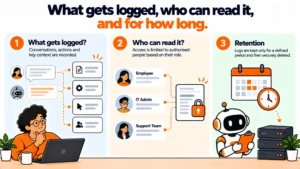
Retention and deletion. How long the vendor keeps your data after termination, and whether you can require deletion and get confirmation. For HR content this is a data protection question rather than a commercial preference, because the conversations contain things employees said about their own circumstances.
Notice and auto-renewal. When you can leave and what happens if you miss the window. This is the clause that most often costs money, and the cost is usually an unwanted additional term.
Post-termination access. Whether you can still read the system after it stops answering. Thirty days of read-only access is worth more than it sounds, because it lets you settle any dispute about what the old assistant used to say.
Derived material. Whether the vendor retains anything built from your content, and whether that is used beyond serving you. Phrasings vary widely and the answer matters for HR material specifically.
Why the Conversation Log Is the Asset
Worth being concrete about what you are protecting, because it is not obvious until you have had it and lost it.
A year of conversation history is a list of every question your employees were uncertain enough about to ask a machine, in their own vocabulary, with a timestamp. That is a map of where your documentation is thin, which topics recur seasonally, which phrases people use instead of your policy terms, and which answers were wrong. It is the input to every content improvement for the next two years, and the raw material for a test set if you ever change products.
It also has a second use that most teams discover late: it is evidence. If an employee says they were told something, the log either supports that or does not. Losing access to it means losing the ability to check, which matters precisely in the cases where checking matters.
No other artefact in the deployment has these properties. The documents are replaceable because you wrote them. The configuration is rebuildable, tediously. The log is the only thing that cannot be recreated at any price, and it is the only thing most agreements do not name.
When the Contract Barely Matters
You have exported recently and routinely. If you take a full export every quarter and keep it, most of this article is insurance you have already bought. This is the single most effective protection and it does not require negotiating anything.
You are on a monthly plan with a short notice period. Low commitment cuts both ways and your exposure is small.
The deployment is new. In the first few months there is little accumulated value to lose. Contract terms matter most once the log and the configuration have become substantial, which is also when nobody is thinking about exit.
The documents are the whole value. Some deployments genuinely are just a document search layer with no tuning and little traffic. If that describes yours honestly, the exit is simple.
The Questions to Ask Before You Sign
These are better asked at purchase, where they are routine, than at exit, where they are a negotiation.
Is the conversation history included in data export, and in what format? Ask for the word history or transcripts in the clause, not just data. Ask whether export is self-service or a support request, because a support request at exit is slower than you will want.
Can we export it ourselves, on demand, during the term? A yes here makes most other answers less important. It is also the question whose answer tells you most about how the vendor thinks about ownership.
What is the notice period and is there auto-renewal? Get the dates, and put the notice deadline in a calendar with a reminder a month earlier. This single step prevents the most common and most avoidable cost in this category.
Will you provide read-only access after termination, and for how long? Many vendors will if asked at signing. Few volunteer it.
What do you retain, and is anything derived from our content used beyond our own service? For HR material the honest answer matters, and a vendor who answers crisply is telling you something good about their data handling generally.
| Question | Ask at | Good answer | Warning sign |
|---|---|---|---|
| Is history exportable? | Signing | Named in the agreement, self-service | "Customer data" undefined |
| Export during the term? | Signing | Yes, on demand, documented format | Support ticket only |
| Notice and auto-renewal | Signing | Calendar notice, no auto-renewal | Anniversary notice, long window |
| Read-only after exit | Signing | 30 days, written in | Not possible |
| Derived material retained? | Signing | Nothing retained, deletion confirmed | Vague or silent |
Annual Payments Change the Arithmetic
Worth separating commercial structure from contract terms, because they interact.
A monthly flat subscription is simple to leave. Matram is $29 Basic, $69 Standard and $199 Pro per month, flat, with unlimited seats, and a 30-day trial that takes no card. Crisp is $0, $45, $95 and $295 a month per workspace, with additional agents charged on top. On either basis, leaving costs you the notice period and nothing else.
A single yearly payment is different in kind. SiteGPT takes one yearly payment of $468, $948 or $3,108, equivalent to $39, $79 or $259 a month billed yearly. Leaving in month four does not stop a monthly charge; it abandons the remaining eight months you already paid. That is not a criticism of annual pricing, which is usually cheaper per month precisely because of the commitment. It is a reason to treat the renewal date as the decision point and to evaluate alternatives in the two months before it rather than whenever dissatisfaction peaks.
Per-resolution pricing has a third shape. Intercom Fin is $0.99 per resolution, which means there is nothing to strand on exit but also no predictability while you are in it. For an internal deployment where usage is a cost rather than a revenue event, that unpredictability is the thing to model rather than the exit.
So the practical rule is simple. Match your commitment length to your confidence. A product you are unsure about belongs on a monthly basis even at a worse rate, because the option to leave cleanly is worth the premium while you are still learning whether it works.
What Happens to the Documents
Short answer: nothing, and it is worth saying so plainly because this is the part teams worry about and the part that is genuinely fine.
Your policies, handbook and other source material exist in your own storage. You uploaded copies. Any reputable vendor deletes its copies on request and most will confirm it. There is no realistic scenario in which an HR chatbot contract leaves you without your own documents.
Two small caveats. If you did any authoring inside the vendor's product, for example writing short answer documents in their interface rather than in your own system, those are the one piece of content that lives only there. Export them, or better, do not author there in the first place. And if the vendor converted your documents into a cleaned or chunked form that is more useful than your originals, that derived version is theirs rather than yours, which is rarely a problem but occasionally means losing some tidying work.
The structural work, meanwhile, is portable and valuable. If you restructured your policies so that each rule is self-contained and findable, that investment carries to any product. This is the strongest argument for doing that work in your own documents rather than in a vendor's interface.
What Happens to the Configuration
Nothing comes with you, and no contract will change that, because the configuration only means anything inside the product it was written for.
Refusal rules, tone settings, audience scoping and custom answer overrides are all product-specific. Even if a vendor exported them, the next product's model would not accept them. This is not a contractual failure; it is a fact about the category, and it is why the behaviour document described in our piece on switching vendors matters more than any export clause.
What you can protect is the reasoning. Keep a running note of each configuration decision and the question that prompted it. One line each. That note is yours, it is portable, and it converts a six-week reconstruction into a two-week one. It is also the only part of the configuration that survives the person who made it, which is the more common loss.
The Clause About Things Built From Your Content
This is the one most often skipped because it reads as boilerplate, and it is the one where phrasings differ most between vendors.
When you give a product your handbook, it does not simply store the file. It processes it: splits it into passages, builds an index, often produces a cleaned or normalised version that handles your formatting quirks. That processed form is derived material, and a contract that commits to returning or deleting your data may say nothing about it.
In practice this matters in two narrow ways and one broader one. Narrowly, the derived version is sometimes more useful than your original, because it has had structural tidying applied, and losing it means losing that work. Also narrowly, deletion of your uploaded files does not necessarily mean deletion of the index built from them, and an index can be reconstituted into something close to the source text.
The broader concern is improvement. If aggregated patterns from customer content inform the product generally, your policy language has contributed to something that outlives your subscription. For most content that is unobjectionable and for HR material it is a question worth having an answer to, because the material includes how your company words its approach to pay, discipline and leave, and the conversations include what employees said about their own situations.
Reasonable vendor positions span a wide range here and most are defensible. Some use nothing. Some use aggregated, de-identified patterns. Some distinguish between documents and conversations, treating the latter more strictly, which is a sensible line. What you want is a sentence in writing stating which of those applies, obtained at signing, where it is a routine disclosure rather than a concession.
Ask it plainly: does anything derived from our documents or conversations persist after termination, and is any of it used other than to serve us. A vendor who answers that crisply is signalling something useful about their data handling generally, and a vendor who cannot is signalling something too.
The Deletion Question, Which Is Different for HR Content
Most software exit discussions treat deletion as hygiene. For an HR assistant it is more than that, because of what the conversations contain.
Employees ask these systems about resignation, grievances, pay, illness and family circumstances. They ask things they would not ask a person, which is part of the value and all of the sensitivity. That history is personal data about identifiable employees, held by a third party, and your obligations about it do not end when your subscription does.
So the deletion clause needs three things. A defined period after termination, confirmation in writing when deletion has happened, and clarity about backups, since data deleted from a live system may persist in backups for a further period that should be stated rather than assumed.
Ask also whether any of it was used for training or product improvement, and get that in writing at signing rather than at exit. Vendor positions on this vary legitimately, and some improve their service using aggregated patterns while others do not touch customer content at all. Either can be acceptable. What is not acceptable for HR material is not knowing.
If you have a works council or equivalent, this is the clause they will ask about, and having a crisp answer ready is considerably easier than retrofitting one.
Six Options Worth Knowing
Matram. Best for teams who want a low-commitment monthly basis while they establish whether this works. Disclosure that should shape how you read this: Matram is owned by the same people who publish this site. It is $29 Basic, $69 Standard and $199 Pro per month, flat, with unlimited seats, and a 30-day trial that takes no card, which means the evaluation itself carries no commitment. Where it struggles, stated plainly: there is no free tier, so no indefinite zero-cost fallback after a trial ends; it answers questions but does not action tickets; and it is not an HR workflow platform, so it holds no records and produces no acknowledgement audit trail. On exit specifically, ask the same five questions you would ask anybody, because an ownership disclosure is not a substitute for a clause.
SiteGPT. Best for teams confident enough to commit annually in exchange for a lower effective rate. One yearly payment of $468, $948 or $3,108, which is $39, $79 or $259 a month billed yearly. Where it struggles on exit: the remaining term is stranded rather than cancelled, so align any switch with the renewal date.
Crisp. Best where the shared inbox is also wanted. Flat per workspace at $0, $45, $95 and $295 a month, with additional agents charged on top. Where it struggles: additional-agent charges mean the flat figure is a floor, which matters for forecasting more than for exit.
Chatbot.com. Best for website-first use. $19 per user a month entry, $29.50 Essential and $79 Growth. Where it struggles: per-user pricing fits a support team rather than a whole company.
Leena AI. Best for large organisations wanting an internal-first product. Where it struggles: no published pricing, and enterprise agreements tend to have longer terms, which raises the stakes on every clause in this article.
Doing your own quarterly export. Best for everybody, as a complement rather than an alternative. Chosen because it is the only protection that does not depend on a vendor's cooperation at the least cooperative moment. Where it struggles: it requires somebody to remember, which is why it belongs in a calendar rather than in an intention.
The Decision Table
| Situation | Scale | Setup | Primary Pain | Recommended Starting Point |
|---|---|---|---|---|
| About to sign a first contract | Any | Nothing in place | No exit terms considered | Ask the five questions, get history named |
| Deployment over a year old | Any | Substantial log and config | Valuable assets undefined in contract | Export now, then read the agreement |
| Considering leaving, monthly plan | Any | Monthly billing | Low exposure | Export, give notice, migrate |
| Considering leaving, annual plan | Any | Yearly payment | Remaining term stranded | Time the move to renewal |
| Works council or strong data governance | 200 plus | HR conversations held externally | Deletion and training unclear | Get deletion and training terms in writing |
| Vendor relationship already poor | Any | Export may be slow | Cooperation unlikely | Export before giving notice |
| Nobody knows what the contract says | Any | Signed years ago | Unknown exposure | Read it; put notice date in a calendar |
What the Trial Commits You To
The trial is where most of these relationships begin and it deserves more attention than it gets, because the terms you accept to start a trial frequently become the terms of the agreement by default.
Check three things before you load a single document. Whether the trial converts automatically to a paid term and on what notice, which is the mechanism by which teams acquire subscriptions they never explicitly chose. Whether the trial terms differ from the standard agreement on data handling, because some vendors apply lighter protections during evaluation on the reasonable assumption that nobody uploads anything sensitive. And whether anything you configure or upload during the trial survives conversion or has to be redone.
That second point matters more than it sounds for an HR deployment. A trial is exactly when you will upload real policies and let real colleagues ask real questions, because synthetic testing tells you very little. So the trial is the moment your actual HR content first sits with a third party, often before any data protection review has happened, and often under terms nobody read. The fix is small: do the data handling review before the trial rather than before the purchase, and if that is not possible, trial with a redacted document set and accept a less realistic evaluation.
A trial that takes no payment details is meaningfully different from one that does, and not only commercially. It cannot convert without a deliberate act, which removes the auto-conversion risk entirely. Among the products with published pricing in this category, some take a card up front and some do not, and it is worth checking which you are agreeing to rather than assuming.
The other thing to settle during the trial is what an HR chatbot contract will say about the conversation history, because the trial is when you have the most attention and the least commitment. Ask then. A vendor answering export questions during an evaluation is answering a buying question and tends to be straightforward; the same question asked eighteen months later is answering an exit question and tends to be referred to legal.
And keep whatever the trial produced. The questions your colleagues asked during a two-week evaluation are a small but genuine dataset, and if you decide against the product you have still learned something about your own documentation. Export before the trial lapses, because trial data is usually deleted faster than contract data and with less ceremony.
How to Take an Export That Is Actually Useful
An export nobody can read is a false comfort, and plenty of teams have one. Four things make the difference.
Take the whole history rather than a window. Products often default to a recent period in their export interface, and a quarter of history is far less useful than all of it, particularly for anything seasonal. Leave cycles, benefits enrolment and performance periods all generate question spikes that only mean something across a full year.
Take the answers, not just the questions. Some exports give you what was asked and omit what was said, which halves the value. The questions tell you where documentation is thin. The answers tell you which ones were wrong, and that second category is the one that occasionally matters a great deal.
Store it where a future colleague will find it. The characteristic failure here is an export sitting in the personal drive of somebody who has since left, which is functionally identical to never having taken it. A named folder in shared storage, with a date in the filename, and a line in whatever runbook your team keeps.
And check it opens. Actually open the file, scan a few hundred rows, confirm the columns mean what you think. Exports fail silently more often than you would expect, producing a file of the right size and the wrong contents, and discovering that at exit is the worst possible moment.
| What to export | Why | Common gap |
|---|---|---|
| Full conversation history, all dates | Seasonal patterns need a full year | Interface defaults to recent window |
| Answers as well as questions | Identifies wrong answers, not just gaps | Some exports omit responses |
| Custom answer overrides | Each one marks a document that reads badly | Rarely a documented export |
| Audience and scoping configuration | Speeds up any future rebuild | Usually screenshots only |
| Any documents authored in-product | The one content type that lives only there | Forgotten entirely |
| Your own decision notes | The reasoning behind each configuration choice | Never existed in the first place |
Do this quarterly and most of the risk in this article evaporates, because the clause you did not negotiate stops mattering when you already hold the data.
Who Should Read the HR Chatbot Contract
This is not a question of diligence but of which specific pair of eyes catches which specific problem, and the answer is that three people need to see it and usually one does.
Procurement or whoever owns commercial terms catches notice periods, auto-renewal and the payment basis. They are good at this and it is the part most likely to be read. What they will not flag is that conversation history is undefined, because to a commercial reader customer data looks like a complete category.
Whoever owns data protection catches retention, deletion, sub-processors, residency and the training question. For an HR assistant this review is not optional, because the system will hold statements employees made about their own circumstances. If your organisation has a data protection officer, this agreement belongs in front of them, and if it does not, this is a reasonable moment to get external advice rather than to proceed on optimism.
And the person who will actually own the deployment catches the thing neither of the others can see, which is that the conversation log is the valuable asset. That reader is usually in HR or people operations, is usually not shown the agreement, and is the only person who knows what would hurt to lose. Get them fifteen minutes with the draft and one instruction: look for whether the questions employees ask are named anywhere.
The failure pattern is sequential rather than anybody's fault. Procurement signs a commercially sound agreement, data protection was not consulted because the purchase looked small, and the eventual owner inherits terms they would have changed. Running all three reviews on a modest subscription feels disproportionate, which is exactly why it gets skipped, and the cost only appears two years later.
A reasonable compromise for a small purchase: procurement reads it properly, the owner reads only the export and termination sections, and somebody confirms in writing what the vendor does with employee conversations. That is perhaps an hour of total effort and it covers most of what matters.
Using the Renewal as the Moment to Fix the Contract
If you are already a year or two into an agreement with terms you would not have chosen, renewal is when you can change them, and almost nobody tries.
The bargaining position is real and modest. A vendor would rather amend an export clause than lose a renewing customer, and the amendments worth asking for cost them nothing operationally. Naming the conversation history as exportable customer data. Adding thirty days of read-only access after termination. Converting an anniversary notice window to a calendar one. Confirming deletion in writing. None of those is a commercial concession and all of them are usually available to a customer who asks at the right moment.
Ask two months before the renewal date rather than at it, because at the date the only question on the table is whether you are staying, and a request made then reads as a threat rather than as housekeeping. Framed as tidying up the paperwork for our own governance review, these requests are routine and are usually granted.
It is also worth re-asking the pricing question at renewal, because this market moves. Our own records on vendor pricing in this category have changed twice in nine days in both directions, with one vendor publishing a figure it had previously withdrawn. A basis that was the cheapest option when you bought may not be now, and renewal is the only moment when switching basis costs nothing.
And while you are there, re-read what you signed. A meaningful share of teams discover at renewal that the agreement already contained the export rights they assumed they lacked, or already allowed the monthly basis they had been told was unavailable. Reading the thing you signed is the cheapest item on this list and the one most often skipped, because it feels like it should not be necessary.
What Getting This Wrong Costs
Rarely money, usually information, and the information does not come back.
The expensive version is the one in the opening story: a year or more of conversation history lost to an undefined term, discovered at the moment it is least recoverable. The direct cost is zero and the consequence is that every subsequent content decision is made on intuition rather than evidence. Teams notice about a quarter later, when somebody asks which policies generate the most questions and nobody can answer.
The avoidable version is the auto-renewal nobody tracked. A missed notice window on an annual agreement is a year of a product you decided against, and it happens often enough that it should be treated as a predictable risk rather than an accident. A calendar reminder set on the day you sign eliminates it entirely.
And the quiet version is the deletion question never asked. Months after exit, somebody in a governance review asks what happened to the employee conversations held by a former supplier, and the honest answer is that nobody knows and nobody has confirmation. That is not a crisis. It is a gap in a record that should not have a gap, and it was a one-sentence question at signing.
So the question is not whether your HR chatbot contract protects you. It is whether you have read the five clauses that matter, and whether you took an export last quarter.
When You're Ready to Act
If you are signing, add one line to the agreement naming the conversation history as exportable customer data, and put the notice deadline in a shared calendar before the contract is filed.
If you are already a year in, export everything this week. Do not wait for a decision about leaving, because the export is useful either way and its value is highest before anybody has a reason to slow it down.
And whichever stage you are at, write down who owns the renewal date. The contract clauses matter, and the thing that actually determines whether they help you is whether a named person is watching a calendar.
One closing observation on proportion, because everything above could be read as an argument for treating a modest subscription like a major procurement. It is not. An HR chatbot contract at these price points does not warrant a month of legal review, and insisting on one is how teams end up with no assistant at all. The whole of the protection described here is roughly four questions asked at signing, one calendar entry, and an export every quarter. That is an hour of work in year one and an afternoon a quarter thereafter. What makes an HR chatbot contract worth even that much attention is not the money, which is small, but the fact that the system accumulates something genuinely irreplaceable while nobody is looking at it. Protect the log and the rest is ordinary software housekeeping.
Frequently Asked Questions
What do we actually keep when an HR chatbot contract ends?
Your own documents, without question, because you uploaded copies of material that exists in your own storage. Beyond that it depends entirely on the agreement. The conversation history, meaning the record of what your employees asked and what answers they got, is the valuable asset and the one most often left undefined by a clause referring vaguely to customer data. Configuration never transfers in any usable form, regardless of what the contract says, because it only has meaning inside the product it was written for.
Why does the conversation log matter so much?
Because it cannot be recreated at any price and because it is the only record of what your employees do not understand about their own employment. It tells you which topics recur, what vocabulary people use instead of your policy terms, where your documentation is thin and which answers were wrong. It also serves as evidence if somebody later disputes what they were told. Documents are replaceable and configuration is rebuildable; the log is neither.
Should we negotiate exit terms before signing?
Yes, and it is far easier then than later, because at signing these are routine questions and at exit they are a negotiation with somebody who has no commercial reason to be generous. The five worth raising are export scope with the conversation history named explicitly, retention and deletion with written confirmation, notice and auto-renewal dates, read-only access after termination, and what the vendor retains or derives from your content.
What about auto-renewal?
Treat it as the most likely way this costs you money, because it is. The pattern is a notice window tied to a contract anniversary rather than to a calendar month, missed by a few weeks, resulting in an additional full term of a product you had decided against. The prevention is trivial: on the day you sign, put the notice deadline in a shared calendar with a reminder a month earlier, owned by a named person rather than by whoever happens to be around.
Does an annual payment make leaving harder?
It makes it more expensive rather than harder, and the distinction matters for timing. With a single yearly payment, leaving in month four abandons the eight months already paid rather than stopping a recurring charge, so the practical effect is that your decision point is the renewal date. Evaluate alternatives in the two months before renewal rather than whenever frustration peaks, and if you are genuinely unsure about a product, a monthly basis at a worse rate buys you an option worth having.
What should happen to employee conversations after we leave?
They should be deleted within a defined period, with written confirmation, and the agreement should say what happens to backups, since data removed from a live system can persist in backups for longer. This matters more for an HR assistant than for most software because employees ask these systems about resignations, grievances, pay and health, so the history is personal data about identifiable people held by a third party. Your obligations regarding it do not end with your subscription.
Can the vendor use our content to improve their product?
Positions vary legitimately, and the important thing is knowing rather than assuming. Some vendors use aggregated patterns to improve their service and others do not touch customer content at all, and either can be acceptable depending on your governance. What is not acceptable for HR material is being unable to answer the question, which is what happens when it is never asked at signing. Get it in writing, because this is the clause a works council or a governance review will ask about.
What is the single best protection?
A full export taken by you, on a schedule, while the service is running normally. It is the only safeguard that does not depend on a vendor's cooperation at the moment they have least reason to cooperate, it costs an afternoon a quarter, and it is useful whether or not you ever leave. Put it in a calendar rather than in an intention, and keep the exports somewhere a future colleague will find them.