
TL;DR
- The core decision: whether to compare products by category or by job, because only one of those is comparable across vendors.
- When doing nothing is right: when you already know which jobs you need done and nobody is asking you to justify a category.
- What has to be true: you can list the specific jobs the system must do, without using any of the three acronyms.
- How the options split: by capability area, which is stable, rather than by label, which moves with whoever is selling.
- Decision rule: if two vendors disagree about which category a product is in, the category is not telling you anything.
- Outcome to expect: comparisons that survive contact with a salesperson, because they're built on jobs rather than names.
Three Words for One Shelf
Somebody sends you a list of systems to look at. One calls itself an HRIS. One calls itself an HRMS. One calls itself an HCM platform and mentions, further down the page, that it's also an HRIS.
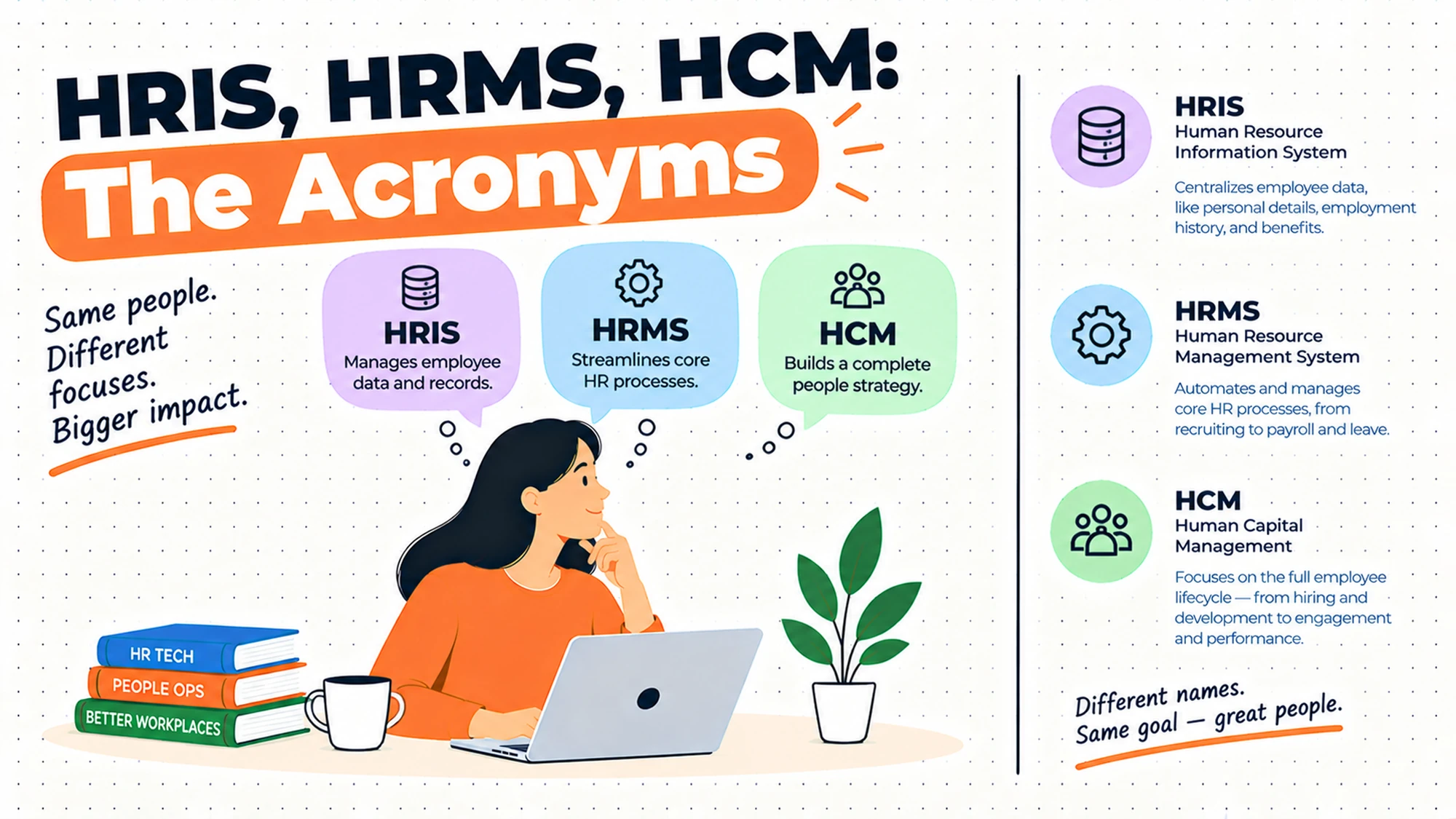
You look for the distinction and find plenty of explanations. HRIS is the record. HRMS adds process. HCM is strategic and covers the whole employee relationship. It reads like a hierarchy, and it's tidy enough that you assume you've missed something obvious if it doesn't clarify anything.
You haven't. The three terms have no agreed boundary, and the reason is structural rather than anybody being careless. A vendor adopts whichever word makes the product sound complete for the buyer they want. A product with strong records positioning calls itself an HRIS when selling to somebody who wants a record, and an HCM platform when selling to somebody senior who wants strategy. Both descriptions are defensible because nobody owns the definitions.
Best tools for HRIS Software
The practical effect is that you cannot use the labels to narrow a market. Two products in the same category can share almost no capability. Two products in different categories can do nearly identical things. Any shortlist built on the category word is filtering on marketing.
So the reframe worth holding: stop asking which category a product belongs to and start asking which specific jobs it does. A list of jobs is comparable across every vendor in this market. A category label is comparable across none of them.
When You Genuinely Do Not Need to Act Yet
Your current setup is genuinely fine. You know what your system does, it does it, and nobody is asking you to categorise it. The acronyms are a buyer's problem, not an operator's, and understanding them changes nothing about a system already in place.
Friction is starting to show. Somebody has asked whether you have an HRIS or an HCM, or a shortlist has been assembled by category and you suspect it's mixing incomparable things. That's worth an hour of translation into capabilities, and it doesn't require a project.
It has become a real cost. You're partway through a selection and the comparisons aren't holding up, because each vendor is answering a differently shaped question. Or somebody has been asked to buy a category rather than solve a problem and the requirements can't be written. At that point the terminology is actively obstructing the decision.
The edge case that forces it. A procurement process or an approval gate requires you to specify a category, or an internal standard names one. This happens and it's frustrating, because you have to translate a real requirement into a label that doesn't map cleanly. Write the capability list first, then choose whichever label the process demands and attach the list to it, so the specification survives the categorisation.
Five Questions This Reader Asks at 11pm
What does HRMS stand for? Human Resource Management System. HRIS is Human Resource Information System, and HCM is Human Capital Management. The expansions are the least useful part of this, because all three describe roughly the same territory in different registers: information, management, and something closer to strategy. Nothing in the words tells you what any particular product does.
Is there any real difference? There's a conventional account, and it's worth knowing because people will use it. HRIS means the record. HRMS means the record plus the processes around it. HCM means all of that plus the strategic layer of planning and development. It's a reasonable description of increasing scope, and it breaks the moment you test it against actual products, because vendors do not respect it.
Which one do we need? The wrong question, and it's the one everybody arrives with. You need a specific set of jobs done. Once that list exists, you'll find products carrying all three labels that satisfy it and products carrying all three that don't. The label tells you how the vendor positions, which is genuinely informative about who they sell to and almost uninformative about capability.
Is HCM just HRIS with better marketing? Sometimes, and not always. There's a real pattern where the term signals a product aimed at larger organisations, sold to a more senior buyer, with more emphasis on planning and analytics. That's a useful signal about fit. It does not mean the product does more of what you need, and for a smaller team the extra scope frequently arrives as configuration weight rather than as value.
How do I compare products that call themselves different things? Build a list of jobs in your own words, send the same list to every vendor, and make each one answer against it. This sounds obvious and it's the step that gets skipped, because each vendor's own material is organised around their positioning and it's easier to absorb their structure than impose yours. The moment you impose a common structure, the comparison becomes possible.
What the Labels Claim and What They Deliver
Here is the conventional account and where each boundary fails. Worth knowing so you can recognise the argument when a vendor makes it.
| Term | What it is meant to include | Why the boundary moves |
|---|---|---|
| HRIS | The employee record, documents, basic reporting | Almost every product now claims process too |
| HRMS | The record plus workflows, absence, service delivery | Nothing stops an HRIS vendor listing the same features |
| HCM | All of that plus planning, development, analytics | Used as a seniority signal more than a capability claim |
| Core HR | The irreducible record everything else depends on | The only term here with a fairly stable meaning |
| Talent suite | Hiring, performance, development, sometimes learning | Overlaps HCM entirely, sold to a different buyer |
| Payroll platform | Calculating and paying, plus the data to do it | Many now hold the record too, blurring the line |
The fourth row is the exception worth noting. Core HR is used with reasonable consistency to mean the employee record and the things that cannot be removed without the rest collapsing: identity, employment terms, position, reporting line, dates. If you want one term that carries meaning across vendors, it's that one.
The last row is where the confusion causes actual harm rather than annoyance. A product that calculates pay and also holds the employee record is doing two jobs that fail differently, and teams frequently assume that because payroll is accurate the record must be. Payroll is accurate about what was paid. That's a different claim from the record being right about who is employed and on what terms.
Five Diagnostic Questions You Can Self-Assess Against
Can you list what you need without using any of the three words? Try writing five lines. If each one describes a job somebody does and a thing that must be possible, you're ready to compare products. If they keep resolving into category names, the requirement hasn't been articulated yet and no amount of market research will supply it.
When two vendors use the same word, do they mean the same thing? Check one term against two products. You'll find capabilities in one that the other doesn't have, both under the same label. That exercise takes twenty minutes and permanently removes the temptation to filter by category.
Is the category word coming from you or from a vendor? Trace where it entered the conversation. Frequently a requirement gets written as we need an HCM because that phrase appeared in a document somebody read, and from then on the shortlist is filtered on a word nobody in the organisation chose.
Does anybody internally need the label? Sometimes the answer is yes: a procurement form, an approval paper, an IT standard. That's a real constraint and it's satisfiable. Write the capability list, then attach whichever label the process requires. What you must avoid is letting the label do the filtering.
Are you buying scope you'll configure and not use? The broader labels signal broader scope, and scope has a cost even when unused, because configuration decisions get made for modules nobody will open. If several capability areas on a product's list are areas you've explicitly decided not to solve, that's a reason for caution rather than reassurance.
Six Capability Areas the Acronyms Are Meant to Separate, Reviewed
The core employee record
Who works here, on what terms, reporting to whom, since when. Every product in this market claims it and they differ enormously in how well they do it. It earns its place as the first thing to evaluate because everything else depends on it: reporting built on a weak record is confidently wrong, and workflows built on it route to the wrong people.
The differences that matter are unglamorous and rarely demonstrated. Whether the record is effective-dated, so you can reconstruct what was true on a past date. Whether it handles a person holding two positions. Whether a change propagates or has to be entered repeatedly. Whether history survives a correction.
Ask for a past date to be reproduced live. Products that struggle here will struggle in ways you'll feel for years.
The second thing worth testing is what happens to a correction. Somebody's start date was entered wrong and gets fixed six months later: does the system treat that as a correction to a fact that was always true, or as a change effective from today? Both behaviours exist and they produce very different reporting. A product that cannot distinguish a correction from a change will quietly misstate every historic count that touches the field.
Pay and its inputs
Calculating and paying, and holding the data that determines both. It earns its place as the area with the least tolerance for error: mistakes are visible to the individual immediately and damage trust disproportionately.
The boundary question is the one to settle. Some products calculate pay, some hold the inputs and hand off, some do both in one place. Each arrangement works. What fails is the arrangement nobody described, where the record holds a rate, payroll holds a different rate, and nothing reconciles them until somebody notices a payslip is wrong.
Establish which system decides the rate and which system pays it, and make sure a change entered once reaches both. Obligations around payroll records differ by jurisdiction, so confirm what you must retain locally.
The direction of the connection matters as much as its existence. A record that pushes changes to payroll behaves differently from a payroll that pulls them on a schedule, and differently again from two systems that sync in both directions. The last arrangement sounds most capable and is the one most likely to produce a conflict nobody can resolve, because when two systems each believe they hold the truth about a field, something has to decide and usually nothing does.
Hiring and the pipeline before somebody joins
Managing applicants up to the point of acceptance. It earns its place separately because the data is a different shape: applicants are not employees, most never become employees, and mixing the two populations in one record quietly breaks counting.
The integration point is where value sits and where products differ most. A clean handover creates the employee record from the accepted candidate without re-keying, carrying the agreed terms across. A weak one produces a person typed in twice, with two versions of their name and a start date somebody transcribed.
Ask specifically what is created automatically at acceptance and what a person still has to type.
The other question is what happens to everybody who did not get hired. Applicant records accumulate, they contain personal information, and obligations around how long they may be kept and on what basis differ by jurisdiction. A combined product makes this easier to ignore, because the data sits in the same place as employee data and inherits whatever retention behaviour was configured for employees. Establish the position locally and configure it deliberately.
Performance and development
Reviews, goals, development conversations and whatever supports them. It earns its place where the organisation has an actual cycle to run and the current arrangement has stopped coping.
Where it misleads is that this area demos extremely well and is the most commonly bought and least used capability in the category. It depends almost entirely on manager behaviour rather than on software, so a team that cannot get reviews completed today will not get them completed because a system now requests them. It also raises an access question, because the material is more sensitive than the basic record and the permissions have to be designed rather than inherited.
Buy it when you have a working process that's outgrowing its current support. Buying it to create the process rarely works.
If you do buy it, treat the access design as part of the purchase rather than as implementation detail. Review content sits at a different sensitivity from a phone extension, and a permission model that was adequate for the basic record will not be adequate once this material is in the same system. Teams that leave this until configuration tend to resolve it by restricting broadly, which then makes the everyday lookups everybody actually needed awkward.
Workforce planning and analytics
Headcount planning, scenario modelling, and reporting beyond operational counts. It earns its place in organisations where planning genuinely happens on a cycle and the numbers currently get assembled by hand each time.
Where it falls short is dependence. Analytics are only as good as the record and the definitions underneath, and most disappointment here is a data problem wearing a reporting product's clothes. A planning module on top of an inconsistent record produces attractive, confident output that nobody should act on.
Fix the definitions first. This capability is worth real money once the foundation is sound and close to worthless before that.
There is a reliable tell for whether you are ready. Ask two people to produce the same number independently from whatever you have now. If the answers match and both can explain how they got there, a planning layer will help. If they differ, or they match but neither can reconstruct the method, the analytics module will industrialise whichever version happens to be configured, and its authority will make the disagreement harder to surface rather than easier.
Service delivery to employees
How people ask HR things and how HR answers: self-service, a knowledge base, request tracking. It earns its place once the team is big enough that requests get lost in individual inboxes, and it's the area most likely to be genuinely undervalued in a selection because it isn't strategic and it's felt daily.
Where it falls short is that it can make HR feel distant if implemented as a wall. The tooling is neutral; what determines the experience is whether a person still appears when a person is needed.
Evaluate it by watching somebody unfamiliar try to find an answer, not by watching the vendor move through a knowledge base they wrote.
The failure mode to watch for is a knowledge base that answers questions nobody asks. Content gets written by whoever has time, which means it covers the topics that are easy to document rather than the ones that generate requests. A far better starting point is to take the last thirty things people actually asked HR and write answers to those, which is unglamorous, takes an afternoon, and removes more requests than any amount of structure.
The Decision Table
| Situation | Scale | Setup | Primary Pain | Recommended Starting Point |
|---|---|---|---|---|
| You know the jobs you need done | Any | Any | None | Ignore the acronyms entirely |
| Shortlist assembled by category | Any | Any | Filtering on marketing | Rewrite as a capability list |
| Requirement says buy an HCM | Any | Formal procurement | A label chosen by somebody else | Write capabilities, attach the label |
| Vendors answering differently shaped questions | Any | Active selection | No common structure | Send one list to all of them |
| Record is weak but analytics look strong | Any | Any | Foundation, not reporting | Fix definitions before buying analytics |
| Payroll and record hold different rates | Any | Separate systems | Undecided boundary | Name which system decides |
| Applicants and employees in one count | Any | Combined product | Two populations, one record | Separate the pre-hire data |
| Reviews not completed today | Any | Any | Behaviour, not tooling | Do not buy performance yet |
| Requests lost in individual inboxes | Over one hundred | Growing HR team | Service delivery, undervalued | Weight it properly in the comparison |
The third row is worth handling carefully rather than fighting. When a requirement arrives as a category name, the label usually came from a document rather than from analysis, and arguing about terminology makes you look pedantic. Writing the capability list and presenting it as the specification behind the label satisfies the process and restores the real requirement underneath it.
The fifth row catches experienced teams. Strong analytics on a weak record are more dangerous than no analytics, because output that looks authoritative gets used in decisions. If your headcount numbers currently disagree between systems, adding a reporting layer distributes one of the disagreeing answers more widely and with more confidence.
The Question That Replaces the Acronym
If the categories cannot narrow a market, something has to. The replacement is a list of jobs written in your own words, and it's more useful than it sounds because it's the only artefact in this process that stays constant across every conversation.
A job is a sentence describing something that must be possible, in language somebody in your organisation would recognise. A manager can see who reports to them without asking HR. A change of position entered once reaches payroll without re-keying. We can show what somebody's terms were on a date last year. Each is testable, none contains a category word, and every vendor can be made to answer it directly.
Then rank them, which is the part people skip. Ranking forces the conversation where two people discover they meant different things, and it gives you something to do when no product satisfies everything, which is the normal outcome. An unranked list of equally essential jobs provides no guidance at exactly the moment you need guidance.
A practical way to force the ranking is to ask which single job, if a product did it badly, would make you walk away regardless of everything else. Most groups can answer that even when they cannot rank a full list, and the answer usually surprises at least one person in the room. Start there and work down, because the top of the list is the part that actually does work during a decision.
The second question worth asking of each capability area is whether you want it now, later, or never. Never is a legitimate and underused answer. A product carrying a capability you've decided not to use is not free: somebody configures it during implementation, it appears in the interface, and it generates questions. Writing never against two areas will shorten your shortlist faster than any feature comparison.
Be prepared for never to be challenged, usually by somebody pointing out that you might want it one day. That objection is always available and it is almost always wrong as an argument for buying now, because capability bought ahead of a need arrives configured for an organisation that no longer exists by the time the need appears. The honest response is that later is a real option and it is not the same as now.
One more translation is worth doing before you start. Take each vendor's own category claim and set it aside explicitly, in writing, so it doesn't creep back in. The claim is genuinely informative about one thing, which is who they built the product for. A platform positioned for large complex organisations will be heavy for a small team however it's labelled, and one positioned for small teams will hit a ceiling however comprehensive its capability list appears.
That ceiling is worth asking about directly rather than inferring. Ask each vendor what kind of customer outgrows them and what usually triggers the move. Vendors who answer this straightforwardly are describing a boundary they understand, which is a good sign. Vendors who say nobody outgrows them are either not paying attention to their own churn or are managing the conversation, and the answer tells you which.
Where the Terminology Causes Damage
| The failure | How it shows up | What would have to change |
|---|---|---|
| Shortlist filtered by category | Incomparable products treated as peers | Filter on jobs, not labels |
| A category name written as a requirement | Nobody can say what must be possible | Translate to capabilities first |
| Assuming a broader label means more capability | Scope bought, never used, still configured | Mark each area now, later or never |
| Payroll accuracy taken as record accuracy | The record drifts unnoticed | Name which system decides each field |
| Analytics evaluated before the record | Confident output built on weak data | Fix definitions before the reporting layer |
| Performance bought to create a process | A module nobody completes | Buy support for a process that works |
The third row is the quiet one. A broader-sounding label implies more, and more implies better, and the cost of unused scope is invisible at purchase. It arrives as configuration decisions for modules nobody will open, interface complexity for everyday users, and a renewal conversation where somebody asks what all of this is for.
The last row is the most expensive mistake in this list and the easiest to make, because performance modules demo beautifully. If reviews do not happen now, they will not happen because a system requests them. What changes completion is whether managers are expected to do it and whether anybody notices when they don't, neither of which is a software property.
What to Put in Writing
| Artefact | Who owns it | When it is written | What it prevents |
|---|---|---|---|
| The jobs list, in your own words | Whoever runs the selection | Before any vendor contact | Filtering a market on marketing |
| The ranking of those jobs | The decision-maker | Before the demos | No guidance when nothing fits fully |
| Now, later or never, per capability area | The decision-maker | Before the demos | Buying scope nobody will use |
| Which system decides each shared field | Whoever owns the systems | Before signing | Record and payroll silently diverging |
| The label the process requires, and why | Whoever handles procurement | When the form demands it | A specification lost to a category |
| What must be evidenced, where you operate | HR, with local advice | Before shortlisting | Requirements supplied by a vendor |
The third row is the cheapest decision on this list and it shortens everything downstream. Marking two capability areas as never gives you a written reason to decline the parts of a demo designed to expand your scope, and it converts an awkward conversation into a reference to something already agreed.
Questions to Ask Before You Commit
On language. Can you state the need without an acronym? A bad answer uses one.
On origin. Where did the category word come from? A bad answer is a vendor's site.
On comparison. Are all vendors answering the same list? A bad answer is their own material.
On scope. Which areas are never? A bad answer is all of them eventually.
On the record. Can they reproduce a past date live? A bad answer describes it.
On boundaries. Which system decides the pay rate? A bad answer is both.
What Getting This Wrong Costs
The first cost is a comparison that quietly isn't one. Products filtered by category into a shortlist can differ so much in capability that the evaluation is comparing things with no common basis, and because each vendor answers within their own framing, nobody in the room notices. The decision then gets made on impressions, which is where it would have been made without any process at all.
The second cost is unused scope, paid for repeatedly. A broader label attracts a broader purchase, and the capability nobody needed still takes configuration time during implementation, still appears in the interface for everyday users, and still shows up at every renewal. None of that is visible at the point of signing, which is why it keeps happening.
The third cost is the foundation problem disguised as a feature gap. When numbers disagree or reporting is unsatisfying, the categories encourage a reading where you need a more advanced tier of product. Frequently the actual issue is that the core record is inconsistent or the definitions were never agreed, and moving up a category buys a more sophisticated layer on the same weak base. The disappointment then repeats at greater expense.
So before any of this, write the jobs down in plain language, rank them, and mark the capability areas you're deliberately not solving. Do that and the acronyms become what they actually are: a description of who each vendor is selling to, which is worth knowing and is not a specification.
When You Are Ready to Go Further
None of this needs a market study. It needs five sentences describing what must be possible, written without any of the three acronyms, ranked in order, with two capability areas explicitly marked as never.
Send that same list to every vendor rather than absorbing each one's material in their own structure. It's a small act of imposition and it changes the dynamic of every conversation afterwards, because you're now asking them to answer rather than to present.
The step beyond that, once you've chosen, is to keep the jobs list. It becomes the thing you check against a year later when somebody asks whether the system is working, and it's a far better test than a satisfaction survey or a feature audit, because it records what you were trying to achieve at the moment you were thinking most clearly about it.
HROpsLab publishes independent comparison work across HR tooling, applicant tracking and payroll. We sell nothing, we take no vendor money, and we publish no paid placements. If the next step is looking at what your current tooling actually supports here, our comparison work is one place to start.
Frequently Asked Questions
What does HRMS stand for?
Human Resource Management System. The companion terms are HRIS, Human Resource Information System, and HCM, Human Capital Management. The expansions are the least useful part of the subject, because all three describe approximately the same territory in different registers: information, management, and something closer to strategy. None of the words tells you what a particular product actually does, and the conventional hierarchy people cite is a description of intent rather than an enforced boundary.
What is the difference between an HRIS and an HRMS?
The conventional account says an HRIS is the employee record and an HRMS adds the processes around it, such as workflows, absence and service delivery. It's a reasonable description of increasing scope and it fails as a filter, because nothing prevents a product calling itself an HRIS from listing every one of those process features. Two products sharing a label can have almost no capability in common. The distinction is worth knowing so you recognise the argument when a vendor makes it, not because it can narrow a market.
Is HCM the same as HRIS?
In practice the terms overlap heavily, and HCM functions more as a signal about the intended buyer than as a capability claim. Where the term is used consistently, it tends to indicate a product aimed at larger organisations, sold to a more senior audience, with more emphasis on planning, analytics and development. That's genuinely useful information about fit, since a platform built for large complex operations will feel heavy to a small team. It does not reliably mean the product does more of what you specifically need.
Which one does a small company need?
The question can't be answered as asked, and reframing it is the actual advice. Write down five things that must be possible after a purchase, in your own words, without using any of the three acronyms: a manager seeing their own team without asking HR, a position change entered once reaching payroll, reproducing somebody's terms as they stood last year. Then find products that do those. You'll find candidates under all three labels that qualify and candidates under all three that don't.
Does the distinction matter when buying?
Only in one direction. The labels are useless for filtering capability and mildly useful for reading positioning, because they tell you who the vendor built the product for. Where they cause real harm is when a category name gets written into a requirement, because then the shortlist is filtered on a word nobody in your organisation chose, usually one that entered the conversation from a document somebody read. If a procurement form demands a category, write the capability list first and attach the label to it.
What is core HR?
The irreducible employee record that everything else depends on: identity, employment terms and their history, position, reporting line and dates. It's the one term in this area used with reasonable consistency across vendors, which makes it the most useful word available when you need to be precise. It's also the capability worth evaluating first and hardest, because reporting built on a weak record is confidently wrong and workflows built on it route to the wrong people.
How do you compare systems that call themselves different things?
Build a list of jobs in your own language, rank it, and send the same list to every vendor so each answers against your structure rather than presenting within theirs. This is the step that gets skipped, because absorbing each vendor's own material is easier than imposing a common frame, and it's the step that makes comparison possible at all. Also ask each to demonstrate rather than describe: reproduce a past date live, model your three strangest real cases, make a configuration change on the call.
Should you buy the broader category to allow for growth?
Be cautious, because unused scope is not free. Capability you've decided not to use still consumes configuration decisions during implementation, still appears in the interface for everyday users, and still appears at renewal when somebody asks what you're paying for. A more useful discipline is to mark each capability area as now, later or never, and to treat never as a legitimate answer. Growth is a real consideration; buying three years ahead of a need frequently means configuring and maintaining something nobody opens.
The labels tell you who a vendor sells to. They don't tell you what the software does.