
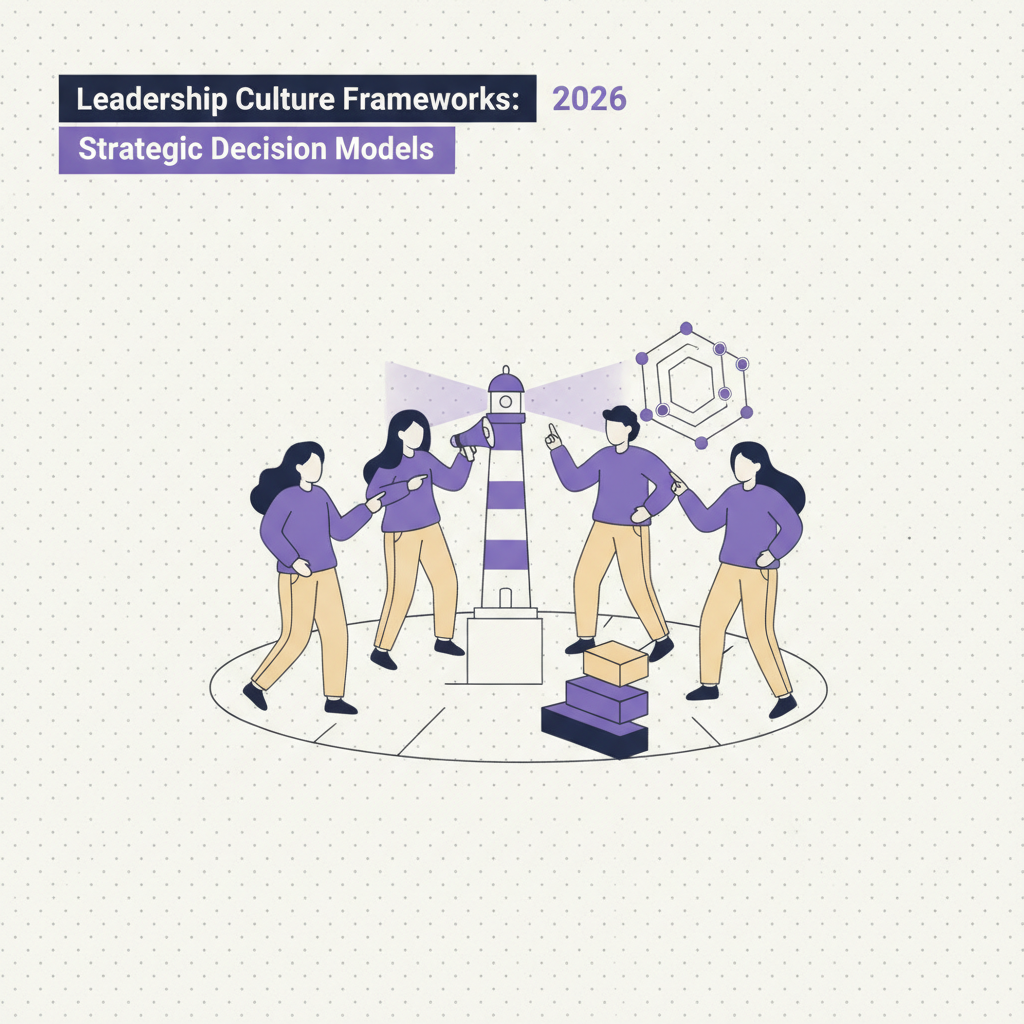
Choosing among competing leadership culture frameworks in 2026 requires a clear-eyed look at how each model shapes decisions, accountability, and organizational behavior, so here is the essential summary. TL;DR
- Most leadership culture programs fail at the diagnostic stage, not the execution stage. You can’t prescribe the right framework without an accurate read on where you actually are.
- According to Gallup’s 2023 State of the Global Workplace report, 51% of managers say they do not have the skills to lead in the current environment, yet fewer than 30% of organizations conduct formal leadership culture diagnostics before deploying new programs.
- McKinsey research found that companies with strong, deliberately designed leadership cultures are 2.4 times more likely to achieve above-average financial performance than peers operating on informal norms.
- The right framework to choose depends on your company’s growth stage, leadership maturity, and whether your culture gaps are structural (accountability, decision rights) or behavioral (trust, communication).
- Start with a formal leadership culture audit using a structured diagnostic model before committing budget to any platform, program, or external facilitator.
- At companies over 500 employees, behavioral diagnostics without a governance layer systematically fail. You need both the human and structural sides addressed in sequence.
In late 2023, the Chief People Officer of a 1,400-person regional healthcare network in Nashville sat across from her executive team with a 47-page engagement report and no idea what to do next. The organization had spent $380,000 on a multi-year leadership development program with a well-regarded consulting firm. Scores had improved marginally. Turnover among frontline managers had climbed anyway. When she asked the consulting firm why the scores and the outcomes didn’t match, they pointed to “culture headwinds.” She pointed to their contract. What had actually failed was not the programming. It was the diagnostic framework underneath it. Nobody had mapped decision rights, accountability structures, or the behavioral norms at the middle management layer before prescribing a solution. They had treated culture as a sentiment problem when it was a systems problem.
This scenario is not unusual. Deloitte’s 2024 Global Human Capital Trends report found that 72% of HR executives say culture is a top priority, yet fewer than 19% say they have an effective method for measuring it against business outcomes.
Best tools for Leadership & Culture
This article breaks down 5 strategic frameworks, extracts the pattern-level insight behind each one, and gives you a decision matrix to match the right model to your specific organizational situation.
Why Leadership Culture Strategy Is Still Broken in 2026
Programs get bought before problems get diagnosed: A 240-person SaaS company I reviewed last year had invested $180,000 across two years in leadership coaching subscriptions, a 360-feedback platform, and a culture consulting retainer. None of the three vendors had been given the same definition of what “leadership culture” meant inside that company. Each was solving a different problem. The result was three parallel interventions with no common language, no shared metrics, and an executive team increasingly confused about why nothing was sticking. You can’t fix what you haven’t named.
Framework selection gets driven by vendor relationships, not fit: According to SHRM’s 2024 HR Technology Adoption Survey, 63% of HR leaders selected their culture or leadership development platform based primarily on a prior vendor relationship or peer recommendation rather than a structured requirements analysis. That means the majority of programs start with an answer before they have a question. Framework fit matters more than brand recognition. A model built for a post-merger integration at a 3,000-person manufacturing company will not transfer cleanly to a 90-person fintech with a flat org and a fractional CHRO.
Measurement stops at sentiment, never reaches behavior: The specific, measurable consequence here is a gap most boards are starting to notice: leadership programs report satisfaction scores, not behavioral change rates or business outcomes. When leadership culture work can’t be tied to a measurable delta in promotion readiness, manager effectiveness scores, or team performance ratings over time, it becomes discretionary budget at the first cost-cutting conversation. In my experience across HR deployments at companies under 1,000 people, that conversation comes every 18 months.
The frameworks and tools in this article exist precisely to close those three gaps. Let’s start with what we’re actually talking about.
What Are Leadership Culture Frameworks?
Leadership culture strategy is a deliberate organizational discipline that defines how leadership behavior is designed, measured, and reinforced across every level of a company. It is not an HR program. It is an operating model decision. The distinction matters because it changes who owns it, how it gets funded, and how success is defined.
In practice, a leadership culture strategy follows a repeatable workflow that most organizations skip or compress:
- Conduct a formal diagnostic to identify the current-state leadership culture, including behavioral norms, decision-making patterns, and accountability structures.
- Define the target-state culture explicitly, tied to the company’s three-to-five year business strategy and growth stage.
- Select a governance framework that assigns ownership and accountability for culture outcomes to specific roles, not teams or functions.
- Deploy behavior-level interventions (not just programs) aligned to the gap between current state and target state.
- Measure behavioral change on a quarterly cadence against pre-defined indicators, and adjust the model based on what the data shows.
Done properly, this process eliminates the most common failure pattern in culture work: treating a structural problem as a sentiment problem and spending two years wondering why scores are moving but outcomes aren’t.
Why Leadership Culture Strategy Fails (Even With Enterprise-Grade Tools)
No accountability system: The most common structural failure in leadership culture work is the absence of a named accountability owner below the CHRO. Culture committees, culture task forces, and “all-hands” ownership models are accountability diffusion by another name. When no individual role owns the leadership culture diagnostic cadence, the intervention roadmap, and the outcome metrics, the program becomes a shared responsibility that nobody is actually measured on. Accountability gaps compound over months into systemic drift where the gap between stated values and actual leadership behavior widens quietly until it surfaces as a retention crisis.
No specialized expertise: Leadership culture strategy sits at the intersection of organizational psychology, systems design, and business strategy. Most internal HR teams are built for operational excellence, not for that intersection. According to Deloitte’s 2023 Global Human Capital Trends report, only 23% of HR organizations say they have the internal capability to design and execute a culture strategy without significant external support. Deploying a leadership development platform without that expertise at the wheel is the equivalent of buying a sophisticated diagnostic tool for a hospital and handing it to the accounting department.
No lifecycle tracking: Leadership culture is not a project with a start and end date. But most organizations treat it as one. Gartner research on HR program effectiveness found that 68% of culture and leadership programs are evaluated only at program completion, not at six-month or twelve-month intervals post-delivery. Behavioral change has a decay rate. Without a tracking mechanism that monitors behavioral indicators after the program ends, you have no way to know whether what you deployed actually changed anything durable or just moved a survey score for a quarter.
No compliance discipline: This one catches HR leaders off guard. Leadership culture tools that collect behavioral data, psychometric assessments, 360-feedback records, and manager effectiveness ratings are touching personally identifiable employee data in jurisdictions with increasingly specific rules. Under GDPR, the right to explanation and the right to erasure apply to automated decisions and scored outputs that affect employment conditions. Several US states, including California under CPRA and Illinois under BIPA, have their own employee data protections that intersect with how culture platforms store and process behavioral profiles. Penalties under GDPR for non-compliant HR data processing can reach 4% of global annual revenue. Most culture platform implementations I’ve reviewed don’t include a data processing agreement review as a standard procurement step.
The gap between deploying a leadership culture strategy and deploying one responsibly is exactly where every major failure described in this article occurred.
What to Look For in a Leadership Culture Framework or Platform
Explainability at the decision level: Any platform or framework that produces a leadership effectiveness score, a culture health rating, or a behavioral assessment must be able to explain how that output was derived. If your HR director can’t explain to a manager why their score is what it is, using that score for development decisions creates legal exposure and destroys trust. Demand full methodology documentation before signing.
Audit cadence built into the contract: Look for vendors and frameworks that build in a formal review cadence, not just at program end, but at 60, 90, and 180 days post-implementation. The audit should cover behavioral change indicators, not just satisfaction or adoption rates. If the vendor’s standard contract doesn’t include this, it tells you something about whether they expect the program to produce measurable results.
Security and compliance certifications: Require SOC 2 Type II certification at minimum. For European operations or US companies with EU employees, GDPR compliance documentation is non-negotiable. If the platform processes psychometric or behavioral assessment data, verify whether it falls under HIPAA or EU AI Act oversight in your jurisdictions. ISO 27001 certification is a reasonable additional bar for enterprise buyers.
Integration without data duplication: A leadership culture platform that requires you to manually export data from your HRIS to run analysis is a platform that won’t get used consistently. Look for native integrations with Workday, BambooHR, Personio, Greenhouse, Lever, or iCIMS depending on your current stack. Data should flow in real time, not in batch exports, and the platform should not store employee data in a separate silo that creates a compliance headache during audits.
Pilot program availability: Any reputable vendor in this space should offer a structured pilot, ideally 60 to 90 days, with a defined cohort, a pre/post measurement design, and a go/no-go decision framework built into the pilot contract. If a vendor won’t offer a pilot or prices it prohibitively, they’re telling you they don’t have confidence in the 90-day outcome. Walk away.
Transparent pricing tied to outcomes: The worst pricing models in this space charge a flat annual fee regardless of adoption or outcomes. Look for pricing that scales with usage, and ask specifically whether the contract includes performance benchmarks that trigger a renegotiation or refund clause. Vendors who price on outcomes are vendors who believe in their product.
Post-implementation support SLA: Require a named customer success manager, not a shared support queue. The contract should specify a minimum check-in cadence (quarterly at minimum), a defined escalation path for implementation issues, and a response SLA for critical support tickets. Culture platforms that go quiet after onboarding are universally the ones that produce disappointing results 18 months in.
Best Leadership Culture Strategy Platforms in 2026
Humu
Humu is a behavioral nudge platform built for enterprise and mid-market HR teams that want to shift leadership behavior at scale without adding more programs to an already crowded calendar. Its core model is built on behavioral science, not content delivery.
Humu works by ingesting engagement data, performance signals, and organizational structure to generate personalized micro-nudges delivered to managers and leaders at the moment they’re most likely to act on them. Rather than asking leaders to complete a course or attend a workshop, Humu interrupts existing workflows with a specific, low-friction suggested action tied to a target behavior. The platform integrates with major HRIS and collaboration tools and claims behavioral change signal data across more than 2 million employee touchpoints in its training corpus. The differentiation is the causal model underneath: nudges are selected based on what’s been shown to produce behavioral change in comparable organizational contexts, not just what sounds like good advice.
Key Features
- Personalized weekly nudges delivered to managers based on real-time performance signals
- Science-backed nudge library with over 300 behavior-specific interventions
- Org-wide culture health dashboard with team-level drill-down capability
- Nudge effectiveness tracking tied to engagement and retention metrics over time
- Native integrations with Workday, Slack, Microsoft Teams, and BambooHR
Best For
Mid-market to enterprise companies (500 to 5,000 employees) with an existing engagement data infrastructure and an HR team that wants to move from insight to behavior change without adding a new program layer. The ideal buyer is a VP of People Ops or CHRO who has good diagnostic data but poor behavior translation.
Pricing
Humu does not publish list pricing. Based on public reporting and buyer community discussions, enterprise contracts typically start around $80,000 to $120,000 per year depending on headcount and integration scope. Confirm directly with the vendor for current rates.
Where It Struggles
Humu requires a meaningful existing data foundation to generate relevant nudges. Companies without clean HRIS data, without consistent engagement survey cadences, or with fewer than 150 employees won’t generate enough behavioral signal to make the platform’s personalization engine meaningful. The nudge model also requires leadership buy-in at the top to avoid being perceived as surveillance by middle managers, which is a real adoption risk in organizations with trust deficits. Implementation typically takes 10 to 14 weeks before the first meaningful behavior data is visible.
Leapsome
Leapsome is a people enablement platform that combines OKR tracking, performance reviews, engagement surveys, and learning pathways into a single interface designed to make leadership culture measurable and self-reinforcing.
Leapsome’s core mechanism is the connection between goal-setting, feedback, and development planning. It ingests goal data, 1:1 notes, peer feedback, and manager review inputs to produce a continuous leadership effectiveness picture rather than a snapshot at review time. The platform is particularly strong for companies that want to tie leadership culture metrics directly to business objectives, because the OKR layer makes it possible to draw a line from a manager’s behavioral indicators to their team’s outcome performance. Leapsome reports over 1,500 companies on its platform across 50+ countries, with particularly strong adoption in European mid-market firms. Its feedback engine supports both structured cycles and always-on peer input, which reduces the annual review bottleneck that distorts most leadership culture data.
Key Features
- Continuous 360-degree feedback with configurable question sets and anonymity controls
- OKR and goal management linked to individual development plans
- Engagement survey engine with real-time heatmaps by team and manager
- AI-assisted learning pathway recommendations tied to identified skill gaps
- Native integrations with Workday, BambooHR, Personio, Slack, and Microsoft Teams
Best For
European-headquartered or GDPR-sensitive companies between 100 and 2,000 employees that want an integrated performance-and-culture platform rather than point solutions. The ideal buyer is an HR director or CHRO who is tired of reconciling data across three separate tools and wants a single source of truth for leadership effectiveness.
Pricing
Leapsome offers modular pricing. Based on public information, all-in platform access starts at approximately $8 per employee per month for smaller cohorts, with enterprise pricing negotiated by module selection and contract length. Confirm with the vendor for 2026 rates.
Where It Struggles
Leapsome’s breadth is also its risk. Companies that deploy all modules simultaneously often find that adoption is shallow across each rather than deep in the ones that matter most. I’d recommend a phased rollout starting with performance and feedback before layering in OKRs and learning. The platform’s UI, while clean, has a learning curve for managers who are not already accustomed to continuous feedback tools. And the AI-generated learning recommendations can feel generic without significant customization of the underlying skill taxonomy. Don’t buy the full suite on day one.
Korn Ferry Intelligence Cloud
Korn Ferry Intelligence Cloud is the enterprise-grade leadership intelligence platform built on Korn Ferry’s 50-year database of leadership assessment and organizational design work. It’s designed for large, complex organizations that need a rigorous, data-driven approach to leadership culture at scale.
The platform ingests organizational data, leadership assessment results, and market benchmarks to produce a leadership culture diagnostic grounded in Korn Ferry’s proprietary competency framework, which covers 38 leadership competencies mapped to 67 derailers. The differentiation is the benchmark depth. Because Korn Ferry’s database contains assessment data from more than 4 million leaders across 100 countries, the gap analysis it produces is not internal benchmarking; it’s comparison against a global norm set segmented by industry, role level, and company size. This is genuinely useful for a 1,500-person company that wants to know not just how its leaders compare to each other, but how they compare to leadership populations at comparable organizations.
Key Features
- 38-competency leadership assessment framework benchmarked against 4 million+ global leaders
- Succession pipeline readiness scoring with gap analysis by role and level
- Culture diagnostic module mapping current vs. target leadership behaviors
- Organizational network analysis to identify informal influence patterns
- Integrations with Workday, SAP SuccessFactors, and major ATS platforms including iCIMS
Best For
Enterprise and upper mid-market companies (1,000 to 5,000+ employees) with a dedicated talent management function and a CHRO who needs to present a board-ready leadership culture narrative backed by external benchmark data. Not suited for organizations under 500 employees.
Pricing
Korn Ferry Intelligence Cloud is enterprise-priced with custom contracts. Based on market intelligence from HR buyer communities, annual platform access for a 1,000-person organization typically starts in the range of $150,000 to $250,000 depending on module selection and assessment volume. Confirm directly with Korn Ferry for current structures.
Where It Struggles
The platform’s sophistication is a double-edged consideration. Implementation timelines of 16 to 24 weeks are typical, and the data quality requirements for meaningful output are significant. Organizations with inconsistent performance review data, incomplete role profiles, or low assessment completion rates will not get accurate gap analyses. The Korn Ferry competency framework is also proprietary, which creates a dependency: if you want to compare outputs to a third-party model or transition away from the platform, the data doesn’t travel cleanly. And the price point puts it out of reach for most companies under 800 employees.
Culture Amp
Culture Amp is the most widely adopted dedicated culture and engagement platform in the mid-market, serving over 6,500 companies with a product built specifically around the feedback-to-action loop that most engagement tools break.
Culture Amp’s mechanism is survey-driven but action-oriented. The platform delivers engagement surveys, manager effectiveness surveys, and DEI surveys, then translates results into manager-specific action recommendations rather than just scores. The leadership culture application sits in its manager effectiveness and 360-feedback modules, where it generates a behavioral profile for each people manager and maps that profile against team-level engagement outcomes. What distinguishes Culture Amp from generic survey tools is the benchmark database: with 6,500+ companies contributing data, the platform’s industry and size-based benchmarks for manager effectiveness are among the most credible in the market. The company also publishes its benchmark methodology, which is a transparency signal that matters when you’re presenting culture data to a skeptical CFO.
Key Features
- Manager effectiveness surveys with team-level benchmarking against 6,500+ company database
- Always-on 360 feedback with configurable peer and upward review cycles
- Science-backed survey question library developed with organizational psychologists
- Predictive flight risk modeling tied to engagement trend data
- Native integrations with Workday, BambooHR, Greenhouse, Lever, Personio, and Slack
Best For
Companies between 200 and 2,000 employees that want a credible, benchmark-backed culture measurement system without the implementation complexity of enterprise platforms. The ideal buyer is a People Ops leader or HR director who is the primary culture owner and needs to present data to a leadership team that is skeptical of culture metrics.
Pricing
Culture Amp’s pricing is module-based. Based on public reporting, the engagement and manager effectiveness modules together typically start at approximately $5 to $8 per employee per month, with volume discounts at higher headcounts. Enterprise pricing is negotiated. Confirm current rates with the vendor.
Where It Struggles
Culture Amp is excellent at measurement and less strong at intervention. The platform tells you clearly where your leadership culture gaps are, but the “recommended actions” module, while improving, still relies heavily on the manager’s own motivation to act on the suggestions. Organizations that need behavior change facilitation, not just behavior measurement, will find Culture Amp necessary but not sufficient. Pairing it with a nudge platform like Humu or a coaching layer is a common pattern among mature Culture Amp users. Also note: the platform’s predictive models require at least two to three prior survey cycles to generate statistically meaningful trend data.
Torch
Torch is a leadership development platform that combines professional coaching, mentoring, and peer learning into a single managed experience designed for companies that want to develop leadership culture through direct human investment rather than software-mediated nudges or surveys.
Torch’s core mechanism is matching leaders with vetted external coaches and internal mentors, then tracking the development arc through structured goal-setting, session logging, and periodic check-ins. Where it diverges from traditional coaching procurement is in the platform layer: Torch provides HR teams with aggregate visibility into coaching engagement, development goal themes, and skill area coverage across the organization, which turns individual coaching relationships into organizational intelligence. The platform reports over 1,200 coaches in its network, vetted against a published competency standard. It also includes a peer learning module that facilitates cohort-based leadership circles, which is particularly useful for companies that want to build cross-functional leadership community alongside individual skill development.
Key Features
- Curated coach matching with 1,200+ vetted executive and leadership coaches
- Structured goal-setting and progress tracking visible to HR at an aggregate level
- Peer learning cohort facilitation with structured conversation prompts
- Mentoring program management with matching algorithm and engagement tracking
- Integrations with Workday, BambooHR, Slack, and Microsoft Teams for scheduling and notifications
Best For
Companies between 150 and 1,500 employees that are investing in a specific leadership population, such as first-time managers, high-potential directors, or a newly promoted executive team, and want a managed, human-led development experience with enough platform visibility for HR to demonstrate ROI to leadership.
Pricing
Torch pricing is cohort-based. Based on market reporting, coaching program pricing typically starts at approximately $3,000 to $5,000 per participant per six-month engagement depending on coaching level and session frequency. Mentoring and peer learning modules are priced separately. Confirm current structures directly with Torch.
Where It Struggles
Torch is not a culture measurement platform. It won’t tell you whether your leadership culture is improving at an organizational level. The aggregate coaching insights are useful for trend identification, but they don’t replace a diagnostic tool or an engagement survey platform. Organizations that buy Torch expecting it to serve as their culture measurement system will be disappointed. It’s a development execution platform, not a diagnostic one. Coach quality also varies more than the platform acknowledges publicly. Requiring a structured first-session evaluation and an opt-out period for coach mismatches is a procurement step most buyers skip and later regret.
Comparison Table of Top Leadership Culture Platforms in 2026
| Provider | Primary Use Case | Company Size | Starting Price | GDPR Ready | Best For |
|---|---|---|---|---|---|
| Humu | Behavioral nudge and culture change | 500-5,000 | ~$80K/year | Yes | Behavior change at scale |
| Leapsome | Performance and culture integration | 100-2,000 | ~$8/employee/month | Yes | European mid-market HR teams |
| Korn Ferry | Enterprise leadership diagnostics | 1,000+ | ~$150K+/year | Yes | Board-ready succession and culture data |
| Culture Amp | Culture measurement and manager effectiveness | 200-2,000 | ~$5-8/employee/month | Yes | Benchmark-backed culture measurement |
| Torch | Coaching and leadership development | 150-1,500 | ~$3K-5K/participant | Yes | Cohort-based leadership development |
Leadership Culture Platforms vs. Traditional Consulting Programs
Traditional leadership culture consulting delivers a fixed-scope engagement: diagnostic, recommendations, facilitation, and exit. Platforms deliver ongoing measurement, intervention, and visibility. Neither is inherently superior. The question is whether your leadership culture need is a one-time design problem or an ongoing operating challenge. Most organizations start with the former and discover they actually have the latter.
| Factor | Traditional Consulting | Culture Platform |
|---|---|---|
| Core function | Diagnosis and recommendation delivery | Continuous measurement and intervention |
| Services included | Facilitation, report, action planning | Survey engine, analytics, nudges, development tracking |
| Integrations | None (standalone deliverable) | HRIS, ATS, collaboration tools |
| Visibility | Snapshot at engagement end | Real-time and trend-based across quarters |
| Automation | Manual analysis and reporting | Automated nudges, alerts, and recommendation generation |
The decision point is straightforward once you ask the right question. If your leadership culture problem is a design problem, you need a consultant. If it’s an execution and measurement problem, you need a platform. Most organizations at 200 employees and below are still in the design phase, and a six-month consulting engagement is often more appropriate than a multi-year platform contract. At 500 or more employees with a distributed management layer and multi-location operations, the volume of behavioral signals and the complexity of the manager population exceed what human pattern recognition and quarterly consulting reports can process reliably. That’s the threshold where a dedicated platform starts earning its contract value.
How to Choose the Right Leadership Culture Platform
Match your situation with the right platform:
| Your Situation | Best Fit | Also Consider | Avoid | Why |
|---|---|---|---|---|
| You have engagement data but can’t translate it into manager behavior change | Humu | Culture Amp | Korn Ferry | Humu converts existing signal into behavioral nudges; Korn Ferry requires more structural setup than this situation warrants |
| You’re scaling from 150 to 500 employees and need one platform for performance and culture | Leapsome | Culture Amp | Torch | Leapsome integrates OKRs, feedback, and engagement in one place; Torch won’t give you the measurement layer you need at this stage |
| Your board is asking for succession pipeline data and external leadership benchmarks | Korn Ferry | Humu | Torch | Korn Ferry’s 4-million-leader benchmark database is the only option that produces board-credible external comparison data |
| You’re a 300-person company with a skeptical CFO who wants culture data benchmarked against peers | Culture Amp | Leapsome | Korn Ferry | Culture Amp’s published benchmark methodology and 6,500+ company database is the most defensible option at this size and budget |
| You’re developing a cohort of 20 first-time managers and need a structured human-led experience | Torch | Leapsome | Humu | Torch’s coaching and peer learning model is built for this exact use case; Humu works better at population scale than cohort depth |
Final Thoughts
Leadership culture strategy is not a culture problem. It is a decision-rights and measurement problem that presents as a culture problem, which is why most organizations keep buying the wrong solution.
Companies under 200 employees should resist the pull toward platform procurement before completing a formal diagnostic. Spend the first $30,000 on a structured current-state assessment and a clear definition of target-state leadership behaviors. That investment will make every subsequent dollar more effective. At 500 or more employees with distributed managers, a regional structure, or significant growth in the prior 18 months, you need a platform that produces real-time behavioral data, not quarterly survey snapshots. The management population has grown too complex for manual tracking to stay accurate.
The pattern across every case in this article is the same. Organizations that invest in frameworks and decision models before they invest in programs produce better outcomes. Not because frameworks are magic, but because they force the specific diagnostic work that transforms vague culture ambitions into named, measurable behavioral targets. The Nashville healthcare CPO I mentioned at the top eventually ran a structured diagnostic, identified three specific accountability gaps at the director level, and rebuilt her program around those gaps. Eighteen months later, manager retention in the pilot division had improved by 31%. The content of the new program wasn’t dramatically different from the old one. The targeting was.
For most organizations between 200 and 1,500 employees, Culture Amp is the most defensible starting point. It produces benchmark-backed measurement data, has the broadest HRIS integration coverage, and is the platform most likely to generate outputs your CFO and board will accept as credible without requiring a data science team to interpret them. From there, layer in Torch for targeted cohorts or Humu for behavior change execution as your program matures. Revisit your leadership culture stack every 12 to 18 months. Changes in management population size, geographic distribution, and board expectations around succession data mean last year’s right answer may not be next year’s.
Running the 90-Day Leadership Culture Diagnostic: Sequence, Owners, and Thresholds
A diagnostic that isn’t scoped with a hard deadline turns into a permanent listening tour. Set a 90-day window from kickoff to board-ready findings, split into three phases with named owners at each handoff.
Phase 1 (Days 1-30): Structural mapping
- HRBP leads decision-rights mapping across the top four organizational layers — who approves budget, hiring, and escalations at each level.
- Pull the last 12 months of manager effectiveness scores, involuntary turnover by manager, and exit interview themes tagged to leadership behavior.
- Flag any layer where decision authority is undocumented or contested — this is the single most common blind spot in mid-market companies.
Phase 2 (Days 31-60): Behavioral assessment
- Run structured interviews with a minimum of 15% of people managers, stratified by tenure and function, not just top performers.
- Score the gap between stated company values and observed leadership behavior on a 1-5 scale per value; a variance above 1.5 points on any core value is an escalation trigger, not a footnote.
- Cross-reference behavioral scores against the structural map from Phase 1 — a low trust score paired with unclear decision rights points to a systems fix, not a coaching fix.
Phase 3 (Days 61-90): Reporting and governance handoff
- Deliver findings as a decision memo, not a slide deck: current-state gaps, root cause (structural vs. behavioral), recommended intervention sequence, and named accountability owner for each recommendation.
- Get executive sign-off on one accountable owner per gap before any vendor or program is selected. If nobody signs their name to a gap, it does not get funded.
The most common failure inside this sequence is skipping middle-management interviews because leadership assumes senior-level sentiment reflects the whole organization. It doesn’t — middle managers absorb the gap between stated values and daily practice, and their scores are the earliest reliable signal of drift. The second common failure is running the diagnostic without a size-matched comparison point; a framework calibrated for a 3,000-person manufacturer will misdiagnose a 150-person services firm because the accountability layers don’t map the same way. Build the comparison into Phase 1, not as an afterthought in the final report. Budget for external facilitation in Phase 2 specifically — internal HR teams asking colleagues to rate their own management chain rarely get candid data, and the resulting false-positive scores are what lead to the $180K-plus mis-investments described earlier in this guide.
Vendor and Compliance Checklist Before You Sign a Leadership Culture Platform Contract
Leadership culture platforms collect psychometric data, 360-feedback records, and manager effectiveness ratings — all of which qualify as employment-related personal data under multiple overlapping regulatory regimes. Procurement teams that treat this like a standard SaaS purchase are the ones who end up explaining a data incident to the board.
Build this into procurement, not legal review after signature
- Require a signed Data Processing Agreement (DPA) before any employee data enters the platform — not before go-live, before the contract is countersigned.
- Confirm the vendor supports both erasure requests and an explanation mechanism for any automated or scored output that affects employment decisions.
- Ask for the vendor’s data residency map — where behavioral profiles are stored and processed matters for GDPR, CPRA, and BIPA obligations simultaneously if you have employees in multiple jurisdictions.
- Get a written answer on retention periods for psychometric and 360 data, and whether that retention period is configurable by your organization or fixed by the vendor.
| Jurisdiction | Trigger | Required action before signing |
|---|---|---|
| GDPR (EU employees) | Automated scoring affecting employment conditions | DPA on file, documented right to explanation and erasure |
| CPRA (California) | Collection of sensitive personal information | Notice at collection, opt-out mechanism confirmed with vendor |
| BIPA (Illinois) | Biometric or behavioral pattern data collected in assessments | Written consent process verified, retention schedule documented |
Assign one named owner — usually HR ops or legal, not procurement — to run this checklist against every leadership culture vendor before a contract clears finance. Set a 30-day review window; anything faster usually means the DPA and data residency questions were skipped. The failure mode to watch for is a vendor sales team that treats these questions as unusual or excessive — a platform that regularly serves enterprise HR data should have DPA templates and jurisdiction-specific documentation ready on request, not in development. If a vendor can’t produce a DPA within five business days of the request, that’s a disqualifying signal, not a negotiation point. GDPR penalties for non-compliant HR data processing can reach 4% of global annual revenue, which makes this checklist a finance conversation as much as a legal one.
Related reading
Frequently Asked Questions
How long should a leadership culture diagnostic take before choosing a framework?
Budget roughly 90 days from kickoff to a board-ready report: 30 days for structural mapping of decision rights and accountability, 30 days for behavioral assessment through manager interviews, and 30 days for reporting and executive sign-off. Compressing this timeline is the most common reason organizations select a framework that doesn't match their actual gap.
Who should own leadership culture strategy inside an organization?
A single named role below the CHRO, not a committee or task force. Diffuse ownership models consistently fail because nobody is measured on the diagnostic cadence, intervention roadmap, or outcome metrics. Assign one accountable owner per identified gap before any platform or vendor is selected.
What's the difference between leadership culture strategy and general company culture work?
Leadership culture strategy specifically targets how leadership behavior is designed, measured, and reinforced across management layers — it's an operating model decision tied to accountability structures and decision rights. General company culture work is broader and often stays at the sentiment level, which is why it rarely moves business outcomes on its own.
How often should leadership culture programs be measured after launch?
On a quarterly cadence against pre-defined behavioral indicators, plus a formal check at six and twelve months post-delivery. Programs evaluated only at completion have no way to detect behavioral decay, which is the most common reason survey scores improve while turnover and performance outcomes don't.
Do leadership culture platforms require a data processing agreement?
Yes, if the platform collects psychometric assessments, 360-feedback, or manager effectiveness scores tied to identifiable employees. This data falls under GDPR, CPRA, and in some cases BIPA. A signed DPA should be a prerequisite for contract signature, not a follow-up item after implementation begins.
What size company actually needs a formal leadership culture framework versus informal norms?
Once an organization passes roughly 500 employees, informal norms and ad hoc coaching stop scaling reliably across management layers, and a documented framework with governance and accountability becomes necessary. Below that size, the priority is usually a lighter diagnostic focused on decision rights rather than a full platform deployment.