
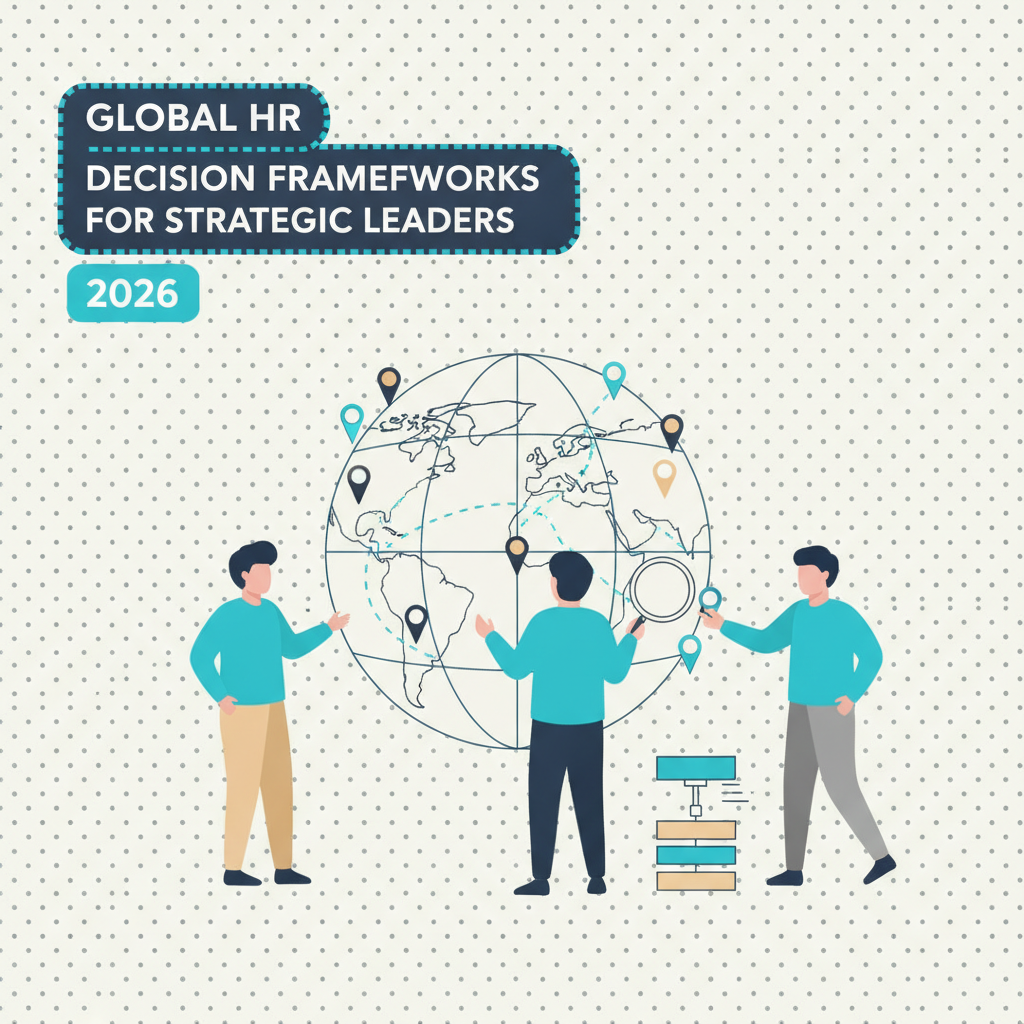
As multinational teams scale across regions and regulations shift overnight, strategic leaders increasingly rely on global HR decision frameworks to align policy, culture, and compliance before committing resources. TL;DR
- Most global HR failures aren’t compliance failures. They’re operating model failures, chosen before anyone understood the market.
- According to Mercer’s 2024 Global Talent Trends report, 58% of HR leaders say their current global operating model doesn’t match their workforce distribution.
- Companies that misclassify their global operating model spend an average of 23% more on people operations per employee in international markets, based on PwC Workforce benchmarking data.
- The right decision framework depends on three factors: workforce concentration, local compliance complexity, and whether HR is a cost center or a growth driver in that market.
- Run the four-quadrant operating model test in Block 10 before committing to a global HRIS rollout or EOR contract renewal.
- Deloitte’s 2025 Human Capital Trends report found that 67% of companies operating in five or more countries run at least two conflicting HR operating models simultaneously without realizing it.
In early 2024, a 900-person fintech company headquartered in Singapore decided to standardize its global HR operations. They had teams in the UK, Brazil, Germany, and the Philippines. The CHRO, under pressure from the CFO to cut costs, rolled out a single Workday configuration globally, hired a regional HR Business Partner for APAC, and declared the model done. By Q3, German works council negotiations had stalled because no one owned local consultation rights, Brazilian payroll was running two weeks late due to eSocial misconfigurations, and two senior engineers in Berlin had resigned citing the “impersonal and automated” onboarding they’d received. Total cost: approximately $340,000 in payroll penalties, legal fees, and replacement hiring.
That story isn’t unusual. McKinsey’s 2024 People & Organization research found that 54% of companies expanding internationally report their HR operating model as a top-three barrier to growth within the first 18 months of entering a new market.
Best tools for Global HR
This article breaks down four global HR operating model archetypes, extracts the decision criteria separating high-performing from broken global HR functions, and gives you a practical selection framework to match your model to your market reality.
Why Global HR Is Still Broken in 2026
Operating model chosen before market entry: Most companies choose their global HR structure reactively, after they’ve already hired in a new country. A 1,400-person US-based SaaS company I’ve followed expanded into Poland and Colombia simultaneously in 2023 by extending their existing HR Business Partner model with no local presence. Within six months, they had misclassified seven contractors in Colombia, triggering a back-payment liability of approximately $180,000. The operating model hadn’t been designed for those markets. It had been copy-pasted.
Compliance complexity consistently underestimated: According to SHRM’s 2024 Global HR Competencies survey, 61% of HR leaders rated their team’s cross-border employment law knowledge as “moderate” or below at the time they entered a new market. That’s not a talent problem in isolation. It’s a structural one. Companies enter Germany without understanding co-determination rights, Brazil without accounting for CLT rigidities, or Japan without recognizing that termination without cause is practically impossible. The gap between what the operating model assumes and what local law requires is where liability accumulates.
Technology decisions made ahead of strategy: The single most common pattern I see is an HRIS selected globally before anyone has decided whether HR in each market is centralized or federated. When the system enforces a single workflow, it breaks local processes that exist for legal, not operational, reasons. The measurable consequence: average time-to-hire increases by 31% in the 12 months following a forced global HRIS rollout in markets with previously localized systems, according to Gartner’s HR Technology Benchmarking data from 2024.
Each of these failures points to the same root cause: strategy chosen after the fact rather than before. The rest of this article gives you the frameworks to reverse that sequence.
What Is a Global HR Operating Model?
A global HR operating model is a strategic structure that defines how HR decisions, services, and accountability are distributed across an organization’s international markets. It determines who owns compliance, who owns employee experience, and how those two responsibilities interact when they conflict.
In practice, a global HR operating model plays out in a sequence of decisions most companies make without naming them:
- Decide which HR functions are globally standardized versus locally owned.
- Assign accountability for compliance, payroll, and employee relations in each market.
- Select technology infrastructure that can support the chosen distribution of authority.
- Define escalation paths when local law conflicts with global policy.
- Build review cadences to update the model as headcount and market conditions shift.
Getting this sequence right means you spend less time putting out compliance fires and more time building the talent infrastructure that actually drives growth in each market.
Why Global HR Fails (Even With Enterprise-Grade Tools)
No accountability system: Global HR functions routinely fail not because no one cares, but because no one owns a specific outcome in a specific market. When a German works council request hits a centralized HR Ops team in Austin, it gets logged as a ticket. It doesn’t get escalated to someone who knows that a failure to respond within three weeks triggers a legal consultation right. Accountability diffused across a shared services center and a regional HRBP creates a gap where nothing falls until something breaks. Accountability gaps compound over months into systemic legal and operational errors that are three to five times more expensive to unwind than they were to prevent.
No specialized expertise: Most mid-market HR functions don’t have deep in-country employment law expertise, and they don’t know they need it until they’re in a dispute. Deloitte’s 2024 Global Human Capital Trends report found that 49% of HR teams at companies with 500 to 2,000 employees lack dedicated legal expertise for their two largest non-HQ markets. That’s not a training problem. It’s a resourcing model problem. Running global HR on generalist HR Business Partners who rotate markets every two years guarantees a recurring knowledge gap at exactly the moment a new country manager is making headcount decisions.
No lifecycle tracking: Global HR models are built for a company’s structure at a point in time. A company that entered France with 10 employees under an EOR arrangement and now has 80 is almost certainly paying 40% more per employee than a direct entity would cost, and nobody has done the math because nobody owns the model review. According to Gartner’s 2024 HR Shared Services benchmarking, only 31% of companies formally review their global HR operating model on an annual cycle. The rest are running a 2021 model on a 2026 workforce.
No compliance discipline: GDPR enforcement actions against HR data practices increased 34% between 2022 and 2024, according to the European Data Protection Board’s annual report. In the US, state-level pay transparency laws now cover employees in California, New York, Colorado, Washington, and Illinois, each with distinct disclosure requirements. A global HR function without a compliance calendar tied to the operating model will miss these changes until an employee files a complaint or a regulator issues a notice. Penalties under GDPR alone can reach 4% of global annual revenue for systemic violations.
The gap between running global HR and running it with discipline is where every major failure described in this article occurred.
What to Look For in Global HR Decision Frameworks
Clear ownership at the market level: Every country or region where you employ people should have a named owner for three things: compliance decisions, employee relations escalations, and payroll accuracy. That owner doesn’t have to be an in-country employee. But they have to be identifiable and reachable. Shared ownership is no ownership. If you can’t name the person who fields a German works council inquiry on a Tuesday afternoon, you don’t have an operating model. You have a spreadsheet.
A defined review cadence tied to headcount thresholds: Your operating model should trigger a formal review at three inflection points: when a market crosses 25 employees, when it crosses 75, and when it crosses 200. These thresholds represent the points at which EOR economics shift, local entity costs become competitive, and HRBP coverage ratios change. Build the review into your annual people planning cycle, not as a one-time project but as a standing governance checkpoint.
Security and compliance certifications for supporting technology: Any global HR technology stack you rely on should carry SOC 2 Type II certification at minimum, with ISO 27001 for companies processing data across EU borders. If you employ people in the EU, GDPR Article 28 requires documented data processing agreements with every third-party vendor touching employee data. Audit your current vendor agreements against this requirement. In our experience across HR technology assessments, roughly 40% of mid-market companies have at least one global HR vendor without a current DPA on file.
Integration without data duplication across HRIS and payroll: A global HR operating model breaks down when employee data lives in different systems that don’t talk to each other. Your framework should specify which system of record owns which data type, and no employee record should require manual reconciliation between Workday and ADP GlobalView, or between BambooHR and a local payroll provider like Payfit in France or Sage in the UK. Data duplication is not an IT problem. It’s a governance failure that your operating model should explicitly prevent.
A pilot architecture before full rollout: Before you roll out any new global HR model configuration, test it in one market for 60 to 90 days with a defined set of success criteria. Typical pilot metrics include time-to-resolution for employee queries, payroll error rate, and HRBP response time. A model that works in Canada may require significant adaptation for Mexico or Singapore. The 90-day pilot is the cheapest governance tool available, and most companies skip it.
Transparent cost modeling tied to market headcount: Your operating model should have a cost model attached. EOR fees, local entity maintenance costs, HRBP fully loaded cost per employee, and payroll processing costs per pay cycle should all be visible and comparable across markets. If your cost per employee in Germany is 2.3x your cost in Poland for the same role complexity, that’s either a market reality or a model inefficiency. You can’t tell the difference without the numbers.
Post-implementation support with named escalation paths: Whether you’re working with a global PEO, an HRIS vendor, or an employment law firm, your support model should include a named relationship owner, a quarterly review cadence, and a documented escalation path for compliance emergencies. A 48-hour SLA for routine queries is table stakes. What matters is the path when a labor authority contacts your company in a market where your regional HRBP is on leave. That path should exist before you need it.
Best Global HR Operating Model Frameworks and Platforms in 2026
Rippling
Rippling is a workforce management platform that connects HR, IT, and Finance into a single employee record, making it one of the few tools built to support a globally distributed operating model without requiring manual reconciliation between systems.
Rippling’s architecture is built around a single source of truth for employee data, which it uses to automate downstream actions across payroll, benefits, device management, and app provisioning. For global teams, it supports payroll in over 50 countries either natively or through its Employer of Record network. Its Global Payroll product allows companies to run payroll in multiple currencies from a single interface, with country-specific compliance rules built into the workflow rather than bolted on. Rippling serves over 10,000 companies globally, with a strong concentration in tech and professional services firms at the 100-to-2,000 employee range.
Key Features
- Single employee record synced across HR, IT, and Finance globally
- Native payroll in 50+ countries with built-in compliance rule sets
- Automated onboarding workflows triggered by country-specific employment type
- Global workforce analytics with headcount, cost, and attrition by market
- Native integrations with Greenhouse, Lever, NetSuite, Slack, and Google Workspace
Best For
Tech-forward companies at 100 to 1,500 employees running distributed teams across multiple countries who need a single platform to replace a patchwork of country-specific HR tools. Ideal buyer is a Head of People Ops or VP HR who is also de facto managing IT provisioning.
Pricing
Rippling uses modular pricing. Core HR starts at approximately $8 per employee per month. Global payroll and EOR services are priced separately and scale with headcount and country count. Custom pricing for companies above 500 employees. Confirm current rates on Rippling’s website before budgeting.
Where It Struggles
Rippling’s strength is breadth, not depth. In markets with high compliance complexity, like Germany, Brazil, or Japan, the platform’s built-in rule sets cover the basics but won’t replace a local employment lawyer. Implementation for companies with existing HRIS data in multiple formats can take four to six months and requires dedicated internal project ownership. Companies that need deep Works Council support documentation or union negotiation workflows will need to supplement with local counsel regardless.
Deel
Deel is a global HR and payroll platform built specifically for companies hiring internationally, either through direct employment, contractor agreements, or Employer of Record arrangements. It’s designed for speed and compliance in new market entry scenarios.
Deel operates its own legal entities in over 100 countries, which means it can onboard an employee in a new market within days rather than weeks. Its compliance layer includes localized employment contracts, automated tax calculations, and mandatory benefit configurations for each jurisdiction. For companies running a distributed HR model where local HR ownership isn’t feasible, Deel acts as the de facto HR infrastructure layer. It processes payroll for over 35,000 companies across 150 countries, and its compliance database is updated in near-real-time as labor laws change. Deel also offers an HRIS module for companies that want to consolidate employee data without using it as an EOR.
Key Features
- EOR services in 100+ countries with owned legal entities, not third-party partners
- Automated compliance updates when local labor laws change mid-contract
- Built-in equity management for global stock option grants and vesting schedules
- Contractor-to-employee conversion workflow with misclassification risk scoring
- Integrations with Workday, BambooHR, Personio, QuickBooks, and Xero
Best For
Companies at 50 to 1,000 employees entering new international markets quickly and needing compliant employment infrastructure without setting up local entities. Especially strong for companies with a significant contractor workforce they’re converting to employment in high-risk misclassification jurisdictions like Brazil, Spain, or Australia.
Pricing
EOR services typically start at approximately $599 per employee per month. Contractor management starts at around $49 per contractor per month. Global payroll for companies with existing entities starts at approximately $29 per employee per month. Confirm pricing tiers on Deel’s website, as they change with market conditions.
Where It Struggles
Deel’s EOR model means the legal employer is Deel, not your company. In some markets, that creates friction with employees who want a direct employment relationship with your brand. High-volume hiring in a single country (above 75 to 80 employees) typically makes a direct entity more cost-effective, and Deel doesn’t proactively flag that threshold for you. Its HRIS module is newer and less mature than Rippling’s or Personio’s. Customer support quality varies significantly by region; APAC and LATAM support response times have drawn criticism in multiple third-party reviews.
Personio
Personio is an HRIS and payroll platform built for European mid-market companies, with particular depth in German-speaking markets, the UK, Spain, and the Netherlands. It’s the default choice for companies whose primary workforce is in Europe.
Personio covers the full HR lifecycle from recruiting through offboarding, with payroll available natively in Germany, Austria, and Spain, and through payroll partners in the UK and Netherlands. Its compliance features are tuned for European employment law, including GDPR data management workflows, works council documentation support in Germany, and SEPA payroll processing. Personio serves over 14,000 companies across Europe, predominantly in the 50 to 2,000 employee range. Its reporting module allows HR leaders to track headcount, turnover, and absence across markets in a single dashboard, which makes it useful for companies consolidating fragmented European HR data for the first time.
Key Features
- Native payroll processing in Germany, Austria, and Spain with automatic tax filings
- Works council documentation workflows built into German compliance module
- GDPR-native data architecture with automatic data retention and deletion rules
- Absence and time tracking with country-specific leave law configurations
- Integrations with Greenhouse, Workday (for companies using Workday globally), Slack, and Datev
Best For
European-headquartered companies at 50 to 1,500 employees, or US and UK companies with significant European headcount who need a compliant HRIS that understands European employment law by default. Ideal buyer is an HR Director managing DACH, Benelux, or Iberian markets who is tired of bending a US-built HRIS to fit European compliance requirements.
Pricing
Personio uses a modular pricing model starting at approximately 4 euros per employee per month for core HR, with payroll, performance, and recruiting modules priced separately. Enterprise pricing for companies above 500 employees is custom. Verify current pricing on Personio’s website before budgeting.
Where It Struggles
Personio’s depth is almost entirely European. If you have significant headcount in APAC, LATAM, or North America, you’ll need a second system. Its recruiting module is functional but not competitive with dedicated ATS platforms like Greenhouse or Lever for high-volume hiring. Implementation timelines for companies migrating from legacy HR systems average three to five months. Customer success quality is strong in Germany and the UK but thinner in newer markets like France and the Netherlands.
Workday HCM
Workday HCM is the enterprise standard for global HR at companies with 500 or more employees. It’s the platform that large, complex organizations turn to when they need a single system of record across dozens of countries and thousands of employees.
Workday’s strength is configurability. Its global payroll framework supports over 40 countries natively, with a partner ecosystem covering another 100-plus through certified payroll partners. For companies running a federated HR model, Workday allows different business units to maintain distinct workflows while feeding into a unified reporting layer. Its workforce planning module, recently expanded with AI-driven scenario modeling, allows CHROs to model headcount and cost across geographies before making hiring decisions. Workday serves more than 10,000 organizations globally, including a significant share of Fortune 500 companies. The platform’s reporting capabilities are genuinely best-in-class for organizations with complex org structures.
Key Features
- Global payroll in 40+ countries with a certified partner network covering 100+ more
- AI-driven workforce planning with scenario modeling across geographies
- Configurable business process frameworks for federated and centralized HR models
- Native skills intelligence layer for workforce capability mapping across markets
- Deep integrations with SAP, Oracle, ADP GlobalView, iCIMS, and Greenhouse
Best For
Companies at 500 or more employees operating in multiple countries who need enterprise-grade reporting, complex org structure support, and a platform that can serve as a single source of truth for the CFO and CHRO simultaneously. Ideal buyer is a CHRO or VP of HR Technology at a company with at least five international markets.
Pricing
Workday is enterprise-priced. Based on public reporting and customer disclosures, annual contracts typically start at $400,000 to $600,000 for companies at 1,000 employees, scaling with headcount and module count. Confirm pricing through a Workday account executive. This is not a platform you evaluate without a dedicated procurement process.
Where It Struggles
Workday’s implementation timelines are long. Typical global rollouts take 12 to 24 months and require a dedicated internal project team plus a certified implementation partner. Total cost of ownership, including implementation, customization, and annual support, routinely runs 3x to 4x the base license cost. Small and mid-market companies frequently find that Workday’s configurability becomes a burden rather than a benefit when their HR team doesn’t have the bandwidth to maintain it. The platform rewards investment. It punishes underresourcing.
Remote
Remote is a global employment and payroll platform focused on helping companies hire full-time employees and contractors internationally without setting up local entities, with a particular emphasis on transparency and employee experience in distributed teams.
Remote owns its legal entities in over 75 countries and differentiates itself from competitors by not using third-party EOR partners in any of its core markets. For HR leaders managing a globally distributed workforce where employee trust and benefit quality matter as much as compliance, Remote’s benefits administration is notably strong. It offers locally competitive benefits packages in each market, benchmarked against local standards rather than a global minimum. Remote serves over 15,000 companies across 180 countries. Its IP protection framework, which includes an IP assignment agreement built into every employment contract, addresses a risk that most EOR platforms handle inconsistently.
Key Features
- Owned legal entities in 75+ countries with no third-party EOR subcontracting
- IP protection agreements built into every employment contract by default
- Locally benchmarked benefits packages in each market, not a global minimum floor
- Automated contractor misclassification risk assessment tool
- Integrations with BambooHR, Personio, Workday, Xero, and QuickBooks
Best For
Companies at 25 to 500 employees building a globally distributed team where employee experience and IP protection are top priorities. Especially well-suited for tech companies with engineering talent in Eastern Europe, Latin America, or Southeast Asia where misclassification risk is high and benefits parity matters for retention.
Pricing
Remote’s EOR service starts at approximately $599 per employee per month. Contractor management is available at approximately $29 per contractor per month. Global HRIS is available as a standalone product starting at approximately $6 per employee per month for companies with existing entities. Confirm current pricing on Remote’s website.
Where It Struggles
Remote’s platform is strongest in its top 30 to 40 markets. In smaller or more complex jurisdictions, service quality and response times are less consistent. Its HRIS functionality is basic compared to Rippling or Personio. Companies needing deep workforce analytics or performance management will need a separate tool. Remote also doesn’t offer a co-employment model for companies that want to maintain direct employer relationships while outsourcing payroll administration.
Comparison Table of Top Global HR Platforms in 2026
These five platforms don’t compete in the same way. The right choice depends on your market footprint, headcount, and whether you need employment infrastructure, HR management, or both.
| Provider | Primary Use Case | Company Size | Starting Price | GDPR Ready | Best For |
|---|---|---|---|---|---|
| Rippling | Global HRIS and payroll unification | 100-2,000 | ~$8/employee/month | Yes | Tech companies consolidating HR and IT globally |
| Deel | EOR and global contractor management | 50-1,000 | ~$599/employee/month (EOR) | Yes | Fast international expansion without local entities |
| Personio | European HRIS and payroll | 50-1,500 | ~4 EUR/employee/month | Yes | European-focused companies needing DACH compliance depth |
| Workday HCM | Enterprise global HCM and planning | 500+ | ~$400K/year (enterprise) | Yes | Large enterprises needing a single global system of record |
| Remote | EOR with employee experience focus | 25-500 | ~$599/employee/month (EOR) | Yes | Distributed teams prioritizing IP protection and benefits parity |
Global HR Operating Models vs. Country-by-Country HR Management
A global HR operating model defines a consistent framework for how HR decisions get made across all markets. Country-by-country HR management, the default at most growing companies, means each market builds its own HR approach independently. The difference isn’t philosophical. It’s financial and operational. Country-by-country management creates compliance arbitrage risk, benefit inequity, and a data landscape that makes workforce planning across geographies nearly impossible.
| Factor | Country-by-Country HR Management | Global HR Operating Model |
|---|---|---|
| Core function | Reactive compliance and payroll per market | Strategic workforce architecture across all markets |
| Services included | Local payroll, basic contracts, ad hoc ER support | Centralized policy, local execution, unified reporting |
| Integrations | Separate tools per country, manual reconciliation | Single HRIS or federated system with shared data standards |
| Visibility | No cross-market headcount or cost view | Real-time workforce analytics across all geographies |
| Automation | Manual processes, high admin burden per market | Automated compliance triggers, workflow standardization |
The decision point: country-by-country management works when you have fewer than three international markets and total international headcount under 50. It’s cheaper to set up and faster to execute in the short term. But it doesn’t scale. Every new country adds a new silo, a new payroll vendor, a new compliance risk, and a new gap in your workforce data. At 150 or more international employees across four or more markets, the cumulative cost of fragmentation (in admin time, compliance errors, and reporting gaps) typically exceeds the cost of implementing a global model. At 500 or more employees with multi-country operations, the volume of compliance obligations and workforce data signals exceeds what any team can manage without a coherent operating model underneath them.
How to Choose the Right Global HR Operating Model
Match your situation with the right platform:
| Your Situation | Best Fit | Also Consider | Avoid | Why |
|---|---|---|---|---|
| Entering 3+ new countries in the next 12 months, no local entities | Deel | Remote | Workday | EOR speed matters more than platform depth at this stage |
| European HQ with 200+ employees across DACH, UK, and Spain | Personio | Rippling | Workday | Personio’s European compliance depth reduces legal exposure cost |
| US-based tech company with distributed team across 8+ countries | Rippling | Deel | Personio | Rippling’s unified HR-IT model fits distributed tech teams well |
| 1,000+ employees across 10+ countries needing board-ready workforce analytics | Workday | Rippling | Remote | Workday’s reporting depth justifies enterprise cost at this scale |
| 50-person company with contractors in 5 countries at misclassification risk | Remote | Deel | Workday | Remote’s IP protection and compliance tooling addresses the specific risk |
Final Thoughts
The core thesis of this article is simple: global HR fails at the operating model layer, not the technology layer. Global HR is not a payroll problem. It is a governance problem that payroll vendors keep selling solutions for.
Companies under 200 employees with international headcount should run the 25-75-200 headcount threshold review described in Block 6 before committing to any global HR platform. The decision between EOR and direct entity is a financial model question, not a vendor relationship question. At 500 or more employees operating across five or more countries, you need a formal operating model document, a named market owner for each major jurisdiction, and a quarterly review cadence. Without those three things, your HRIS is just an expensive spreadsheet.
Every case study in this article, the Singapore fintech, the US SaaS company in Poland and Colombia, shares one pattern. Decisions were made in sequence: enter market, hire people, then figure out HR. That sequence guarantees reactive compliance, patchwork tooling, and a cost structure nobody owns. The companies that build global HR functions that actually work reverse the sequence. They define the operating model first, then select the tools that support it, then enter the market. The framework in Block 6 and the decision matrix in Block 10 are designed to force that reversal before it’s too late.
The most defensible starting point for most companies at the 100 to 500 employee range is Rippling, because its single-record architecture forces data governance discipline from day one and integrates with the payroll and EOR tools you’ll need as you scale into more complex markets. Start with Rippling for your HR backbone, layer Deel or Remote for EOR in new markets, and graduate to Workday when your international headcount and reporting requirements justify the implementation investment. Revisit your global HR stack every 12 to 18 months. New market entries, regulatory changes like the EU AI Act’s workforce provisions, and headcount crossing the 75-employee threshold in any single country mean last year’s right answer may not be next year’s.
Building a Governance Council That Actually Owns the Global HR Operating Model
A global HR operating model without a governance body is a policy document, not a functioning system. The companies that avoid the Berlin resignations and eSocial payroll delays described above share one structural feature: a standing governance council that meets on a fixed cadence, holds real decision authority, and includes people who are personally accountable when something breaks.
Who sits on the council
A working governance council typically has five seats: the global Head of HR or CHRO as chair, a regional HRBP or country lead for each market above 25 employees, a payroll or HR Ops lead, in-house or outside employment counsel for the top three non-HQ markets, and a finance partner who tracks per-employee cost by country. Fewer than five seats means gaps in accountability. More than eight and decisions stall.
What the council actually decides
- Escalation ownership: who has 48 hours to respond to a works council notice, a regulator inquiry, or a pay transparency complaint before it becomes a legal matter.
- Policy exceptions: when a local law requirement conflicts with global policy, the council rules within five business days, not after the fact.
- Vendor and EOR renewal timing: contracts are reviewed 90 days before auto-renewal, tied to the headcount thresholds covered elsewhere in this framework.
- Model drift: quarterly review of which markets have quietly reverted to shadow processes outside the documented operating model.
Cadence and documentation
Meet monthly for the first year after any operating model change, then quarterly once the model stabilizes. Every meeting produces a written decision log with the issue, the owner, the deadline, and the resolution. Without a log, councils become discussion forums that repeat the same unresolved problem for six months, which is exactly what happened in the fintech case where German works council negotiations stalled with no documented owner.
The escalation matrix
Attach a RACI matrix to the council charter that names, for each country, who is Responsible for day-to-day HR execution, who is Accountable for compliance outcomes, who must be Consulted before policy exceptions, and who is merely Informed. Publish this matrix to every people manager, not just HR. Line managers are usually the first to notice a compliance gap, and if they don’t know who to call, the gap sits unaddressed until it triggers a penalty or a resignation.
Councils fail when they exist on paper but never convene, or when attendance is delegated downward until no one in the room has authority to commit budget or override a vendor contract. Treat governance council membership as a named role in the operating model itself, reviewed at the same 25, 75, and 200 employee thresholds that trigger a full operating model reassessment.
Cost Modeling: Comparing EOR, Local Entity, and Hybrid Spend Inside One Operating Model
Every global HR operating model eventually collides with a cost question: at what headcount does an Employer of Record arrangement become more expensive than a local entity, and does the operating model actually track that number? Most companies never build this model at all, which is how a company can end up paying 40% more per employee in a market than a direct entity would cost without anyone noticing.
Building the per-employee cost baseline
Start by calculating a fully loaded per-employee cost for each market under your current structure: EOR service fees, statutory contributions, benefits administration, HR Ops overhead allocated by headcount, and any compliance consulting fees paid in the past twelve months. Compare that figure against a projected local entity cost, which includes entity registration and maintenance, in-country payroll processing, statutory filings, and a fractional in-country HR resource. Below is a simplified comparison structure to adapt to your own markets.
| Headcount in market | Typical EOR cost driver | Typical entity cost driver | Usual crossover point |
|---|---|---|---|
| 1-15 | Per-employee monthly fee | High fixed setup cost | EOR favored |
| 16-50 | Fee scales linearly with headcount | Fixed costs amortize | Break-even zone |
| 50+ | Fee remains linear, no economies of scale | Fixed costs fully absorbed | Entity favored |
Currency and compliance risk adjustments
Raw cost comparisons undercount risk. Add a compliance risk premium for markets with high misclassification exposure, such as Brazil or Colombia, and a currency volatility buffer of at least 5-10% for markets with historically unstable exchange rates. A model that only compares nominal fees will systematically undervalue entity conversion in high-risk jurisdictions.
Who owns the recalculation
Assign the finance partner on the governance council to rerun this comparison every time a market crosses the 25, 75, or 200 employee thresholds, and annually regardless of headcount movement. Feed the output into the operating model review, not into a separate finance-only spreadsheet that HR never sees. The two most common failure modes are letting an EOR contract auto-renew past its economic break-even point, and converting to an entity prematurely in a market where headcount growth stalls and fixed costs never amortize. Both failures are avoidable with a documented, recurring cost model tied directly to the operating model’s review cadence rather than treated as a one-time procurement decision.
Related reading
Frequently Asked Questions
How often should a global HR operating model be formally reviewed?
Review it at three fixed headcount thresholds per market: 25, 75, and 200 employees, plus an annual review regardless of growth. These points mark where EOR economics shift, entity costs become competitive, and HRBP coverage ratios change. Companies that skip this cadence typically run an outdated model years after their workforce distribution has changed, accumulating cost and compliance gaps.
Who should sit on a global HR governance council?
A working council needs five roles: the CHRO or global HR head as chair, country or regional HRBP leads, a payroll or HR Ops lead, employment counsel covering the top non-HQ markets, and a finance partner tracking per-employee cost. Fewer seats leaves accountability gaps; more seats slows decisions. Each seat must have real authority, not just attendance.
At what headcount does a local entity usually beat an EOR on cost?
There's no universal number, but many markets cross over somewhere between 25 and 75 employees, once fixed entity setup and maintenance costs amortize below the linear per-employee EOR fee. The exact point depends on local statutory costs, compliance risk, and currency volatility, so it should be recalculated per market rather than assumed from a benchmark.
What happens if no one owns escalation for local compliance issues?
Issues get logged as generic tickets instead of routed to someone who understands local legal deadlines, such as works council consultation windows. Accountability gaps compound over months into larger legal and financial problems that are far more expensive to resolve than they would have been to prevent early, as seen in cases involving stalled negotiations and payroll penalties.
Should HR technology decisions come before or after the operating model is defined?
The operating model should always come first. Selecting a global HRIS before deciding which functions are centralized versus locally owned forces a single workflow onto markets with different legal requirements, breaking processes that exist for compliance reasons. This sequencing error is a leading cause of increased time-to-hire and local process failures after global rollouts.
How do currency and compliance risk affect global HR cost comparisons?
Nominal cost comparisons between EOR and entity models understate real risk if they ignore currency volatility and compliance exposure. Add a risk premium for high-misclassification markets and a currency buffer of roughly 5-10% for volatile currencies before comparing options. Skipping this step leads companies to undervalue entity conversion in markets where legal and financial risk is actually highest.