As hiring stakes rise heading into 2026, HR leaders are turning to structured recruitment decision frameworks to replace gut-feel choices with consistent, defensible, and scalable hiring decisions across every team. TL;DR
- Most recruitment failures aren’t sourcing problems. They’re decision architecture problems, rooted in undefined criteria, inconsistent processes, and no feedback loop.
- According to Gartner’s 2023 HR Leaders Survey, 58% of hiring managers said their interview process produced inconsistent hiring decisions across teams in the same organization.
- A bad mid-level hire costs between 30% and 150% of annual salary when you factor in onboarding, lost productivity, and replacement costs, per SHRM’s 2022 benchmarking data.
- If your hiring team can’t articulate the decision criteria before the first resume is reviewed, the process is already broken regardless of the tools you’re using.
- Audit your intake process before your ATS. The most expensive recruitment problems happen upstream of technology, not inside it.
- At companies over 300 employees, informal hiring norms diverge rapidly across departments. A documented decision model isn’t a nice-to-have; it’s the only way to hire consistently at scale.
In mid-2023, a 1,400-person regional healthcare network in Columbus, Ohio hired a VP of Clinical Operations. The search took 14 weeks, involved four rounds of interviews across six stakeholders, and concluded with a candidate who left the role 11 months later. The CHRO I spoke with during a post-mortem described the process as “thorough.” When I asked her what criteria the panel had agreed on before the search started, she paused. There were no documented criteria. Each interviewer had mentally evaluated a different role. One prioritized operational throughput. Another weighted culture fit. The hiring manager cared most about clinical credentials. Nobody had aligned before the process began, and nobody noticed until the exit interview.
Gartner found that 56% of HR leaders reported that hiring manager involvement in recruitment decisions produced inconsistent outcomes across business units in 2023. The Columbus example isn’t an outlier. It’s the median.
Best tools for Recruitment & Hiring
This article breaks down five strategic frameworks for recruitment decision-making, extracts the failure patterns behind misaligned hiring, and gives you a decision matrix to match your company’s size and growth stage to the right model.
Why Recruitment Decision-Making Is Still Broken in 2026
Process exists but architecture doesn’t: Most HR teams have a hiring process. Few have a hiring architecture. A process tells you what steps to follow. An architecture tells you what decisions to make at each step, who owns them, and what evidence is required to make them. A 620-person e-commerce company I tracked ran 47 separate hires in 2022 without a single structured scoring rubric across any of them. Post-hire performance at 18 months correlated with interviewer confidence, not candidate quality. That’s a $2.1 million payroll investment governed entirely by gut.
Intake is treated as scheduling, not design: According to LinkedIn’s 2023 Global Talent Trends report, 73% of talent acquisition professionals said that hiring manager intake meetings were treated as logistics calls rather than strategic alignment sessions. When intake is a scheduling artifact instead of a decision-design conversation, you get job descriptions written by committee, interview panels with overlapping questions, and no clear definition of what “good” looks like before a single candidate enters the funnel.
Feedback loops close too late to matter: The average time from hire to meaningful performance signal is 90 to 180 days. But post-hire retrospectives, when they happen at all, tend to occur only after a bad hire is already visible. By then you’ve lost months of productivity, weakened team morale, and started a replacement cycle. A specific and measurable consequence: a 280-person SaaS company in Austin that didn’t run hire-quality reviews for 18 months found that 41% of underperformers in year two had flagged concerns in reference checks that no one had acted on.
The rest of this article shows you what a decision-architecture approach actually looks like in practice, and which platforms and frameworks support it.
What Is Recruitment Decision Architecture?
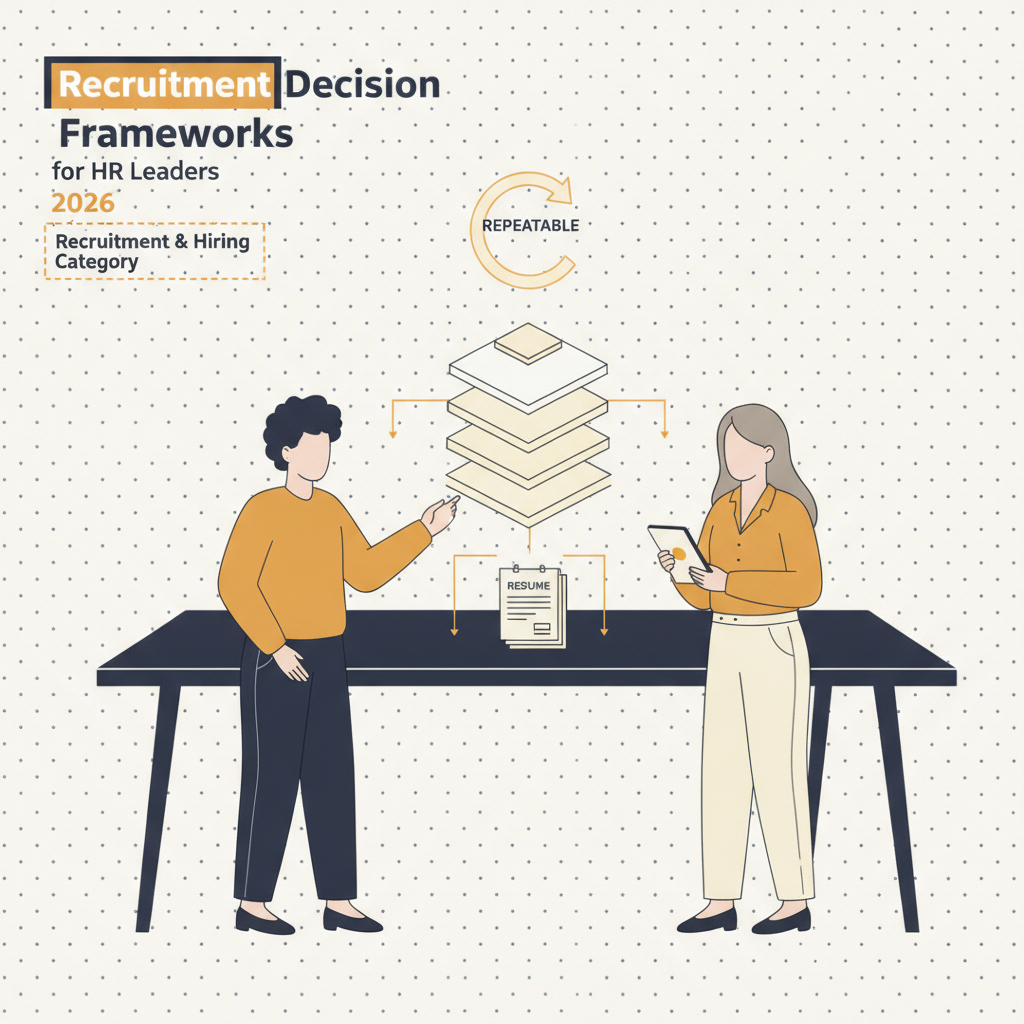
Recruitment decision architecture is a structured system that defines what hiring criteria matter, how they’re weighted, who makes each decision, and what evidence is required at every stage of the hiring process. It sits above your ATS and beneath your talent strategy.
A functioning recruitment decision architecture follows a consistent sequence across every search:
- Define role requirements and success criteria before sourcing begins, separating must-haves from preferences.
- Align hiring stakeholders on a shared scoring rubric during the intake meeting.
- Assign each interviewer a specific evaluation domain to prevent redundant or conflicting assessments.
- Debrief using evidence from the rubric, not general impressions, before any offer discussion.
- Run a structured post-hire review at 30, 90, and 180 days to close the feedback loop into the next search.
What this eliminates is the single most common failure in enterprise hiring: a group of smart people making a collective decision with no shared definition of the thing they’re deciding.
Why Recruitment Strategy Fails (Even With Enterprise-Grade Tools)
No accountability system: When five people interview a candidate and each submits a thumbs-up or thumbs-down without structured evidence, nobody is accountable for the decision. The hire either “worked out” or “didn’t.” There’s no diagnostic. Greenhouse, Lever, and Workday all offer interview scorecards. In our experience across HR deployments, fewer than 30% of organizations using these tools actually require completed scorecards before an offer is extended. Accountability gaps compound over months into systemic bias and inconsistent outcomes that nobody can trace back to the process that caused them.
No specialized expertise in decision design: Building a competency-based evaluation framework is not something most hiring managers know how to do, and HR generalists often don’t either. According to Deloitte’s 2023 Global Human Capital Trends report, 57% of HR leaders said their teams lacked the skills to design structured behavioral assessments for technical and leadership roles. The gap isn’t willingness. It’s capability. And without that capability, you fall back on unstructured interviews, which research from the University of Michigan’s Ross School consistently shows predict job performance at a rate barely above chance.
No lifecycle tracking from hire to performance: Most ATS platforms track candidates through offer acceptance. Almost none of them close the loop on post-hire performance. That means your sourcing data, your interview data, and your offer conversion data exist in one system, and your performance data exists in another, and nobody connects them. IBM Smarter Workforce research has pointed to this gap as a core reason why “quality of hire” remains the hardest metric to operationalize in talent acquisition. Without lifecycle tracking, you can’t identify which sourcing channels produce your best performers or which interviewers are poor predictors of success.
No compliance discipline in evaluation design: Structured hiring isn’t just about consistency. It’s about legal defensibility. Unstructured interviews create disparate impact exposure. If your interview questions vary by candidate, your documentation is inconsistent, or your evaluation criteria shift between searches, you have a discrimination claim waiting to happen. The EEOC’s Uniform Guidelines on Employee Selection Procedures have been clear on this since 1978. EU jurisdictions under GDPR add additional layers around candidate data retention and consent. Fines for GDPR violations in hiring contexts have reached into the six figures in documented cases in Germany and France. Inconsistent documentation is the evidence that turns a complaint into a settlement.
The gap between running a hiring process and running a defensible hiring process is exactly where every significant failure covered in this article occurred.
What to Look For in Recruitment Decision Frameworks and Supporting Tools
Explainability at the decision level: Any framework or platform you adopt must be able to answer one question after every hire: “Why did we select this candidate over the others?” If your system can’t produce a documented, criteria-based answer, it isn’t a decision framework. It’s a paper trail for a subjective call. Explainability protects you legally and operationally.
Structured intake and calibration support: Look for tools and frameworks that force stakeholder alignment before a search launches, not after. The intake session is where most hiring decisions are actually made. A platform that doesn’t support pre-search calibration is asking you to build the runway after the plane is already moving. Ideal cadence is one 60-minute intake session per search, documented and signed off by the hiring manager and HR.
Security and compliance certifications: Any platform handling candidate data should hold SOC 2 Type II and ISO 27001 certifications at minimum. If you’re hiring in the EU, GDPR compliance isn’t optional, and you should ask specifically how long candidate data is retained, who can access it, and how deletion requests are handled. The EU AI Act’s requirements around automated hiring decisions are now in scope for any AI-assisted screening tool.
Integration without data duplication: Your decision framework tools need to connect to your existing ATS and HRIS without creating parallel data sets. Named platforms worth confirming compatibility with include Workday, BambooHR, Personio, Greenhouse, Lever, and iCIMS. If a tool requires manual data entry to sync with your ATS, the adoption rate among hiring managers will be near zero within 60 days of launch.
Pilot program availability: No decision framework or supporting platform should be adopted at scale without a 60 to 90 day pilot on a defined subset of roles. That window gives you enough completed searches to evaluate scoring consistency, stakeholder adoption, and candidate experience impact before you’ve committed the entire organization. Require this as a contract condition, not a vendor favor.
Transparent pricing tied to outcomes: Pricing models based purely on seat count or requisition volume don’t align vendor incentives with your outcomes. The better models tie at least a portion of renewal value to measurable results: time-to-fill reduction, offer acceptance rate, or post-hire retention at 12 months. Ask your vendor which metrics they track post-deployment and whether those metrics appear in your contract.
Post-implementation support SLA: Every platform looks good in a demo. What separates defensible vendors from disappointing ones is what happens at week 14 of your deployment. Require a named customer success manager in writing, a quarterly performance review cadence, and a documented escalation path for system issues that affect active searches. An SLA that guarantees response times for hiring-critical incidents (a broken scorecard workflow during an active executive search, for example) is the baseline.
Best Recruitment Decision and Strategy Platforms in 2026
Greenhouse
Greenhouse is a structured hiring platform built for mid-market and enterprise companies that need consistent, repeatable interview processes across distributed hiring teams. It’s one of the few ATS platforms that treats decision architecture as a first-class feature rather than an add-on.
Greenhouse works by standardizing every stage of the hiring process: from job kickoff through offer. Hiring teams build structured interview kits, assign interview stages to specific evaluation domains, and complete scorecards before debrief sessions are unlocked. The platform ingests job requirements defined at intake and maps them to competency-based question libraries. It produces panel alignment data showing where interviewers agreed and diverged. Greenhouse integrates with over 400 HRIS, payroll, and background check platforms and is used by more than 7,500 companies globally. The differentiation is in the friction it deliberately builds into unstructured evaluation: you can’t easily skip the scorecard.
Key Features
- Structured interview kits with competency-mapped question assignments per interviewer
- Pre-debrief scorecard lockout preventing groupthink contamination
- Sourcing attribution reporting tied to stage-by-stage conversion rates
- DEI dashboards with funnel drop-off analysis by demographic group
- Native integrations with Workday, BambooHR, Slack, LinkedIn Recruiter, and DocuSign
Best For
Companies between 200 and 5,000 employees in technology, healthcare, and financial services where multiple hiring managers run concurrent searches and interview consistency is a compliance or brand priority. The ideal buyer is a TA Director or VP of People who has already tried to enforce structured hiring manually and failed.
Pricing
Greenhouse does not publish list pricing. Based on public reporting and vendor conversations, annual contracts for mid-market companies typically start in the range of $6,000 to $12,000 per year for smaller deployments, scaling significantly with employee count. Verify current pricing directly with the vendor.
Where It Struggles
Greenhouse is not a lightweight tool. Implementation for a 500-person company typically takes 8 to 12 weeks when done properly, including interview kit design, integration setup, and hiring manager training. Organizations that want a plug-and-play ATS will find the configuration requirements heavy. Reporting is strong but requires an admin who understands the data model. Small companies under 100 employees often find the platform over-engineered for their volume and will underuse most of the structured hiring features they’re paying for.
Lever
Lever combines an ATS with a CRM layer, making it the stronger choice for organizations that treat recruiting as a relationship-building function rather than a reactive intake system. It’s built for teams that want to manage both active candidates and passive talent in one pipeline.
Lever’s core mechanism is a unified candidate record that tracks every touchpoint from first sourcing contact through offer, including email threads, interview feedback, and nurture sequences. Where Greenhouse focuses on process enforcement, Lever focuses on relationship continuity. Recruiters can see the full history of every candidate the company has ever engaged, enabling warm re-engagement of silver medalists and past applicants. The platform connects to LinkedIn Recruiter, Slack, Zoom, Workday, and BambooHR, and serves over 5,000 companies with a strong concentration in high-growth Series B through Series D technology companies. Its analytics suite surfaces pipeline velocity, offer decline reasons, and recruiter capacity utilization.
Key Features
- CRM-native pipeline with passive candidate nurture sequences and automated follow-up
- Two-way email sync preserving full candidate communication history in one record
- Structured feedback forms with customizable interview stages per role
- Offer management with approval workflows and compensation band guardrails
- Integrations with Workday, BambooHR, Slack, Zoom, and LinkedIn Recruiter
Best For
Growth-stage technology and professional services companies between 100 and 1,500 employees where recruiter relationship management and re-engagement of past candidates are strategic priorities. The ideal buyer is a Head of Talent or Recruiting Manager who is trying to build a proactive sourcing motion rather than manage inbound applications.
Pricing
Lever uses custom pricing based on company size and module selection. Based on publicly available information, annual contracts for companies in the 100 to 500 employee range typically start around $15,000 to $25,000. Confirm current figures directly with Lever’s sales team.
Where It Struggles
Lever’s structured hiring enforcement is softer than Greenhouse’s. Scorecard completion can be bypassed more easily, which matters if you’re trying to mandate interview consistency across a skeptical hiring manager population. The CRM features require recruiter discipline to keep candidate records clean; an under-resourced team will end up with a cluttered database and degraded pipeline visibility within six months. Reporting customization, while improved in recent releases, still lags behind what a dedicated analytics-forward team would want.
Beamery
Beamery is a talent operating system positioned above the ATS layer. It focuses on workforce planning, talent intelligence, and skills-based hiring strategy rather than requisition management. It’s built for large enterprises that need to connect hiring decisions to workforce data.
Beamery ingests data from your existing ATS, HRIS, and external labor market sources to build a skills graph across your current workforce and candidate database. It then surfaces candidates from your internal talent pool before you ever post a job externally, and benchmarks your open roles against labor market supply signals to guide sourcing strategy. The platform powers skills-based job matching that looks beyond job title history to inferred capabilities. Beamery serves global enterprises with 1,000 or more employees and counts companies like Unilever, Siemens, and Workiva among its customers. It integrates directly with Workday, SAP SuccessFactors, and iCIMS, making it a strategic layer that sits on top of operational systems rather than replacing them.
Key Features
- Skills ontology engine mapping internal workforce capabilities to open role requirements
- Internal mobility matching surfacing current employees as candidates before external search
- Labor market intelligence for sourcing strategy, salary benchmarking, and role scoping
- Talent CRM with compliance-grade candidate consent and GDPR data management
- Enterprise integrations with Workday, SAP SuccessFactors, iCIMS, and Greenhouse
Best For
Enterprise companies with 1,000 or more employees in industries with complex skills requirements (technology, financial services, manufacturing, professional services) where workforce planning and recruiting need to operate from shared data. The ideal buyer is a CHRO or VP of Talent Strategy who is building a skills-based talent model and needs the infrastructure to support it.
Pricing
Beamery is enterprise-priced with custom contracts. Based on public reporting, annual engagements for large enterprises typically run into six figures. This is not a platform for companies under 500 employees. Confirm current pricing directly with Beamery.
Where It Struggles
Beamery’s value proposition depends entirely on data quality. If your HRIS doesn’t have clean, current job architecture data and your ATS has years of inconsistent job titles, the skills graph will produce poor matches. Implementation is a multi-month project, often 4 to 6 months, and requires a dedicated internal HR technology resource. Companies that want recruiting results in 90 days should look elsewhere. Beamery is a long-horizon investment in talent intelligence infrastructure, not a quick fix for open requisitions.
Metaview
Metaview is a specialized tool that uses AI to record, transcribe, and analyze interview conversations, then surfaces structured insights to help interviewers write better feedback and improve evaluation consistency over time.
Metaview integrates with your video conferencing stack (Zoom, Google Meet, Microsoft Teams) and automatically records and transcribes interviews with candidate consent. After each interview, it generates a structured summary organized by the competencies the interviewer was assigned to evaluate, and flags where the conversation diverged from the intended assessment focus. Over time, it builds an interviewer quality score showing which interviewers ask predictive questions, stay on topic, and produce feedback that correlates with downstream performance data. Metaview is used by companies including Deliveroo, Typeform, and Loom. It integrates with Greenhouse and Lever to push summaries directly into scorecard fields.
Key Features
- AI-generated post-interview summaries mapped to pre-defined competency frameworks
- Interviewer calibration scoring based on question quality and coverage consistency
- Candidate consent management with GDPR-compliant recording controls
- Interview question library and in-call prompting for structured evaluation
- Direct integrations with Greenhouse, Lever, Zoom, Google Meet, and Microsoft Teams
Best For
Technology and professional services companies between 100 and 2,000 employees where interview quality is inconsistent and hiring managers are resistant to completing manual scorecards. The ideal buyer is a TA lead who needs to improve structured hiring without adding administrative overhead to an already busy recruiting team.
Pricing
Metaview pricing is modular, based on interview volume and team size. Based on publicly available information, plans for growing teams typically start around $500 to $1,000 per month. Confirm current pricing with the vendor directly.
Where It Struggles
Metaview requires explicit candidate consent for recording, which adds a step to interview scheduling and occasionally creates friction with candidates who decline. In jurisdictions with strict two-party consent laws (several US states, Germany, others), the consent workflow needs careful setup. The AI summaries are only as good as the competency framework you defined upstream; if the intake process was vague, the summaries will reflect that vagueness. Metaview also doesn’t replace your ATS. It’s an intelligence layer, and teams without a structured hiring foundation will underuse it.
GoodTime
GoodTime is an interview scheduling and hiring intelligence platform that removes coordination bottlenecks from the hiring process and uses analytics to identify where time-to-fill is being lost. It’s built for companies where scheduling delays are a real source of candidate drop-off.
GoodTime automates the end-to-end interview scheduling workflow: from candidate self-scheduling through panel coordination and room booking. It connects to calendars, video platforms, and your ATS to eliminate the back-and-forth that typically adds 3 to 7 days to every interview loop. Beyond scheduling, GoodTime’s analytics layer surfaces where in the funnel delays are concentrated, which interviewers are scheduling bottlenecks, and how scheduling speed correlates with offer acceptance rates. The platform serves over 300 enterprise and mid-market customers including Spotify, Slack, and Box. It integrates natively with Greenhouse, Lever, iCIMS, Workday, Zoom, and Microsoft Teams.
Key Features
- Candidate self-scheduling with configurable multi-stage interview loop automation
- Interviewer load balancing across panels to prevent scheduling bottlenecks
- Real-time hiring velocity analytics by role, team, and stage
- Automated interview reminders and pre-interview preparation packets for candidates
- Native integrations with Greenhouse, Lever, iCIMS, Workday, Zoom, and Microsoft Teams
Best For
Mid-market and enterprise companies between 300 and 5,000 employees in fast-moving hiring environments (technology, financial services, high-volume professional hiring) where scheduling delays are measurably increasing time-to-fill and candidate experience scores are a tracked metric. The ideal buyer is a TA Operations Manager or Director of Recruiting who has evidence that scheduling is the primary drag on hiring speed.
Pricing
GoodTime uses custom pricing based on hiring volume and company size. Based on public reporting, mid-market contracts typically start in the range of $20,000 to $40,000 annually. Verify current pricing with GoodTime directly before budgeting.
Where It Struggles
GoodTime solves a scheduling problem, not a decision quality problem. If your interviews are fast but inconsistent, GoodTime will help you do bad hiring faster. It’s a process efficiency tool, not a strategic hiring tool, and it should be layered on top of a structured evaluation framework rather than deployed in isolation. For companies where the real bottleneck is interviewer availability rather than scheduling software, the ROI story gets thinner. And for companies under 200 employees running fewer than 20 hires per month, the automation value may not justify the contract size.
Comparison Table of Top Recruitment Decision Platforms
Here’s how the five platforms stack up across the criteria that matter most for decision-architecture-focused hiring teams:
| Provider | Primary Use Case | Company Size | Starting Price | GDPR Ready | Best For |
|---|---|---|---|---|---|
| Greenhouse | Structured hiring enforcement | 200-5,000 | ~$6,000/yr | Yes | TA teams enforcing interview consistency |
| Lever | Candidate relationship and CRM | 100-1,500 | ~$15,000/yr | Yes | Growth-stage teams building proactive sourcing |
| Beamery | Talent intelligence and skills-based hiring | 1,000+ | Custom (6 figures) | Yes | Enterprises connecting hiring to workforce planning |
| Metaview | Interview quality and analysis | 100-2,000 | ~$500/mo | Yes | Teams improving evaluation consistency at low overhead |
| GoodTime | Interview scheduling automation | 300-5,000 | ~$20,000/yr | Yes | TA ops teams reducing time-to-fill via scheduling speed |
Structured Hiring vs. Traditional Interview-Based Hiring
Traditional interview-based hiring relies on unstructured conversations, individual interviewer judgment, and post-interview consensus built informally in a conference room or a Slack thread. Structured hiring replaces judgment-by-conversation with criteria-based evaluation, defined before the search begins. The difference isn’t philosophical. It’s measurable in offer quality, legal defensibility, and long-term retention.
| Factor | Traditional Interview-Based Hiring | Structured Decision Architecture |
|---|---|---|
| Core function | Evaluate candidates through conversation and instinct | Evaluate candidates against pre-defined, weighted criteria |
| Services included | Scheduling, informal feedback, offer recommendation | Intake design, competency mapping, scored debrief, post-hire review |
| Integrations | Calendar and email only | ATS, HRIS, video, performance management platforms |
| Visibility | Low; decision rationale exists only in memory | High; criteria, scores, and rationale are documented and retrievable |
| Automation | Minimal; most coordination is manual | Scorecard automation, scheduling, feedback routing, analytics |
The decision point is less about philosophy and more about scale and legal exposure. If you’re running fewer than 30 hires per year with a stable team of five or fewer interviewers who work closely together, informal alignment may be sufficient. But at 500+ employees operating across multiple departments or locations, interview norms diverge rapidly and the volume of decisions exceeds what informal consensus can manage reliably. At that threshold, undocumented hiring decisions become a discrimination claim waiting for a trigger.
How to Choose the Right Recruitment Decision Framework
Match your situation with the right platform:
| Your Situation | Best Fit | Also Consider | Avoid | Why |
|---|---|---|---|---|
| Fast-growing tech company, 150-500 employees, building proactive sourcing motion | Lever | Greenhouse | Beamery | Lever’s CRM layer matches proactive recruiting; Beamery is over-engineered for this size |
| Enterprise with 1,000+ employees needing skills-based internal mobility strategy | Beamery | Greenhouse | Metaview | Beamery connects hiring to workforce planning at scale; Metaview doesn’t address this need |
| Mid-market company with inconsistent interviewer feedback across hiring managers | Greenhouse | Metaview | GoodTime | Greenhouse enforces scorecard discipline; GoodTime addresses scheduling, not evaluation quality |
| TA team with structured process in place but poor interview quality and slow feedback loops | Metaview | Greenhouse | Beamery | Metaview layers onto existing process with minimal disruption; Beamery requires infrastructure rebuild |
| High-volume hiring environment where scheduling delays are driving candidate drop-off | GoodTime | Lever | Beamery | GoodTime directly targets scheduling as the drop-off cause; Beamery is a strategic tool, not a speed tool |
Final Thoughts
The fundamental thesis of this article is that most hiring failures are decision design failures, not sourcing or technology failures. Recruitment is not a pipeline problem. It’s a judgment infrastructure problem.
Companies under 200 employees should start with a documented intake template and a simple competency scorecard before buying any new technology. Enforce those two artifacts for six months and your hiring consistency will improve measurably without a dollar spent on software. At 500+ employees, informal processes have already fragmented across teams. You need platform-enforced structure, a post-hire feedback loop, and analytics that connect sourcing channels to performance outcomes. That’s where tools like Greenhouse or Metaview start paying back their contract value.
What the case studies, frameworks, and platform profiles in this article share is a single pattern: the organizations that hire well have made the decision criteria explicit before the first candidate is reviewed, assigned evaluation responsibility clearly, and built a loop from post-hire performance back into search design. The tools accelerate that pattern. But none of them create it. The Columbus healthcare network that lost a VP of Clinical Operations 11 months in had the budget for enterprise tooling. What they didn’t have was a 60-minute intake meeting with a shared rubric. The fix wasn’t a platform.
If I had to name one most defensible starting point for a team that hasn’t done this before, it’s Greenhouse. It enforces the discipline you already know you need but haven’t been able to mandate in a manual process, it produces documentation that holds up in legal and board contexts, and it integrates with every major HRIS in use today. Revisit your recruitment technology stack every 12 to 18 months. Hiring market conditions, AI screening regulation, and candidate behavior shift fast enough that last year’s right answer may not be next year’s.
Designing a Weighted Scoring Rubric Interviewers Will Actually Use
Most rubrics fail for one of two reasons: they’re too vague to produce comparable scores, or they’re so granular that interviewers abandon them after the second question. A workable rubric sits between those extremes, typically covering four to six competencies with clear behavioral anchors and a fixed weighting scheme agreed on before sourcing starts.
- Identify the three to six competencies that actually predict success in the role, sourced from performance data on current top performers, not from the original job requisition.
- Assign each competency a weight that sums to 100, reflecting business priority rather than interviewer preference. Weighting should be locked during intake and not renegotiated mid-search.
- Use a 1-5 scale with written anchors for each score point. A “3” for stakeholder communication should mean the same thing to every interviewer on the panel.
- Assign one competency domain per interviewer to prevent five people from independently re-evaluating “culture fit” while nobody probes technical depth.
- Require submitted scores with written evidence before the debrief. No scorecard, no vote.
A sample structure for a mid-level operations manager search:
| Competency | Weight | Score 4-5 Anchor Example |
|---|---|---|
| Operational judgment | 30% | Describes a specific process redesign with measurable throughput gain |
| Cross-functional influence | 25% | Cites a conflict resolved across two departments with documented outcome |
| Analytical rigor | 25% | Walks through a data-driven decision with clear tradeoff reasoning |
| Communication clarity | 20% | Answers are structured, specific, and free of vague generalities |
The calibration session where this rubric gets built should run no longer than 60 minutes, include the hiring manager, one HRBP, and every scheduled interviewer, and end with signed-off weights. Debrief scoring should aggregate weighted totals into a single composite number rather than a show of hands. A common threshold is that composite scores below 3.2 out of 5 trigger an automatic no-hire consensus, overridable only with documented justification from the hiring manager.
The overengineering trap shows up when teams add a tenth competency, split every competency into three sub-criteria, or ask interviewers to score twenty individual questions. Beyond six competencies, completion rates on scorecards drop sharply because interviewers default to overall gut impressions and backfill the form afterward. Cap the rubric at six competencies, cap the calibration meeting at 60 minutes, and treat any rubric that takes longer than 10 minutes to score per interview as a design failure, not a rigor achievement.
Governance Cadence: Auditing Recruitment Decisions Before They Become Liabilities
A rubric without an audit cycle decays within two or three hiring cycles. Interviewers drift back to unstructured impressions, scorecards get submitted after offers rather than before, and nobody notices until a pattern of inconsistent or legally exposed decisions surfaces in an exit interview or a complaint. Governance closes that gap by assigning specific owners to specific checkpoints on a fixed calendar.
- Monthly: TA operations lead pulls scorecard completion rates across every open requisition. Target completion before offer extension is 95% or higher; anything below 80% for two consecutive months should trigger a re-training session with hiring managers.
- Quarterly: HRBPs run a calibration refresh with department heads to confirm rubric weights still reflect business priorities, especially after reorganizations or role scope changes.
- Quarterly: Legal or compliance reviews adverse impact ratios by demographic group across advancement stages, applying the four-fifths rule as a screening threshold for further investigation, not a legal conclusion on its own.
- Semi-annually: VP of People or CHRO reviews quality-of-hire data at the 90 and 180-day marks against original scorecard predictions, identifying which interviewers or sourcing channels consistently over- or under-predict performance.
- Annually: Full framework review comparing time-to-fill, offer-acceptance rate, and 12-month retention against the prior year, with rubric competencies updated based on which scored dimensions actually correlated with retained, high-performing hires.
The most common failure mode is skipping the monthly checkpoint during hiring surges, precisely when volume makes structured evaluation most necessary and most likely to be abandoned under time pressure. A second failure mode is leaving governance ownerless: if no single role is accountable for pulling completion data, the audit simply doesn’t happen, regardless of what’s written in the hiring policy. A third is data fragmentation, where scorecard data lives in the ATS, performance reviews live in the HRIS, and nobody has built the join between them, making it impossible to answer whether structured scoring actually predicted anything.
Organizations that run this cadence consistently for four consecutive quarters typically see scorecard completion stabilize above 90%, adverse impact flags drop because evaluation criteria are documented and consistent across candidates, and hiring managers stop treating structured interviews as a compliance chore because they can see the audit data connecting their scoring decisions to actual retention outcomes eight months later.
Related reading
Frequently Asked Questions
How many competencies should a hiring rubric include?
Cap it at four to six competencies. Beyond that, interviewers tend to abandon structured scoring in favor of overall gut impressions, and completion rates on scorecards drop sharply. Fewer, well-weighted competencies with clear behavioral anchors produce more consistent, comparable scores across interviewers than a long list of shallow criteria that nobody has time to evaluate properly.
Who should own the recruitment governance audit?
Assign it to a specific role, typically the TA operations lead for monthly scorecard completion checks and an HRBP for quarterly calibration refreshes. Without a named owner, audits get skipped during busy hiring periods. Legal or compliance should independently own the adverse impact review so evaluation of legal exposure isn't filtered through the same team accountable for hiring velocity.
What score threshold should trigger a no-hire decision?
A common approach sets the threshold around 3.2 out of 5 on a weighted composite score, below which the default outcome is no-hire unless the hiring manager documents specific justification for overriding it. The exact number should be calibrated to your organization's historical data on which composite scores correlated with successful 90 and 180-day performance outcomes.
How often should rubric weights be recalibrated?
Recalibrate quarterly, and immediately after any reorganization, role scope change, or shift in business priority that affects what the position actually needs to deliver. Weights locked during intake should not change mid-search, but leaving them untouched for a full year risks evaluating candidates against priorities that no longer match what the business actually needs from the role.
What is an acceptable scorecard completion rate before offers go out?
Target 95% or higher completion before any offer is extended. If completion drops below 80% for two consecutive months, treat it as a governance failure requiring hiring manager retraining, not a minor administrative lapse. Low completion rates are the earliest warning sign that structured evaluation is decaying back into unstructured, undocumented decision-making.
Can recruitment decision architecture reduce legal exposure from hiring claims?
Yes, when documentation is consistent across candidates and evaluation criteria don't shift between searches. Unstructured interviews with varying questions and undocumented reasoning create disparate impact exposure that becomes evidence in discrimination claims. Structured scoring with written justification for every decision gives legal teams defensible documentation showing candidates were evaluated against the same criteria under the same process.