Building a resilient hr strategy framework in 2026 means aligning people priorities with business goals before diving into execution details, so here's a quick summary to orient you. TL;DR
- Most HR strategies fail not because of bad intentions, but because they’re disconnected from business goals and never translated into measurable actions.
- According to Gartner’s 2024 HR Leaders Survey, 58% of HR leaders say their function lacks a clear strategy that is understood and acted on by business leaders.
- McKinsey research found that companies with strong people-strategy alignment outperform peers on total shareholder return by 22% over a five-year period.
- If your HR priorities aren’t tied to at least three specific business outcomes your CFO can name, your strategy is a document, not a plan.
- Work through this guide in sequence: diagnose your current state, build your strategic pillars, assign owners, set metrics, and schedule a quarterly review cadence before you do anything else.
- According to SHRM’s 2023 State of the Workplace report, 67% of HR professionals report spending more than half their time on administrative tasks, leaving almost no capacity for strategic work.
In late 2023, the VP of People at a 900-person regional healthcare staffing firm in Charlotte sat down to present her annual HR roadmap to the executive team. She had a polished deck, five strategic priorities, and a slide showing year-over-year headcount growth. The CFO asked one question: “Which of these reduces our 34% first-year turnover?” She didn’t have a clear answer. The priorities she’d built were real problems. None of them were the problem. Her team spent the next six months working on an employee value proposition refresh while turnover compounded, costing the firm an estimated $4.1 million in replacement costs that year alone.
This isn’t a story about incompetence. It’s a story about structure. Gartner found that 76% of HR leaders report their function is expected to contribute more to business strategy in 2024 than it was three years ago, yet most still operate without a formal strategic planning process.
Best tools for HR Strategy
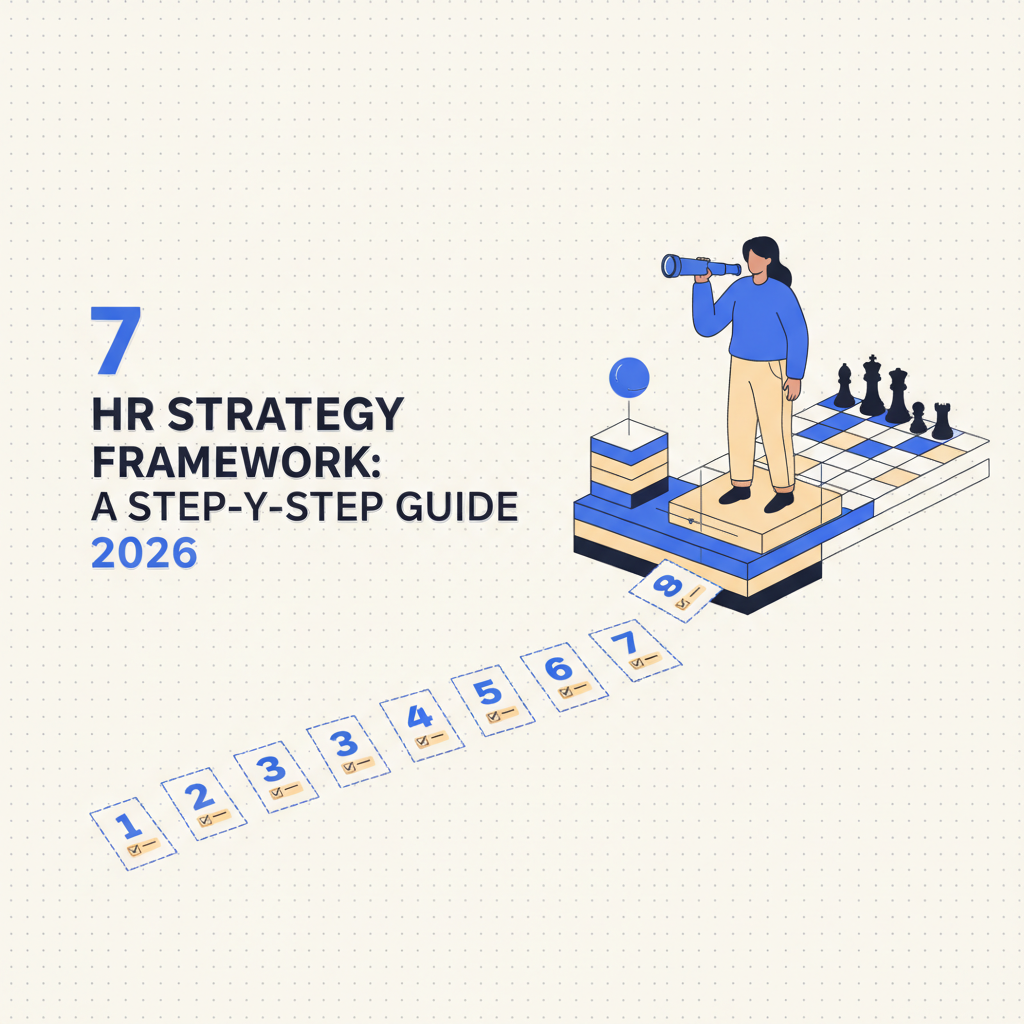
This article breaks down 7 numbered steps for building an HR strategy, extracts the most common failure patterns, and gives you a practical checklist framework to get from diagnosis to execution within 90 days.
Why HR Strategy Is Still Broken in 2026
Strategy gets confused with a list of HR priorities: At a 1,400-person manufacturing company in Columbus I reviewed last year, the “HR strategy” was a slide deck with seven initiatives: DEI program, manager training, new ATS, onboarding redesign, engagement survey, succession planning, and compensation benchmarking. Every item was legitimate. None of them connected to each other, and not one had a business outcome attached. When you ask “what will be different in 12 months,” the answer was essentially “we’ll have done more HR things.” That’s a workplan. It isn’t strategy.
HR operates on a separate planning calendar: According to Deloitte’s 2023 Global Human Capital Trends report, 61% of HR teams finalize their annual plans after the business has already locked its budgets and operating targets. When HR plans in a vacuum, every initiative becomes a negotiation for budget that was already allocated elsewhere. You’re not shaping the business plan. You’re reacting to it. And reactive HR functions never build the internal credibility to graduate to genuine strategic partnership.
No one owns the outcomes: A specific and measurable consequence of poor HR strategy is this: programs run, surveys go out, training gets completed, and nothing changes. According to Gallup’s 2024 State of the Global Workplace report, employee engagement globally sits at just 23%, essentially flat since 2019 despite billions spent on engagement programs. The reason? Initiatives without accountable owners, without baselines, and without defined success criteria generate activity, not change. You can measure exactly how much this costs if you track your voluntary attrition rate against your industry benchmark and price each departure at 1.5x salary.
These three failure modes share a root cause, and the rest of this article is designed to cut through all of them.
What Is HR Strategy?
HR strategy is a planning discipline that connects your organization’s people decisions to its business objectives through prioritized, measurable initiatives owned by named leaders. It’s not a values statement, not a calendar of HR programs, and not a list of things your team wants to improve. It’s a causal argument: if we do X with our people, the business achieves Y.
A well-built HR strategy follows a specific workflow:
- Diagnose the current state of your workforce and HR function against business needs.
- Identify the two or three people-related gaps most likely to constrain business growth.
- Define strategic pillars that directly address those gaps.
- Assign executive sponsors and HR owners to each pillar with clear accountability.
- Set leading and lagging metrics, a review cadence, and a decision rule for when to adjust.
Done correctly, this process eliminates the “we did a lot of HR things” trap and gives your CFO, CEO, and board a people plan they can actually interrogate and fund.
Why HR Strategy Fails (Even With Enterprise-Grade Tools)
No accountability system: Most HR strategies name initiatives but not owners. When everyone is responsible, no one is. A 600-person SaaS company I reviewed had a “talent development” pillar with four sub-initiatives, each led by “the L&D team.” Nobody had a personal performance objective tied to the outcome. When the mid-year review came, progress was reported in outputs (“we ran 12 workshops”) not outcomes (“internal promotion rate increased from 14% to 21%”). Accountability gaps compound over months into systemic errors, and by the time a CHRO realizes the strategy isn’t landing, the annual cycle has already reset.
No specialized expertise: Building and executing a real HR strategy requires capabilities most HR teams have never formally developed: workforce planning, financial modeling, organizational design, and data analysis. Deloitte’s 2023 Human Capital Trends report found that only 39% of HR professionals say they have the analytics skills needed to do the strategic work their business now expects of them. Deploying a Workday dashboard doesn’t close that gap. Neither does hiring one “HR data analyst” and routing all the strategic questions through them.
No lifecycle tracking: HR strategies are frequently built once a year and reviewed once, at year-end. IBM’s Smarter Workforce Institute research has shown that workforce conditions, labor market dynamics, and business priorities can shift materially within a single quarter. A strategy built in January based on a plan to grow headcount by 18% needs a structural review mechanism when the CFO signals a hiring freeze in March. Without a lifecycle tracking process, including defined trigger points for strategic review, you’re executing a plan that may no longer fit the business it was designed to serve.
No compliance discipline: People strategy increasingly intersects with legal risk. Pay equity audits, EEOC reporting, evolving state-level pay transparency laws (currently active in 12 US states), and GDPR obligations affecting HR data in European operations all create exposure if your strategy doesn’t have a compliance lane. Companies that treat compliance as a separate workstream from strategy routinely discover conflicts late, when the cost of correction is highest. California’s AB 168 and Colorado’s Equal Pay for Equal Work Act have each generated enforcement actions against companies that simply didn’t build compliance into their compensation strategy from the start.
The gap between building an HR strategy and building one that actually holds is where every major failure in this article occurred.
What to Look For in an HR Strategy Process
Business outcome linkage at the initiative level: Every HR initiative in your strategy should trace directly to a business outcome your CEO or CFO would care about. Not “improve manager effectiveness” but “reduce team-level attrition by 8 points in FY26, which we project will save $1.2M in backfill costs.” If you can’t articulate the connection in one sentence, the initiative isn’t strategic. It might still be worthwhile. But don’t call it strategy.
Quarterly review cadence with defined triggers: Your strategy review shouldn’t be a passive status update. Build a structured quarterly check with three questions: Are we on track against our metrics? Has anything in the business changed that invalidates our assumptions? Do we need to re-prioritize? Set defined trigger conditions, for example, if voluntary attrition exceeds 18% in any quarter, it automatically activates a strategic review of your retention pillar. Without this, you end up reviewing outcomes after they’ve already hurt the business.
Security and compliance certifications for any supporting technology: If your HR strategy involves platforms that process employee data, which almost all do at this point, you need to confirm SOC 2 Type II certification, GDPR compliance for any EU workforce data, ISO 27001 where applicable, and alignment with HIPAA if you’re in healthcare. This isn’t the technology team’s job alone. HR leaders who greenlight platforms without confirming these certifications are creating organizational liability that will eventually land on their desk.
Integration without data duplication across your HRIS stack: Your strategy execution depends on clean, connected data. If your performance data lives in Lattice, your headcount data in Workday, your engagement data in Culture Amp, and your compensation data in a spreadsheet, you will make strategic decisions on incomplete information. Before you build your strategy, map your data flows. If you’re on BambooHR, Personio, or Rippling, confirm what your performance and engagement tools actually surface in dashboards you can act on. Data silos are a strategy execution problem dressed up as a systems problem.
Pilot program availability before full commitment: Any new program, platform, or structural change embedded in your HR strategy should have a defined pilot phase of 60 to 90 days before you scale. This applies to a new performance framework, a revised onboarding process, and a new talent marketplace tool. Piloting lets you measure leading indicators early, catch implementation failures before they propagate, and build internal credibility through demonstrated results rather than promises. Skipping the pilot to “move faster” is usually how good ideas turn into expensive rollbacks.
Transparent metrics tied to outcomes, not activity: The metrics in your HR strategy should be lagging indicators of business impact (retention rate, internal mobility rate, time-to-productivity for new hires) and leading indicators that predict those outcomes (manager effectiveness scores, onboarding completion rates, offer acceptance rates). Activity metrics, like “number of training hours completed” or “number of job descriptions updated,” have no place in a business-facing HR strategy. They measure effort, not effect.
Post-implementation support with a named owner: Whether you’re implementing a new program or a new platform, name a single owner on the HR side who is accountable for outcomes beyond launch. A named customer success manager on the vendor side, a monthly performance review against adoption and outcome metrics, and a clear escalation path when things go wrong are not optional. Post-launch neglect is responsible for a larger share of failed HR initiatives than poor initial design. Build the support structure before you go live, not after something breaks.
Best HR Strategy Frameworks and Planning Platforms in 2026
Workday Adaptive Planning (People Planning Module)
Workday Adaptive Planning serves mid-to-large enterprises that need to connect workforce planning directly to financial planning. If your CHRO and CFO are expected to present a unified people-and-business plan to the board, this is the platform built for that conversation.
Workday Adaptive Planning ingests headcount data, compensation actuals, attrition history, and business unit financials from Workday HCM and external ERPs. It produces scenario models that let you test the people-cost implications of different growth, restructuring, or hiring plans in real time. The platform supports rolling forecasts rather than static annual plans, which means your HR strategy stays calibrated to business reality quarter by quarter. It serves over 6,000 organizations globally across finance and HR planning functions. The key differentiator is the native integration with Workday HCM, which eliminates the data translation layer that makes workforce planning models unreliable in most organizations.
Key Features
- Scenario modeling for headcount growth, reduction, and restructuring across departments
- Rolling forecast capability that updates workforce projections as actuals come in
- Compensation planning integrated with financial cost-center modeling
- Real-time dashboards connecting HR metrics to P&L outcomes
- Native integration with Workday HCM, SAP SuccessFactors, and major ERP systems
Best For
Companies of 500 to 5,000 employees already running Workday HCM that want to elevate workforce planning into a board-ready financial conversation. Ideal buyer is a CHRO or VP of HR partnering closely with a CFO on operating plan alignment. Works best in organizations with dedicated FP&A and People Analytics resources.
Pricing
Workday Adaptive Planning uses modular pricing. Public reporting suggests contracts for the people planning module start at approximately $30,000 to $50,000 per year depending on company size, user count, and modules included. Confirm current pricing directly with Workday.
Where It Struggles
Implementation is not light. Expect a 3 to 6 month deployment timeline with significant configuration requirements, particularly if your underlying Workday HCM data isn’t clean. Companies without a dedicated People Analytics function often find the platform underused because it requires ongoing modeling work that doesn’t happen automatically. It’s also overkill for companies under 300 employees, where a well-maintained spreadsheet model with quarterly discipline will serve the same purpose at a fraction of the cost.
Lattice
Lattice is a people management platform that connects performance, engagement, growth, and compensation data in one place. It’s designed for HR teams that want to build a strategy execution layer on top of their core HRIS without replacing it.
Lattice’s architecture works around three connected modules: performance reviews, employee engagement surveys, and compensation management. What makes it strategically useful is the analytics layer, which surfaces correlations between manager effectiveness scores, engagement trends, and attrition risk at the team level. In practice, this means you can identify which business units are at highest risk of attrition 60 to 90 days before people resign, which is exactly the kind of leading indicator a real HR strategy needs. Lattice serves over 5,000 companies and integrates with Workday, BambooHR, Rippling, ADP, and Greenhouse, making it compatible with most mid-market HR stacks. Its 1:1 meeting tools and goal-tracking OKR features also address the “no accountability system” failure mode directly.
Key Features
- Continuous and cyclical performance review templates with calibration tools
- Engagement pulse surveys with manager-level sentiment dashboards
- Compensation bands and equity analysis integrated with performance scores
- Goal and OKR tracking tied to individual and team performance cycles
- Integration with Workday, BambooHR, Rippling, ADP, and Greenhouse
Best For
Companies of 100 to 2,000 employees that need a single platform to manage performance, measure engagement, and run compensation cycles without a fully custom enterprise build. Ideal buyer is a VP of People or HR Director who owns both performance management and people analytics but doesn’t have a dedicated data engineering team.
Pricing
Lattice offers modular pricing. Based on public reporting, the platform starts at approximately $11 per employee per month for the performance module, with engagement and compensation modules adding cost. Full-platform contracts for companies of 200 to 500 employees typically run $25,000 to $60,000 annually. Confirm current pricing with Lattice directly.
Where It Struggles
Lattice’s value depends almost entirely on adoption. If managers don’t complete 1:1 notes, don’t use goal tracking, or treat performance reviews as compliance exercises, the platform’s analytics layer has nothing meaningful to surface. I’ve seen Lattice deployments at 300-person companies where 70% of manager records were blank six months post-launch. The tool also doesn’t replace workforce planning; it informs it. If you need scenario modeling for headcount or financial cost projections, you’ll still need a separate solution.
Visier
Visier is a people analytics platform built specifically for HR teams that need to make data-driven workforce decisions without relying on their IT or data engineering team to build the reports first.
Visier connects to your existing HRIS, including Workday, SAP SuccessFactors, Oracle HCM, and BambooHR, and produces a pre-built library of over 2,000 workforce metrics and analyses. Its strategic value is speed: questions that would take a custom BI team two weeks to answer, like “which departments have attrition rates more than 1.5 standard deviations above the company average, and what’s the correlation to manager tenure,” can be answered in minutes. Visier serves over 50,000 organizations globally and includes benchmarking data from its aggregated customer base, which means you can compare your attrition, hiring, and engagement metrics against industry peers without a separate benchmarking subscription. That context is what turns internal data into a strategic argument.
Key Features
- Pre-built library of 2,000-plus workforce metrics with no SQL required
- Attrition prediction and flight risk scoring at the employee and team level
- Workforce composition and pay equity analysis for EEOC and board reporting
- Industry benchmarking built into the platform from aggregated customer data
- Integration with Workday, SAP SuccessFactors, Oracle HCM, ADP, and BambooHR
Best For
Companies of 1,000 to 5,000 employees with complex, multi-location or multi-business-unit workforce structures where manual reporting has become unsustainable. Ideal buyer is a Chief People Officer or SVP of HR who needs board-ready workforce analytics without building an internal data science team. Particularly strong in financial services, healthcare, and technology sectors.
Pricing
Visier uses custom pricing based on employee count and modules. Based on public reporting, mid-market contracts typically start at approximately $75,000 to $150,000 per year. This positions it firmly in the enterprise segment. Verify current pricing directly with Visier before budgeting.
Where It Struggles
Visier requires clean, consistent HRIS data to deliver reliable outputs. If your underlying data has inconsistent job codes, missing manager hierarchies, or duplicate employee records, the platform will surface misleading analytics that are worse than no data at all because they create false confidence. Budget 60 to 90 days for data hygiene work before going live. Visier also doesn’t do performance management or engagement surveys natively, so it works as an analytics layer on top of other tools, not as a standalone strategy execution platform.
Culture Amp
Culture Amp is an employee experience platform that helps HR teams measure engagement, run effective performance cycles, and understand what’s actually driving turnover before it happens.
Culture Amp’s core strength is its survey methodology and the analytics built on top of it. The platform draws on data from over 25 million employees across 6,500-plus companies to provide benchmarking that makes your internal engagement scores meaningful in context. But its strategic value goes beyond survey administration. The platform surfaces “driver analysis,” which identifies which specific workplace factors, like clarity of direction, manager support, or growth opportunity, have the highest statistical correlation to engagement and retention in your specific organization. This lets HR leaders prioritize their strategy based on what actually moves the needle in their workforce rather than what worked at another company. Culture Amp integrates with Workday, BambooHR, Personio, Rippling, and Slack.
Key Features
- Science-backed engagement survey templates with driver analysis and benchmarking
- Continuous 1:1 and feedback tools for manager effectiveness tracking
- Performance review cycles with calibration and bias-detection features
- Attrition and flight risk analytics surfaced from engagement trend data
- Integration with Workday, BambooHR, Personio, Rippling, and Slack
Best For
Companies of 200 to 3,000 employees where culture and engagement are acknowledged business risks, especially those in high-growth, high-attrition sectors like technology, professional services, and healthcare. Ideal buyer is a People Ops leader or CHRO who needs to translate employee sentiment data into specific, defensible strategy recommendations for the executive team.
Pricing
Culture Amp offers tiered pricing by module. Based on public reporting, the engagement module starts at approximately $5 per employee per month, with performance and development modules priced separately. Full-platform contracts for companies of 200 to 500 employees typically run $15,000 to $40,000 annually. Verify current pricing with Culture Amp directly.
Where It Struggles
Culture Amp is strongest when survey participation rates are high (above 70%). Below that threshold, the driver analysis loses statistical reliability and you risk making strategic decisions based on a non-representative sample. The platform also requires active manager engagement to close the loop between survey insights and team-level action. In organizations where managers treat engagement surveys as an HR obligation rather than a management tool, Culture Amp generates great data that nobody acts on. Implementation support is solid, but ongoing program ownership has to sit with HR, not the vendor.
15Five
15Five is a performance and engagement platform designed to make the connection between weekly manager actions and long-term retention outcomes visible, measurable, and improvable.
15Five’s model is built around continuous feedback rather than point-in-time reviews. Its weekly check-in product captures real-time signals on employee sentiment, blockers, and progress toward goals, which means HR leaders get a rolling picture of team health rather than a lagging annual survey result. The platform includes an OKR module, a manager effectiveness score (“Best-Self Review”), and an AI-assisted coaching nudge system that surfaces recommended manager actions based on individual employee responses. 15Five serves over 3,500 companies and has published data showing that companies using its continuous feedback model see voluntary attrition rates 7% lower than peer companies on annual review cycles alone. It integrates with Workday, BambooHR, Rippling, Slack, and Microsoft Teams.
Key Features
- Weekly employee check-ins capturing blockers, sentiment, and progress in five minutes or less
- OKR and goal tracking with individual, team, and company-level alignment views
- Manager effectiveness scoring through structured upward feedback cycles
- AI-assisted coaching prompts that recommend manager actions based on check-in data
- Integration with Workday, BambooHR, Rippling, Slack, and Microsoft Teams
Best For
Companies of 50 to 1,000 employees that want to improve manager effectiveness and reduce attrition without overhauling their entire HR tech stack. Ideal buyer is an HR Director or VP of People at a growth-stage company where managers are first-time people leaders and need structured support. Works particularly well in fully remote and hybrid organizations where manager-employee contact is limited.
Pricing
15Five offers tiered pricing starting at approximately $4 per user per month for the Engage module, with the full platform including performance and OKR features running approximately $14 per user per month. Annual contracts for a 150-person company typically run $25,000 to $30,000. Verify current pricing with 15Five directly, as pricing has shifted with platform expansion.
Where It Struggles
15Five’s weekly check-in model depends on a high frequency of use to generate reliable signals. In organizations where employees have meeting fatigue or where managers don’t actively respond to check-in data, the platform quickly feels like another administrative obligation rather than a useful tool. The AI coaching nudges are helpful in concept, but they require managers to actually read and act on them, which varies significantly by manager quality. 15Five also isn’t a workforce planning or analytics tool. It measures team health well but won’t help you build a board-ready headcount model.
Comparison Table of Top HR Strategy Platforms in 2026
| Provider | Primary Use Case | Company Size | Starting Price | GDPR Ready | Best For |
|---|---|---|---|---|---|
| Workday Adaptive Planning | Workforce and financial planning | 500-5,000 | ~$30,000/yr | Yes | CHROs aligning people plan to board financials |
| Lattice | Performance, engagement, and compensation | 100-2,000 | ~$11/user/mo | Yes | HR Directors running full performance cycles |
| Visier | People analytics and workforce intelligence | 1,000-5,000 | ~$75,000/yr | Yes | CPOs needing board-ready workforce analytics |
| Culture Amp | Engagement surveys and driver analysis | 200-3,000 | ~$5/user/mo | Yes | People Ops leaders turning sentiment into strategy |
| 15Five | Continuous feedback and manager effectiveness | 50-1,000 | ~$4/user/mo | Yes | HR Directors at growth-stage or remote-first companies |
HR Strategy vs. Annual HR Planning
These two things sound similar. They aren’t. Annual HR planning is a calendar exercise: what programs will HR run this year, what budget does HR need, and what headcount will HR add. HR strategy is a business exercise: what people conditions need to change for the company to achieve its operating goals, and how will HR create those conditions. The difference sounds semantic. In practice, it determines whether HR gets a seat in the room where business decisions are made.
| Factor | Annual HR Planning | HR Strategy |
|---|---|---|
| Core function | Budget and activity planning | Business outcome alignment |
| Services included | HR program calendar, headcount requests | Strategic pillars, owner accountability, metrics |
| Integrations | Typically siloed within HR | Connected to finance, ops, and executive planning |
| Visibility | Reviewed by HR leadership only | Presented to CEO, CFO, and board |
| Automation | Limited; mostly manual tracking | Supported by workforce planning and analytics tools |
The decision point comes down to what HR is being asked to influence. If your CEO asks HR to help the company grow from 400 to 700 people in 18 months while maintaining cultural cohesion, that’s a strategy problem, not a planning problem. At that scale, the volume of workforce decisions, from org design to compensation to succession to onboarding, exceeds what an annual plan can manage. At 500 or more employees with rapid growth or multi-location operations, the complexity of people decisions demands a strategic framework with structured review cycles, not just a better project tracker.
How to Choose the Right HR Strategy Platform
Match your situation with the right platform:
| Your Situation | Best Fit | Also Consider | Avoid | Why |
|---|---|---|---|---|
| You need to align HR plan with CFO’s financial model | Workday Adaptive Planning | Visier | 15Five | Only Workday bridges people costs and operating plan in real time |
| First-time managers driving high team-level attrition | 15Five | Culture Amp | Workday Adaptive | Continuous check-ins surface manager gaps before they cause departures |
| You have data but can’t turn it into a board narrative | Visier | Workday Adaptive Planning | 15Five | Visier’s benchmarking and pre-built models produce board-ready outputs fastest |
| Engagement is low but you don’t know the specific drivers | Culture Amp | Lattice | Workday Adaptive | Driver analysis pinpoints which factors actually predict attrition in your org |
| You need performance, engagement, and compensation in one platform | Lattice | Culture Amp | Visier | Lattice is the only mid-market option connecting all three in a single workflow |
Final Thoughts
HR strategy is not a tool problem or a budget problem. It’s an alignment problem: HR functions that can’t articulate a causal link between people decisions and business outcomes will always be treated as cost centers, regardless of the sophistication of their platforms.
Companies under 200 employees should start with a focused, three-pillar strategy built in a single working session with the CEO and CFO, supported by a lightweight tool like 15Five or Culture Amp to generate the leading indicators needed to track progress. At 500 or more employees, the complexity of workforce decisions justifies investment in a dedicated analytics layer (Visier or Workday Adaptive Planning) and a formal quarterly strategic review tied directly to the operating plan cycle.
The Charlotte healthcare firm from the opening of this article, the Columbus manufacturer with seven disconnected priorities, and the SaaS company with a Lattice deployment nobody used all share the same underlying failure: they built HR programs instead of HR strategy. Programs have start dates. Strategy has business owners, outcome metrics, and a cadence of honest review. The platforms above are only useful if the strategic structure exists to make the data meaningful. Buy the tool second. Build the framework first.
For most mid-market HR teams, Culture Amp is the most defensible starting point. You likely already have engagement data, your managers already have teams with measurable attrition risk, and Culture Amp’s driver analysis turns existing signals into specific strategic priorities without requiring a data engineering investment. It produces outputs your CEO can act on. Revisit your HR strategy stack every 12 to 18 months. Shifts in labor market conditions, business model changes, and the rapid evolution of people analytics tooling mean last year’s right answer may not be next year’s.
The 7-Step Build-Out Sequence: From Diagnosis to Board-Ready Plan
Building an HR strategy that survives contact with a CFO requires a fixed sequence, not a brainstorm. Skipping steps or running them in parallel is the single most common reason strategies collapse mid-year. Work through these seven steps in order, and timebox the entire sequence to 90 days.
Step 1-3: Diagnosis and Prioritization (Days 1-30)
- Audit workforce data against business targets. Pull turnover by tenure band, time-to-fill by role family, and internal mobility rate. Compare each against the business’s stated growth or margin targets for the year.
- Interview 8-12 business leaders, not just HR staff. Ask each what would break their function if headcount, skills, or culture didn’t improve. Patterns across three or more leaders indicate a real constraint, not a departmental preference.
- Narrow to two or three strategic pillars. If your list exceeds three pillars, you haven’t prioritized, you’ve compiled a wish list. Each pillar must map to a named business risk: revenue, cost, or regulatory exposure.
Step 4-5: Ownership and Metrics (Days 31-55)
- Assign a named executive sponsor and an HR owner to each pillar. The sponsor is accountable to the CEO for the outcome; the HR owner runs execution. Put both names in the board deck, not “the L&D team.”
- Set one leading and one lagging metric per pillar, with baselines. A leading metric for a retention pillar might be manager 1:1 completion rate; the lagging metric is voluntary attrition at 90 and 365 days. Baseline every metric before launch.
Step 6-7: Cadence and Adjustment (Days 56-90)
- Build a quarterly review with pre-defined trigger thresholds. Example: if first-year attrition exceeds 20% in any quarter, it automatically escalates to an off-cycle review rather than waiting for the scheduled check-in.
- Publish a one-page decision log after every review. Record what changed, why, and what you’re doing differently next quarter. This log becomes your evidence trail when leadership asks whether the strategy is working.
Organizations that compress this sequence into a single planning offsite typically produce priority lists, not strategy. The 90-day pacing forces real diagnosis before commitment, which is the step most teams try to shortcut under deadline pressure.
Metrics, Ownership Maps, and Governance Cadence for Execution Tracking
An HR strategy without a governance layer degrades into a status report within two quarters. Governance means defined metrics, a visible ownership map, and a cadence that forces course correction before small misses become annual failures.
Choosing Leading vs. Lagging Metrics
Every pillar needs both metric types, tracked on the same dashboard. Leading metrics predict outcomes and move monthly; lagging metrics confirm outcomes and move quarterly or annually. Pairing them prevents the common trap of reporting activity (“14 workshops delivered”) instead of results (“internal fill rate rose from 22% to 31%”).
| Pillar | Leading Metric | Lagging Metric | Review Frequency |
|---|---|---|---|
| Retention | Manager 1:1 completion rate | 90-day and 365-day voluntary attrition | Monthly / Quarterly |
| Talent Pipeline | Time-to-fill for critical roles | Internal promotion rate | Monthly / Quarterly |
| Compensation Equity | Pay audit completion rate | Pay gap by role and demographic | Quarterly / Annually |
| Manager Capability | Training completion rate | Team-level engagement score | Monthly / Quarterly |
Building the Ownership Map
A one-page ownership map lists each pillar, the executive sponsor, the HR owner, the metric baseline, and the current status in a single view. This map should be visible to the executive team at all times, not buried in an HR-only workspace. When a pillar owner leaves the organization, the map forces an immediate reassignment decision instead of letting accountability quietly disappear.
Governance Cadence and Escalation Rules
- Monthly: HR owners update leading metrics and flag any pillar trending more than 10% off target.
- Quarterly: Executive sponsors and HR owners jointly review lagging metrics against the annual targets set at kickoff.
- Trigger-based: Any metric breaching its defined threshold (for example, attrition exceeding 18% in a single quarter) forces an off-cycle review within two weeks, regardless of the regular calendar.
Without these three cadence layers, strategies drift silently for months because no single meeting exists where the question “is this still working?” gets asked with data in front of it. The governance layer is what separates a strategy document from a strategy that actually changes business outcomes.
Related reading
Frequently Asked Questions
How many strategic pillars should an HR strategy have?
Two or three pillars maximum. Each pillar must map to a specific business constraint, such as revenue risk from turnover or cost exposure from slow time-to-fill. Lists of five or more initiatives usually signal an unprioritized workplan rather than a strategy, and they dilute executive attention and budget across too many competing efforts.
Who should own each pillar of an HR strategy?
Every pillar needs two named owners: a business executive sponsor accountable to the CEO for the outcome, and an HR owner who runs day-to-day execution. Naming a department like "the L&D team" instead of an individual removes accountability. Put both names in any board or leadership deck so ownership is visible and enforceable.
How often should an HR strategy be reviewed?
Review leading metrics monthly and lagging metrics quarterly at minimum. Build defined trigger thresholds, such as attrition exceeding 18% in a quarter, that force an off-cycle review within two weeks rather than waiting for the scheduled check-in. Annual-only reviews miss shifts in business conditions that can invalidate assumptions within a single quarter.
What's the difference between a leading and lagging metric in HR strategy?
A leading metric predicts an outcome and moves monthly, such as manager 1:1 completion rate. A lagging metric confirms the outcome and moves quarterly or annually, such as voluntary attrition. Tracking both together prevents teams from reporting activity, like workshops delivered, instead of actual business results like improved retention or promotion rates.
How long should it take to build a complete HR strategy?
Plan for a 90-day build-out: roughly 30 days for diagnosis and prioritization, 25 days to assign ownership and set metrics, and the remaining time to establish review cadence and trigger rules. Compressing this into a single planning offsite typically produces a priority list rather than a defensible, business-linked strategy.
What causes most HR strategies to fail after launch?
Three failures recur most often: no named accountability for outcomes, no specialized analytics or financial modeling capability on the team, and no lifecycle mechanism to trigger review when business conditions shift. Any one of these turns a well-built plan into a static document within two quarters, regardless of how strong the original diagnosis was.