
Before diving into the details, here's a quick snapshot of what a compensation strategy framework actually involves and why building one matters for your organization in 2026. TL;DR
- Most compensation programs fail at the strategy layer, not the payroll execution layer. The architecture upstream of your pay runs is where retention is won or lost.
- According to Mercer’s 2024 Total Rewards Survey, 67% of HR leaders said their compensation philosophy was either undocumented or not formally communicated to managers making offer decisions.
- Companies with a clearly defined compensation band structure reduce offer rejection rates by approximately 23%, based on findings from the Josh Bersin Company’s 2023 HR Technology Report.
- The decision criterion that matters most: if your compensation philosophy can’t be explained in two sentences to a skeptical employee, it isn’t a philosophy. It’s a spreadsheet with aspirations.
- Audit your compensation architecture before your next major hiring cycle. The framework in this article gives you a structured starting point, a decision matrix, and five platforms worth evaluating.
In Q3 of 2023, a 780-person e-commerce company in Chicago began losing mid-level engineers at a rate that alarmed the CPO. Exit interviews pointed to pay. The HR team had run clean payroll for years; no missed runs, no tax errors, no compliance flags. But when the CHRO dug into the compensation architecture, she found something worse than an error: she found silence. There were no documented pay bands. Offer decisions had been made by hiring managers using gut feel and offer pressure for at least three years. When she finally mapped actual salaries against market data from Radford, she found a 31% pay spread among engineers with identical titles, levels, and tenure. The company hadn’t run broken payroll. It had run broken compensation strategy.
This isn’t an outlier. According to Mercer’s 2024 Total Rewards Survey, 58% of mid-market companies report significant internal pay equity gaps they discovered only after an external audit or a retention crisis.
Best tools for Payroll & Compensation
This article breaks down 5 strategic frameworks for compensation architecture, extracts the decision criteria that separate functional from broken pay programs, and gives you a diagnostic model to match your current stage to the right approach.
Why Compensation Strategy Is Still Broken in 2026
The philosophy exists only in the CHRO’s head: At a 430-person SaaS company I reviewed in late 2024, the compensation philosophy had been set by the founding CHRO three years earlier and lived entirely in an unlabeled Google Doc that hadn’t been updated since Series B. Hiring managers were making $15,000 to $40,000 offer decisions daily with no band structure, no anchoring data, and no approval process. By the time the company ran an equity analysis, total payroll was running approximately 11% above market in roles with high supply and 18% below market in roles with constrained supply. The inversion was almost perfectly backwards.
Market data is treated as annual event, not operational input: According to Gartner’s 2024 HR Technology Survey, only 34% of HR teams refresh compensation benchmarks more than once per year. The market moved on a different schedule in 2021 through 2024 than it had in the prior decade. Tech sector wages rose sharply, then corrected, then stratified by geography in ways that salary surveys from 18 months ago couldn’t reflect. Companies running compensation decisions on stale Radford or Mercer data weren’t being negligent; they were using a legitimate process that assumed market stability that no longer existed.
Managers own the decision without owning the accountability: The measurable consequence here is an offer acceptance rate that misleads you. When a hiring manager inflates an offer to close a candidate they want badly, they record a win. The downstream cost, a compressed pay band, a resentful incumbent, a retention event six months later, hits a different budget and a different quarter. According to Work Institute’s 2023 Retention Report, pay inequity driven by manager-level discretion accounts for an estimated 27% of voluntary turnover in companies that lack formal band governance. Those aren’t compliance errors. They’re strategy failures paid out over time.
The rest of this article is about closing that gap before it becomes a crisis you’re explaining to your board.
What Is a Compensation Strategy Framework?
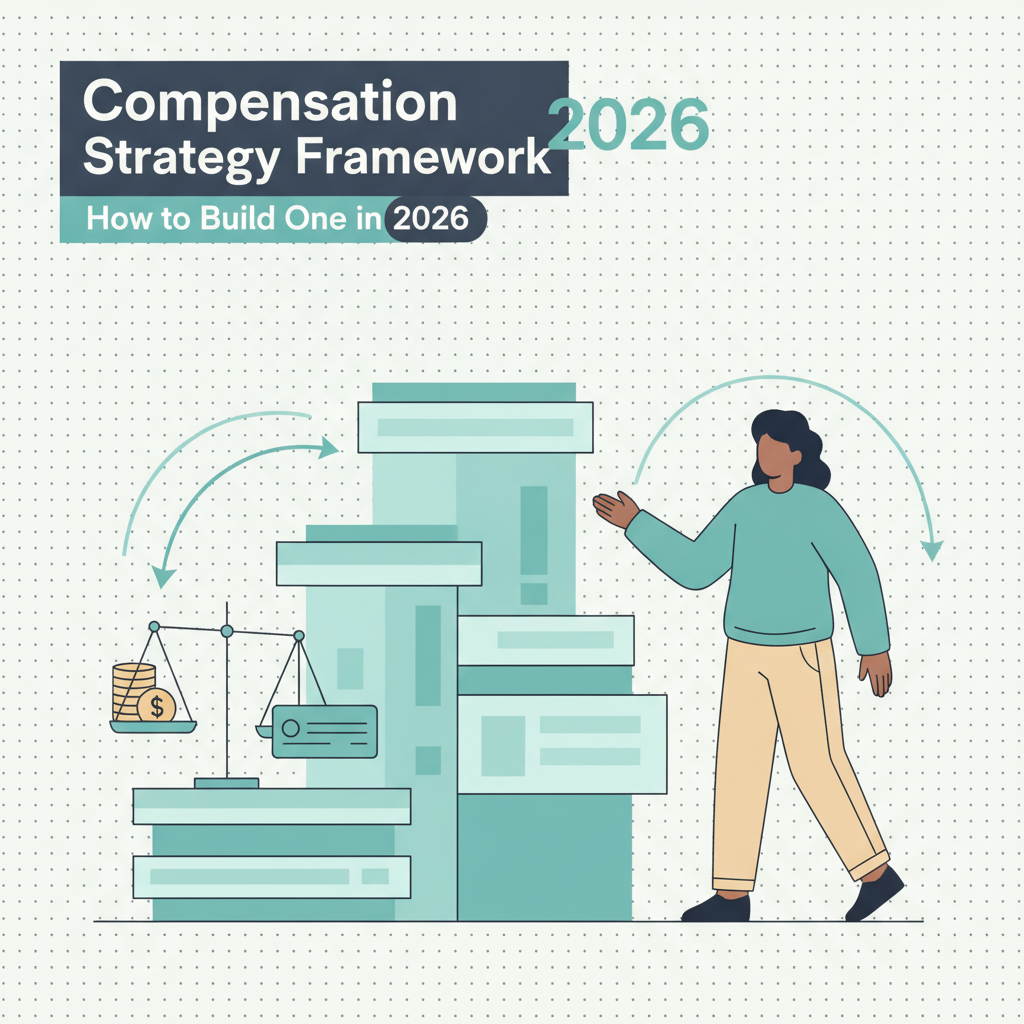
A compensation strategy framework is a structured decision model that defines how your company sets, communicates, governs, and adjusts pay across roles, levels, geographies, and employee types. It answers the question “why does this person earn this amount” in a way that can survive a skeptical all-hands. The framework sits upstream of payroll; it determines what runs through your payroll system, not how it runs.
In practice, a functioning compensation strategy framework moves through five operational stages. Most companies handle stage one adequately and fall apart at stage two or three.
- Define the compensation philosophy: what the company pays relative to market (percentile target), what it values (skills, tenure, performance), and what it will and won’t do.
- Build job architecture: define roles, levels, and career ladders that create anchoring points for pay bands.
- Source and apply market data: purchase or subscribe to salary survey data, map your roles to survey jobs, and set band midpoints.
- Set and communicate pay bands: document salary ranges per level, share them with managers and employees at the level of transparency your philosophy supports.
- Govern and audit: establish a cadence for reviewing actual pay against bands, correcting compression, and refreshing market data.
A working framework doesn’t eliminate judgment from compensation decisions. It makes judgment defensible, consistent, and correctable when it’s wrong.
Why Compensation Strategy Fails (Even With Enterprise-Grade Tools)
No accountability system: Most compensation tools generate excellent data and produce no decisions. The tool tells you that your senior product manager is sitting at the 34th percentile of market. Nobody is accountable for acting on that signal, no owner, no deadline, no escalation path. The HR team flags it in a spreadsheet. The manager finds out when the employee gives notice. That’s not a data problem; it’s a governance problem. Accountability gaps compound over months into systemic errors that cost you your best performers first, because they’re the ones with outside options.
No specialized expertise: Compensation design is a distinct skill set that many HR generalists aren’t trained in, and most companies at the 100-to-500 employee stage can’t justify a full-time compensation specialist. According to Deloitte’s 2023 Global Human Capital Trends report, 61% of HR leaders said they lacked sufficient internal expertise to design or audit a market-competitive total rewards program. The result is compensation decisions made by people who are competent at recruiting or HR business partnering but are operating outside their technical depth when setting band structures or running equity analyses.
No lifecycle tracking: Pay bands aren’t static. Market rates shift. Roles evolve. A band you set at Series B against a Radford benchmark from 2022 is not the same band in 2026. According to Gartner’s 2024 HR Technology Survey, 47% of companies report that their job architectures haven’t been formally reviewed in more than two years. That’s two years of hiring, promoting, and adjusting pay against a map that no longer reflects the territory. By the time you notice, you’ve got compression across two or three levels that requires a six-figure correction budget to fix cleanly.
No compliance discipline: Pay equity legislation has moved fast. By 2026, pay transparency laws in California, New York, Colorado, Illinois, Washington, and several other states require salary range disclosure on job postings. The EU Pay Transparency Directive, effective by 2026 across member states, requires employers to share information on pay criteria and prohibits secrecy clauses that prevent employees from discussing wages. Penalties for non-compliance vary by jurisdiction but can reach 1% to 4% of annual global payroll under GDPR-adjacent enforcement frameworks. Companies that built their compensation programs around opacity are now running compliance risk they haven’t priced in.
The gap between running a compensation program and running one responsibly is where every major failure in this article occurred.
What to Look For in a Compensation Strategy Platform
Real-time market data with named sources: The single most important question you can ask a compensation vendor is “where does your benchmark data come from and how often is it updated?” Platforms that aggregate from multiple survey sources (Radford, Mercer, Culpepper, Willis Towers Watson) and refresh quarterly are meaningfully more useful than those relying on a single annual survey. If the vendor can’t name the source, the data is either proprietary crowd-sourced data of uncertain quality or it’s aged. Both are problems.
Band-setting and scenario modeling tools: You need to be able to model “what happens to our payroll budget if we move from the 50th percentile to the 65th percentile on software engineers” before you commit to it. Platforms that offer scenario modeling let you run compensation strategy as a financial exercise with real inputs, not as a hope exercise followed by a surprise on the P&L. Look for tools that show headcount impact, budget delta, and band overlap simultaneously.
Security and compliance certifications: Compensation data is among the most sensitive data in your company. Platforms handling it should carry SOC 2 Type II certification at minimum. If you operate in the EU or handle data on EU employees, GDPR compliance and data residency controls are non-negotiable. ISO 27001 certification signals a mature information security posture. For companies in healthcare adjacent industries, check HIPAA alignment even if it’s not legally required; it’s a useful proxy for data handling discipline.
Integration without data duplication: A compensation platform that doesn’t connect cleanly to your HRIS creates manual work and introduces data integrity risk. Look for native integrations with Workday, BambooHR, Personio, Rippling, and HiBob. If your ATS is Greenhouse, Lever, or iCIMS, check whether the compensation tool can pull offer data at the point of hire so your band governance applies at the moment offers are extended, not after.
Pilot program availability with a structured timeline: Any serious vendor will support a 60-to-90-day pilot on a subset of your workforce, typically one department or one job family. Be skeptical of vendors who push you toward enterprise-wide deployment before you’ve validated the data quality against your own records. A pilot also surfaces integration issues, data mapping problems, and UI friction before you’ve made a multi-year commitment. Require that the pilot include a structured review at day 45 with success criteria defined before day one.
Transparent pricing tied to headcount, not vague “modules”: Compensation platforms have trended toward modular pricing that makes it difficult to understand your total cost until you’re deep in a procurement process. Push for a clear per-employee-per-month or annual contract price that includes your must-have features. Ask specifically whether pay equity analysis, job architecture tools, and manager-facing dashboards are included or priced separately. A vendor who can’t give you a clean number before a demo is telling you something about how they’ll behave post-signature.
Post-implementation support with a named SLA: Compensation strategy work is cyclical. You’ll need support during your annual compensation review cycle, when you’re prepping for a board discussion on total rewards, and when a pay equity claim surfaces. Look for vendors who offer a named customer success manager (not a shared pool), a defined response time SLA for critical issues (under 4 hours is reasonable), and a quarterly business review cadence. The vendors who win long-term relationships in this space invest in making their customers better at compensation, not just better at using the software.
Best Compensation Strategy Platforms in 2026
Radford (Aon)
Radford is the market data standard for technology and life sciences companies, used by HR teams from Series B startups to global enterprises. It’s the benchmark most compensation professionals reference first when setting band midpoints.
Radford’s core product is its compensation survey database, which covers over 1,000 benchmark jobs across technology, life sciences, and general industry segments. Companies participate in the survey and receive access to aggregated market data in return, a model that keeps the data current and reasonably representative. The platform’s analytics layer lets you cut data by geography, company revenue, stage, and headcount. Radford also offers Total Reward Benchmarking, which layers equity, bonus, and benefits data on top of base salary. The survey covers data from more than 2,000 participating companies globally. Where Radford is strongest is in the specificity of its technology job taxonomy; roles like Staff Engineer, Principal PM, or Head of Machine Learning have distinct survey cuts rather than being forced into generic titles.
Key Features
- Technology and life sciences job taxonomy covering 1,000-plus benchmark roles
- Quarterly data refresh cycles for high-velocity markets
- Total compensation view including equity and variable pay benchmarks
- Geographic cut data for metro areas, remote, and international markets
- Integration with Workday and Mercer’s job leveling frameworks for cross-referencing
Best For
Technology companies and life sciences firms from 150 to 5,000 employees where engineering and product roles make up a significant share of headcount. The ideal buyer is a compensation specialist or CHRO who needs defensible benchmark data for board-level reporting and offer governance.
Pricing
Radford survey participation is free if your company contributes data. Full platform access (analytics, scenario modeling, total rewards) runs on custom pricing based on headcount and module selection. Public reporting suggests starting contracts for the analytics platform run approximately $20,000 to $50,000 annually. Confirm current pricing directly with Aon.
Where It Struggles
Radford’s data is excellent for tech and life sciences, and noticeably thinner for non-technical roles like operations, finance, and HR at mid-market companies. The platform’s interface has improved but still carries a legacy enterprise feel that requires meaningful onboarding time. If you’re a generalist HR team without a dedicated compensation analyst, you may find the platform’s depth intimidating rather than useful. It also doesn’t offer pay equity analysis as a native feature; you’ll need a separate tool or external consultant for that workstream.
Figures HR
Figures HR is a compensation management platform built specifically for European companies and startups scaling internationally. It combines real-time market data with band-setting tools and manager dashboards in a single interface.
Figures aggregates compensation data from over 3,000 companies across Europe, with particularly dense coverage in France, Germany, Spain, the UK, and the Netherlands. The platform’s market data layer connects to a band-setting module that lets you define pay ranges per level and role, then see how your current workforce maps against those bands in real time. This is where Figures differentiates: most compensation platforms show you market data on one screen and your internal data on another. Figures puts them in the same view. The manager-facing layer is one of the cleaner implementations I’ve seen in this category. Hiring managers can check whether a proposed offer falls inside band before extending it, without having access to the full compensation architecture. The platform is GDPR-compliant by design, with EU data residency and privacy controls built into the core product rather than bolted on.
Key Features
- Real-time European salary benchmarks updated continuously from 3,000-plus companies
- Band-setting tool with visual headcount mapping against current ranges
- Manager-facing offer check dashboard with band visibility controls
- Pay equity analysis module with gap identification by gender and level
- Native integration with BambooHR, Personio, HiBob, and Workday
Best For
European companies or US companies with significant European headcount, typically 100 to 2,000 employees. Best suited for People Ops teams that want to operationalize compensation governance without hiring a dedicated compensation analyst. Strong fit for companies navigating EU Pay Transparency Directive compliance.
Pricing
Figures uses per-employee annual pricing. Based on public reporting and customer accounts, pricing starts at approximately $6 to $10 per employee per month depending on module selection and headcount. Custom pricing for larger organizations. Verify current rates on the Figures website before procurement.
Where It Struggles
Figures’ data coverage outside Europe is limited. If more than a third of your workforce is in the US, APAC, or LATAM, you’ll find the benchmark data thin in ways that matter for offer decisions. The platform also lacks the depth of equity compensation modeling that a company with significant RSU or option programs needs; it handles base and bonus well, but equity benchmarking is surface-level compared to Radford or Carta Total Comp. Implementation is faster than enterprise alternatives, but the job architecture module requires meaningful upfront investment to configure correctly.
Carta Total Comp
Carta Total Comp is built for venture-backed companies where equity is a material part of the compensation offer. It combines salary benchmarks with real-time equity valuation data from Carta’s cap table platform.
Carta’s unique advantage is that it sits inside a platform already used by thousands of startups and growth-stage companies to manage their cap tables. That means equity benchmark data is drawn from real grant activity across the Carta ecosystem, not from self-reported survey responses. The platform covers salary benchmarks for technical and non-technical roles, but its differentiated value is in equity benchmarking: you can see what a Staff Engineer equity grant looks like at a Series C company with $50M in ARR in your geography, not just a generic “technology company” benchmark. Carta Total Comp connects to the Carta equity management platform for companies already using it, which means your compensation strategy and your equity ledger are in the same system. The platform covers compensation data from more than 8,500 companies.
Key Features
- Equity grant benchmarks drawn from live cap table data across 8,500-plus companies
- Total compensation view combining salary, bonus, and equity in a single offer model
- Stage-specific benchmarks (Seed, Series A, B, C, pre-IPO) for contextually relevant data
- Offer letter generation with total compensation breakdown for candidates
- Native connection to Carta cap table platform; integrates with Workday and Rippling for HRIS sync
Best For
Venture-backed startups and growth-stage companies from 50 to 1,500 employees where equity makes up a significant share of total compensation. The ideal buyer is a Head of People or CHRO at a Series B through pre-IPO company who needs to compete on total compensation, not just base salary.
Pricing
Carta Total Comp pricing is modular. For companies already on Carta’s equity management platform, Total Comp is available as an add-on. Standalone access starts at approximately $10,000 to $25,000 annually based on headcount. Confirm current pricing with Carta directly, as bundling discounts apply for existing platform customers.
Where It Struggles
Carta Total Comp’s value proposition is tightly tied to companies where equity is a real compensation lever. For companies that are bootstrapped, private-equity-backed, or post-IPO where equity complexity has shifted, the platform’s core differentiation weakens. Salary benchmarks outside the tech and startup ecosystem are thin. The platform also doesn’t offer a strong governance layer for manager-level offer approvals; it’s better at building the offer than controlling who can extend it. Companies that need pay equity analysis or band audit tooling will find the platform underpowered for those use cases.
Payscale
Payscale is one of the most widely used compensation management platforms in the mid-market, covering both salary benchmarking and compensation program design tools for companies that don’t have dedicated compensation teams.
Payscale operates two distinct data assets: MarketPay, which is a survey-based compensation database used by HR professionals, and its consumer-facing salary data platform. The enterprise product, Payscale Compensation Management, lets you import your employee data, map roles to benchmark jobs, set pay grades and ranges, and identify outliers who are outside band. The platform’s strength is in its accessibility; it’s designed for HR generalists who need to run a compensation program without a compensation specialist on staff. Payscale covers more than 250 survey sources and 8,000 benchmark positions. The reporting layer has improved meaningfully in recent releases, and the pay equity analysis module can produce outputs that are defensible in an employee conversation or a board review.
Key Features
- MarketPay database with 8,000-plus benchmark positions across 250 survey sources
- Pay grade and range builder with visual band mapping against current employee data
- Pay equity analysis module with gap reporting by gender, race, and department
- Manager empowerment tools for merit cycle administration and offer guidance
- Integrations with ADP, Workday, BambooHR, UKG, and SAP SuccessFactors
Best For
Mid-market companies from 200 to 2,500 employees across general industry, healthcare, financial services, and non-profit sectors. The ideal buyer is an HR director or CHRO who needs a credible compensation program without the budget or headcount for a dedicated compensation function.
Pricing
Payscale Compensation Management is priced on an annual contract basis. Based on public reporting, starting prices run approximately $15,000 to $30,000 annually for mid-market implementations. Enterprise pricing is custom. Check the Payscale website for current rates and module-specific pricing.
Where It Struggles
Payscale’s data quality in specialized technical roles and in non-US geographies is inconsistent. Companies with significant engineering or data science headcount often find they need to supplement Payscale data with Radford or Levels.fyi to get credible benchmarks for senior technical roles. The platform’s interface has been updated but still feels transactional in places where competitors have moved toward more visual, real-time experiences. Customer support quality has been inconsistent based on practitioner feedback in HR community forums; ask specifically about CSM assignment and response SLA during procurement.
Pave
Pave is a compensation intelligence platform built for high-growth technology companies that want real-time benchmarking, continuous band management, and manager-facing tooling in a single platform.
Pave’s core mechanism is a live data integration with participating companies’ HRIS, ATS, and equity platforms. Rather than asking companies to submit survey data annually, Pave pulls compensation data continuously from connected systems, anonymizes it, and feeds it back as real-time benchmarks. The result is market data that reflects what companies are actually paying today, not what they reported paying 12 months ago. Pave covers more than 7,500 companies in its data network, with particularly strong representation in US technology. The band management module lets compensation teams set ranges, see who’s outside them, and model budget scenarios for corrections. The manager layer gives hiring managers real-time band visibility at the point of offer. Pave also connects to Carta and other equity platforms to build total compensation views that include current equity value.
Key Features
- Real-time compensation benchmarks from live HRIS integrations across 7,500-plus companies
- Continuous band management with automatic flagging of out-of-band employees
- Total compensation modeling including base, bonus, and current equity value
- Manager offer tool with real-time band check and approval workflow
- Integrations with Workday, Rippling, BambooHR, Carta, and Greenhouse
Best For
High-growth US technology companies from 100 to 3,000 employees where compensation moves fast and the cost of being off-market for even one quarter is meaningful. Ideal buyer is a Head of People or compensation lead at a Series B through late-stage company running annual or semi-annual comp cycles.
Pricing
Pave uses per-employee pricing. Based on public reporting and community accounts, pricing starts at approximately $8 to $15 per employee per month depending on headcount and module selection. Annual contracts with volume pricing for larger companies. Confirm current pricing directly with Pave before procurement.
Where It Struggles
Pave’s data network skews heavily toward US technology companies. If your workforce is geographically distributed across Europe, LATAM, or APAC, or if you’re in a non-tech industry, the benchmarks lose credibility fast. The real-time data model also means you’re dependent on the quality and recency of what connected companies have in their HRIS; if your job architecture is messy, Pave’s outputs will reflect that mess back at you. Implementation requires a clean job taxonomy before you start. Companies with undefined leveling frameworks will need to do job architecture work before Pave delivers its full value.
Comparison Table of Top Compensation Strategy Platforms
Use this to narrow your shortlist before requesting demos. Pricing reflects available public data and should be verified with each vendor.
| Provider | Primary Use Case | Company Size | Starting Price | GDPR Ready | Best For |
|---|---|---|---|---|---|
| Radford (Aon) | Market benchmarking, total rewards data | 150-5,000 | ~$20K/year | Yes | Tech and life sciences with compensation specialists |
| Figures HR | Band management, EU compliance | 100-2,000 | ~$6-10 PEPM | Yes | European or EU-facing companies |
| Carta Total Comp | Equity benchmarking, total comp modeling | 50-1,500 | ~$10K/year | Yes | Venture-backed startups with equity programs |
| Payscale | Full compensation management, pay equity | 200-2,500 | ~$15K/year | Yes | Mid-market HR generalist teams |
| Pave | Real-time benchmarking, band governance | 100-3,000 | ~$8-15 PEPM | Partial (US-focused) | High-growth US tech companies |
Compensation Strategy vs. Compensation Administration
These two things are constantly conflated, and the conflation is expensive. Compensation administration is the operational work: running payroll, processing merit increases, managing bonus cycles, and keeping records accurate. Compensation strategy is the upstream architecture: defining what you pay relative to market, why, and how you govern it. Most companies have invested heavily in administration and almost nothing in strategy.
| Factor | Compensation Administration | Compensation Strategy |
|---|---|---|
| Core function | Accurate, timely execution of pay | Defining pay philosophy and band architecture |
| Services included | Payroll runs, tax filings, merit processing | Market benchmarking, equity analysis, job architecture |
| Integrations | HRIS, payroll processor, finance system | Salary surveys, HRIS, ATS, equity platform |
| Visibility | HR and finance see outputs | Managers, employees, and board see frameworks |
| Automation | High: most payroll is fully automated | Low to medium: still requires human judgment at key decision points |
The decision point comes down to what’s causing your compensation pain. If your team is making errors in execution, you have an administration problem and you need better payroll infrastructure. But if your best performers are leaving because they’ve figured out the market has moved and you haven’t, that’s a strategy problem. No payroll platform fixes it. You need a framework, market data, and governance. The threshold where strategy work becomes non-optional is roughly 150 employees. Below that, a spreadsheet and a Radford subscription can carry you. At 150-plus employees with multiple job families, the complexity of keeping actual pay aligned with market and with internal equity exceeds what ad hoc decision-making can handle reliably.
How to Choose the Right Compensation Platform
Match your situation with the right platform:
| Your Situation | Best Fit | Also Consider | Avoid | Why |
|---|---|---|---|---|
| Series B tech company, US-only, 120 engineers and growing fast | Pave | Carta Total Comp | Payscale | Real-time data matches the pace of tech hiring; Payscale’s tech benchmarks are thin |
| 200-person European SaaS, preparing for EU Pay Transparency Directive | Figures HR | Payscale | Radford | Figures built for EU compliance; Radford’s European coverage is limited |
| 800-person mid-market healthcare company, no compensation specialist on staff | Payscale | Radford | Pave | Payscale designed for generalists; Pave requires clean job architecture upfront |
| Pre-IPO startup where equity is 40% of total comp for top performers | Carta Total Comp | Pave | Figures HR | Carta’s equity data is unmatched; Figures is weak on equity modeling |
| 1,500-person tech company with a dedicated comp team doing annual survey participation | Radford (Aon) | Pave | Figures HR | Radford’s depth and survey credibility justify the investment at this scale |
Final Thoughts
Compensation strategy is the single highest-leverage people investment most HR teams aren’t making deliberately. It’s not a technology problem. It’s a governance problem with technology available to solve it, if you’re willing to do the architecture work first.
Companies under 200 employees should start with a documented compensation philosophy (one page, board-reviewed), a single external benchmark source, and a simple band structure by job family and level. That’s enough to make defensible decisions. At 500-plus employees, you need a platform, a governance process with named owners, and a cadence for refreshing both market data and internal equity analysis. Letting that work slip past 500 people means you’re almost certainly building problems that will take a correction budget to fix.
Every case study and every platform in this article points to the same underlying pattern: compensation failures are almost always governance failures in disguise. The data was available. The market signals were visible. What was missing was ownership, a defined process for acting on signals, and a framework that connected individual pay decisions to the company’s stated philosophy. The platforms that work best are the ones that make governance the path of least resistance for managers and HR alike, not an extra step in an already busy process.
For most mid-market companies in the 200-to-1,500 employee range without a dedicated compensation specialist, Payscale is the most defensible starting point. It covers benchmarking, band management, pay equity analysis, and manager tooling in a single platform that doesn’t require a compensation expert to operate. Revisit your compensation stack every 12 to 18 months. Regulatory changes, market corrections, and new entrants in this category mean last year’s right answer may not be next year’s.
How to Build Pay Bands: A Step-by-Step Process for 2026
Building pay bands is not a data project. It’s a sequencing project, and most companies get the sequence wrong by starting with survey data instead of job architecture. Here’s the order that actually holds up under audit.
Step 1: Lock job architecture before touching market data
Group roles into families (engineering, sales, operations) and assign levels (IC1 through IC6, M1 through M4, or whatever ladder fits your headcount). A 200-person company typically needs 4-6 levels per track; a 2,000-person company needs 6-9. Skip this step and every subsequent band you build anchors to job titles instead of job scope, which is exactly how a “Senior Engineer” in one team ends up paid 20% more than a “Senior Engineer” doing identical work in another.
Step 2: Map roles to survey benchmarks, not job titles
Compensation analysts should match each internal level to a survey job code based on scope and responsibility, not the label on the org chart. A mismatch here is the single most common source of band error. Assign one owner (typically a compensation analyst or People Ops lead) to complete this mapping and document the rationale for each match in a shared file managers can query.
Step 3: Set percentile targets by role criticality, not company-wide
Most companies default to a single market percentile (50th, 60th, 75th) across the entire organization. Better practice: set percentile targets per job family based on how hard the role is to backfill. Pay engineering and data science at the 65th-75th percentile if attrition there is expensive; pay administrative or generalist roles at the 50th if the labor pool is deep. Document the logic so a skeptical employee gets a real answer, not “market says so.”
Step 4: Build bands with defensible width, not arbitrary spread
A band that’s too narrow (under 15% from minimum to maximum) forces constant off-cycle exceptions. A band that’s too wide (over 50%) stops functioning as a constraint at all. Most functional bands run 20-40% from minimum to maximum, with the midpoint set at your target percentile. Overlap between adjacent levels should be 10-20%, enough to allow tenure-based growth without collapsing the level distinction entirely.
Step 5: Stress-test against current payroll before publishing
Before you announce anything, run every current employee’s salary against the new bands. Expect 10-20% of employees to fall below band minimum (red-circled) and a smaller share above maximum (green-circled). Budget for red-circle corrections in the same fiscal cycle you announce bands; announcing bands you can’t afford to honor is worse than having no bands at all, because it converts a data gap into a broken promise.
Assign a named governance owner (usually Total Rewards or the CHRO) to review bands against market data at minimum every 12 months, and every 6 months in high-volatility functions like engineering or data science.
Rolling Out Your Compensation Philosophy Without Triggering a Pay Panic
Building a compensation framework is only half the job. Announcing it badly can create more turnover risk than having no documented philosophy at all, because employees who suddenly see where they sit relative to a band tend to react to the gap, not the intent. The rollout sequence matters as much as the framework itself.
Brief managers two weeks before employees
Hiring managers and people managers need to understand the band structure, the percentile logic, and how to answer “why am I not at the top of my band” before any employee sees a number. Run a mandatory 60-90 minute training session covering the philosophy, the five most common employee questions, and an explicit script for what managers can and cannot promise on the spot (never promise an off-cycle adjustment in the same conversation; escalate to HR instead).
Sequence disclosure by risk tier
Don’t announce to the whole company simultaneously if you’ve identified significant compression or red-circled employees. Sequence disclosure: red-circled employees and their managers first (with a documented correction timeline, ideally within one or two pay cycles), then the broader population. Silence beyond 30 days between identifying a gap and communicating a fix erodes trust faster than the gap itself.
Decide your transparency tier deliberately
There are three common tiers: full transparency (exact band published per role, common in companies under pay transparency law jurisdictions), range transparency (band range shared, midpoint logic explained, individual position within band not disclosed by default), and philosophy-only (percentile target and methodology shared, no bands published). Pick one tier and apply it consistently across levels; mixing tiers by department is the fastest way to generate equity complaints, because employees compare notes.
Build a standing Q&A response before launch
Draft written answers to the five questions every rollout generates: why do bands differ by geography, why did a peer get a bigger increase, what happens if I’m below band minimum, how often do bands get reviewed, and can I request an off-cycle review. Distribute this to managers as a reference document, not a script to read verbatim.
Track the rollout like a change management project
Assign a single owner (typically the Total Rewards lead) to track manager training completion, red-circle correction status, and post-rollout attrition in affected teams for 90 days. If voluntary attrition in a communicated department rises more than 2-3 percentage points above baseline in the 90 days following rollout, treat it as a signal that the disclosure tier or correction timeline needs revisiting, not as unrelated noise.
Related reading
Frequently Asked Questions
How often should pay bands be updated after they're first built?
Review bands at least annually, and every six months for high-volatility roles like engineering or data science where market rates shift faster. Waiting longer than 24 months, which nearly half of companies do according to industry surveys, typically produces compression across two or three levels that becomes expensive to correct in a single budget cycle.
What's the difference between a compensation philosophy and a pay band?
A compensation philosophy is the stated logic for how pay decisions get made, including market percentile targets and what the company values in pay decisions. A pay band is the operational output of that philosophy: a specific salary range tied to a role and level. The philosophy explains why; the band is the number managers actually use.
How wide should a pay band be?
Most functional bands run 20-40% from minimum to maximum around a midpoint set at the target market percentile. Bands under 15% force constant off-cycle exceptions, while bands over 50% stop meaningfully constraining offer decisions. Overlap between adjacent levels should sit around 10-20% to allow growth without erasing the distinction between levels.
What should a company do about employees found below their new band minimum?
Budget for corrections in the same fiscal cycle the bands are announced, ideally resolving within one or two pay cycles for the highest-risk cases. Sequence disclosure so affected employees and their managers hear about the gap and the fix timeline before the broader company sees the new bands, since unexplained delay erodes trust faster than the pay gap itself.
Who should own compensation governance inside an HR team?
A named owner, typically a Total Rewards lead or the CHRO in smaller companies, should hold accountability for reviewing actual pay against bands, correcting compression, and refreshing market data on a set cadence. Without a named owner, tools generate accurate data but no one acts on it, which is the most common root cause of compensation strategy failure.
Does pay transparency legislation require publishing exact salaries?
It depends on jurisdiction. Several US states require salary ranges on job postings rather than exact figures, while the EU Pay Transparency Directive requires sharing pay criteria information and prohibits clauses that stop employees discussing wages. Requirements vary enough by location that multi-state or multinational employers should confirm specifics for each jurisdiction rather than applying one standard globally.